Tag Archives: Robert E. Howard

Black Friday, Adventures Fantastic Style

Here in the States, the day after Thanksgiving has come to be known as Black Friday.  I’m not sure why it’s called Black Friday. The term in the US was originally used to describe the days two different stock market crashes occurred in the 1800s.  In more modern times, it started out as the official kickoff to the Christmas shopping season and has since mutated into something that is taking over the whole season. It’s when women get up before God (or never go to bed) and drag their husbands to mob scenes where they save $128 by spending $583.  Or something like that.

The whole thing is enough to make one want to run up the Jolly Roger and start lopping off heads.

So here at Adventures Fantastic, we’re going to provide an antidote to all that insanity by observing Black Friday our way.  Robert E. Howard wrote a number of stories involving the concept of “black”.  We’re going to look at some of them.  The following list is by no means complete; it’s just the ones I’ve read in the last few days.  Feel free to add others in the comments.  Also, a number of other authors could be included in this post.  I’ll save them for next year, but feel free to add suggestions in the comments. Continue reading

A Forgotten Pulpster: H. Warner Munn

H. Warner Munn was born on this date, November 5, in 1903.  Munn passed away in 1981.  He is largely forgotten today, but he wrote for Weird Tales.  Near the end of his life, he returned to writing.

Munn is best known for writing a series known as the Merlin saga.  The first two installments, King of the World’s Edge and The Ship From Atlantis were first published   Merlin’s Ring was to have been published in the Ballantine Adult Fantasy series, but the imprint was canceled.  Ballantine still published the book along with its sequel, Merlin’s Godson.  The latter book combined King of the World’s Edge and The Ship From Atlantis.

Neither of these books (Merlin’s Ring and Merlin’s Godson) are currently available in electronic format in English.  My understanding is that there were other books planned in this series, but Munn died before he could write them.  King of the World’s Edge was favorably compared to the works of Robert E. Howard when it was serialized in Weird Tales.

Munn’s other series involved werewolves.  It was also started in Weird Tales.  When he returned to writing, Munn was convinced by Robert Weinberg to write more stories, which Weinberg published.  These are available in electronic format.

I have to confess I’ve not read much of Munn’s work.  I need to correct that.

James Alderdice Gets Fierce

Fierce
James Alderdice
print $16.99
ebook $4.99

Last summer I highly enjoyed Brutal, the first volume in the Brutal Trilogy.  At the end of July, the second volume went on sale.

Fierce is the type of book too often missing in the fantasy offerings from the mainstream publishers.  It reads at times like it was written by the love child of Robert E. Howard and Karl Edward Wagner.  Although the influences of both can be seen at places, Alderdice very much has his own voice and tells his story on his own terms. Continue reading

Of Editorial Greatness

Earlier today I was reading a post on a site I don’t normally read these days (I was lured by the temptation of a free ebook).  The post made the argument that John Campbell was the greatest editor the science fiction and fantasy fields have seen.

That got me to thinking, which usually gets me in trouble.  I began wondering who would be the greatest editor, greater being defined as having the most impact over time.  The original post didn’t include fantasy other than a passing reference to Unknown.  So I thought I’d throw the question open to anyone who wanted to voice an opinion.  Below is a list I compiled off the top of my head.  I didn’t include any living editors.  If I had, Ellen Datlow would be on it.  My rationale is that the impact of living editors on the can’t be accurately assessed because they are still having an influence and their greatest influences may still be to come.


So in alphabetical order are ten editors.  I’ll provide a brief explanation as to why they have been included.  Some will be quickly eliminated.  Others, not so much. Continue reading

Report on Robert E. Howard Days 2018

This past weekend, Howardians made their annual pilgrimage to Cross Plains. The emphasis this year was on Howard’s fans.

I was afraid the weather was going to be horrendous.  The temperatures were forecast to be around 105F.  Fortunately, things didn’t get that bad, although on Saturday they got close.  The thunderstorms that rolled in Thursday night helped to cool things off.

(l.to r.) Ty Johnston, Jason M. Waltz, your intrepid blogger, David J. West

The highlight of the weekend for me was meeting some folks I’ve been friends with online but not met in person. I knew David J. West was going to be there, but I hadn’t know Jason M. Waltz and Ty Johnston would be attending.  Jason is the editor and publisher of Rogue Blades Entertainment. He’s recently retired and plans to reinvigorate RBE.  Ty is an author who has written some terrific fantasy (start here). They all had a great time and want to come back. These are some great guys who fit right in. (Jason moved to Texas earlier this year, so I expect out paths will cross again soon.)

Indy Cavalier giving his GoH speech.

Friday was the usual day for postal cancellations, hot dog lunch, and panels.  The banquet Friday night was held in the gymnasium of First Baptist Church.  We’d outgrown the Community Center.  The Staghorn Cafe catered the chicken fried steak dinner. As usual, it was delicious. I only spent $15 dollars at the silent auction this year.  For the last few years I’ve been spending less money, probably because I’ve either gotten everything I want or I can’t afford it.  Bill “Indy” Cavalier was the GoH. His speech was entitled “Robert E. Howard Saved My Life”, and was about the impact REH had on his life during some rocky times.

One of the big items of interest this year was the excavation of the cellar.  Jeff Shanks is an archaeologist with the National Park Service. The Howard House in on the National Register of Historic Places, which places it under National Park jurisdiction.  The cellar was excavated earlier this spring.

Jeff Shanks (far center) discusses the excavation of the cellar.

Jeff gave a tour of the cellar, meaning he stood outside the tape along with everyone else and discussed the process of the excavation. The plan as I understand it is to preserve the cellar and try to figure out a way to keep it visible for future visitors. Until that happens, it will be covered back up.  Volunteers filled in the cellar Sunday.  You could see where the pressure from the dirt was causing the walls to begin to curve inward.

The photo on the right shows some of the items recovered from the cellar.  The helmet is a baseball helmet. The jar in the front left still has its content intact. A number of jars were recovered that survived being buried.  Jeff was asking us what we thought.  The most popular response was pinto beans.  I thought it looked more like some type of vegetable soup.  There were some things in the jar that looked to me like corn.  Jeff said they also had jars with peach pits, so he knew whoever had stored the jars had been canning peaches.  The contents of the cellar will be discussed in a report for the Parks Service.  Jeff joked that it will probably be the most read archaeological report from the Service.

Bobby Derie makes a point to Dierk Gunther during the Solomon Kane panel.

This year marked the 90th anniversary of Solomon Kane.  I was eating lunch at the Stag Horn on Friday and missed the birthday cake. But I had a great time with friends old and new and wouldn’t trade it for the cake.  (I didn’t need the sugar anyway.)

(l. to r.) Scott Cupp, James Reasoner, David Hardy, Jason Carney, and Mark Finn discuss what it takes to go From Fan to Pro

The panels, both the fan oriented and the academic papers were good.  I missed part of the Foundation Awards.  I stepped out of the room for a few minutes to return a call from my wife.  Congratulations to the winners.

The barbeque on the grounds of the Howard House was excellent as always. It was followed by the poetry reading. People said goodnight and in many cases goodbye.  The usual informal breakfast was Sunday and the 2018 Howard Days came to a close. From what I understand, it was a success, with a higher than usual attendance.

I’m looking forward to next year.

The Rogue Blades gang displays their invisible blades.

Robert Bloch at 101

Today, April 5, is Robert Bloch’s birthday.  He was born in 1917.  For those of you who are poor at math, not sure what day/year it is, or didn’t read the title of the post, that would make him 101 today if he were still alive.

Bloch was one of the most influential writers of horror, crime, and science fiction of the last century. He wrote a number of novels, the most famous being Psycho.  And while the Hitchcock film is deservedly considered a classic, you should give the book a try if you haven’t read it. There are some differences. Bloch’s written sequels have nothing to do with the film sequels.

In my mind, though, Bloch was better as a short story writer.  The reason I think that may be in part because I’ve a fondness for short fiction.  He started writing for Weird Tales when he was just 17, IIRC.  While is early stuff is pretty rough around the edges, it was no worse that what Farnsworth Wright was buying at the time, and soon became better than much of the stuff by authors long forgotten. Bloch was an earlier correspondent of Lovecraft.  Much of his early work was lovecraftian pastiche. He soon developed his own voice and went on to write some great horror and dark fantasy fiction, such as “Yours Truly, Jack the Ripper”, “The Man Who Collected Poe”, and the Hugo Award winning “The Hell-Bound Train”. If Bloch had any faults, it was that he couldn’t stand Robert E. Howard’s Conan.  (That’s a pretty big fault, if you ask me, but Bloch’s body of work is sufficiently good that I’m willing to overlook it.)

Over the last few years I’ve gotten into the habit of blogging about an author’s work on their birthday.  At the moment, I’m swamped with the day job and slowly going under.  That’s why it’s been like a ghost town around here lately.  I’ve either not had the time to write (blog posts or fiction) or not had the energy when I had the time.  So, no, I’m not dead.  (Sorry to disappoint some of you.)  I’ve just been dealing with Real Life.

I’m hoping to read something short this evening.  If so, I’ll try to post about it here once I get this mountain of exams graded.  I hope to do that, but I may not be able to pull it off.

But don’t let that stop you from raising a glass is Robert Bloch’s memory and celebrating his work by reading a short story or two.

C. L. Moore Channels Brackett and Howard

“There Shall Be Darkness”
Miracle in Three Dimensions
Isle Press
Trade Paper, $16.95
Original publication, Astounding, February 1942

I meant to have this review posted a few days ago, but Real Life got in the way. (I am legally prohibited from discussing the situation; its a personnel matter.) I just finished reading the story a little while ago.

It’s definitely a blend of Brackett setting and Howardian themes. James Douglas, AKA Jamie, is the commander of the Earth forces on the planet Venus. There’s some indication this may taken place in the future of the Northwest Smith series. In the first scene, Jamie comes in and asks for segir whiskey, the preferred drink of Northwest Smith. If it is the same future, it’s much later along the timeline.

You can’t blame him for wanting a drink. He’s in a bad situation. He’s just received his orders to evacuate Venus. The Empire of Earth is falling. Barbarians, the less developed races in the solar system in this instance, have conquered Mars and are in the process of invading Earth. There are overtones of ancient Rome in this setup. Jamie’s Venusian lover, Quanna, begs him to take her to Earth. He refuses, so she takes matters into her own hands.

Jamie is dealing with an outlaw chieftain, Vastari, who is the only person who can unite the squabbling Venusian tribes into a single unit. Vastari sees himself as a freedom fighter, a soldier struggling to throw off the yoke of tyranny. He’s also Quanna’s brother. Jamie thinks she’s a loyal lover. Vastari thinks she’s a loyal spy. Quanna is only loyal to herself. Continue reading

Robert E. Howard’s Birthday, 2018

As far as I know, there aren’t any Howard Anniversaries this year. If there are, they’ve slipped my mind. I usually read something by an author whose birthday I’m posting about. The problem is all the Howard stories I want to read or reread are too long given the time available. I’d still be reading them on C. L. Moore’s birthday (two days after Howard’s).

Instead, I’m going to do something a little different.

Howard was born on January 22, 1906. One hundred twelve years ago. The world has changed a lot since then. Continue reading

Cross Genre-ing

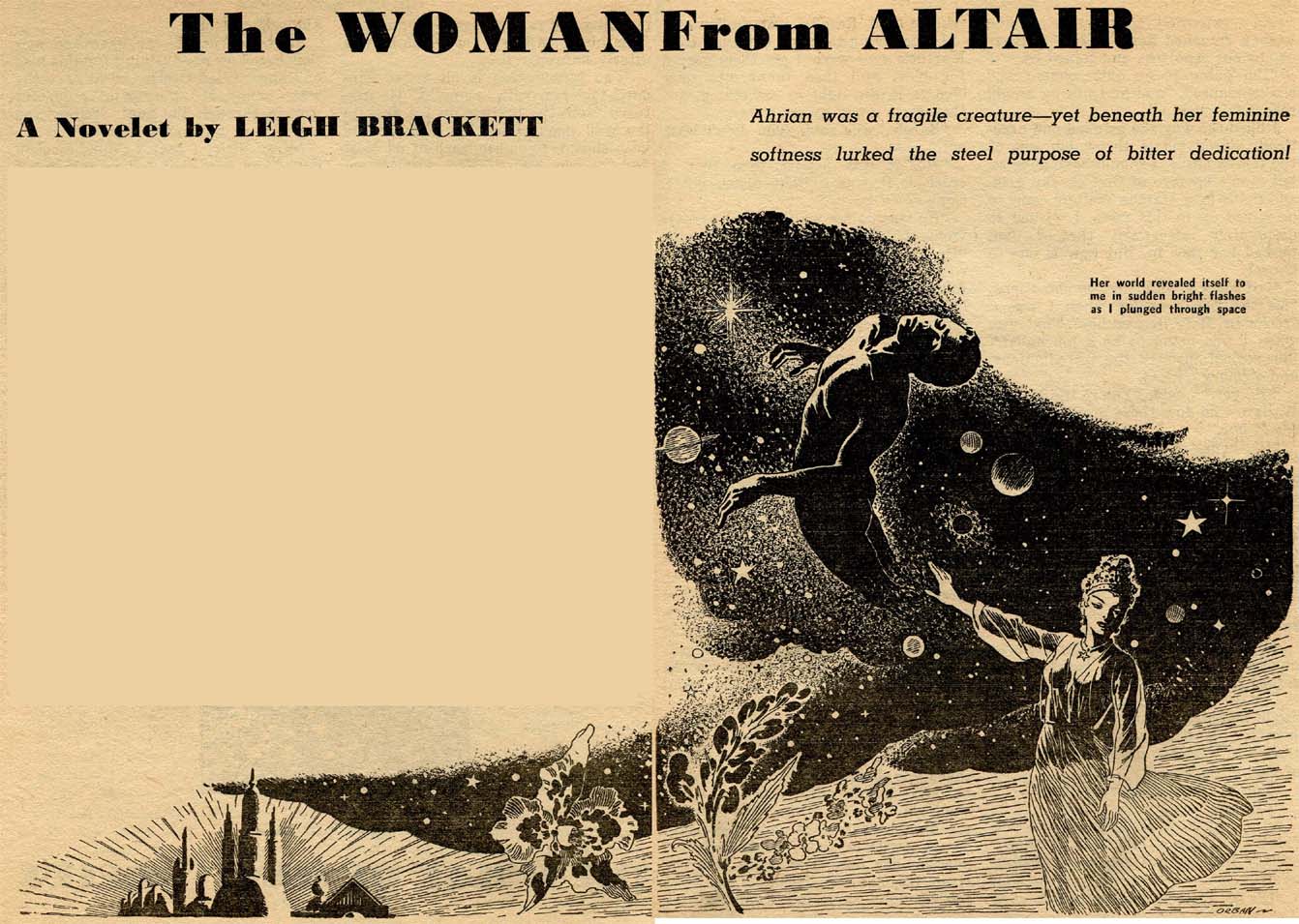
I got into a conversation on Twitter this morning with PC Bushi that grew to include several other individuals. Mr. Bushi initiated things by saying Leigh Brackett’s short story “The Woamn From Altair” demonstrated her range as a writer because it was a well-written story that wasn’t an adventure story.  I agreed. (If you’re interested, my review from a couple of years ago is here.)

Early in the course of the conversation, he linked to a post he had written about Jack Vance and Andre Norton, discussing their versatility as writers.  He says some good stuff, and you should check it out.

The conversation moved onto to all the genres Brackett wrote in.  In addition to space opera and science fiction, she also wrote detective stories (which is what got her the job writing for Howard Hawks on The Big Sleep) and westerns. This discussion got me to thinking… Continue reading

Clark Ashton Smith at 125

Clark Ashton Smith was born on January 13 in 1893. He was one of the greatest fantasists of the Weird Tales era on indeed any era. Writing contemporaneously with Robert E. Howard and H. P. Lovecraft, Smith was considered one of the big three of what many consider to be the golden age of Weird Tales.

Unfortunately, he has not fared as well as those two in the years since he died.  (Smith died in 1961, but he had stopped writing fiction years before.)  He is still revered among fans of weird fiction, but he is not as well known among the general public. This is highly unfortunate.

There are probably several reasons contributing to this relative obscurity compared to his two contemporaries named above.  For one thing, he never had any series characters, such as Howard did, with Conan being the most well known. Much of Lovecraft’s work was set in what has become known as the Cthulhu Mythos, uniting a variety of stories against a common background with common elements.  Smith wrote multiple tales set in a number of story cycles, but for the most part these works shared a setting with no recurring characters and no mythos to link them.

Smith’s style is probably the biggest obstacle a modern reader needs to overcome. He started out as a poet, and with its lush prose, his work reflects that. Smith knew his way around a dictionary and wasn’t afraid to use it. While this might be off-putting and not in line with contemporary trends, I personally find it a good thing. While reading Smith might involve some mental work, and not something to be attempted at bedtime if you’re tired, I have always found reading Smith to be rewarding. Continue reading