
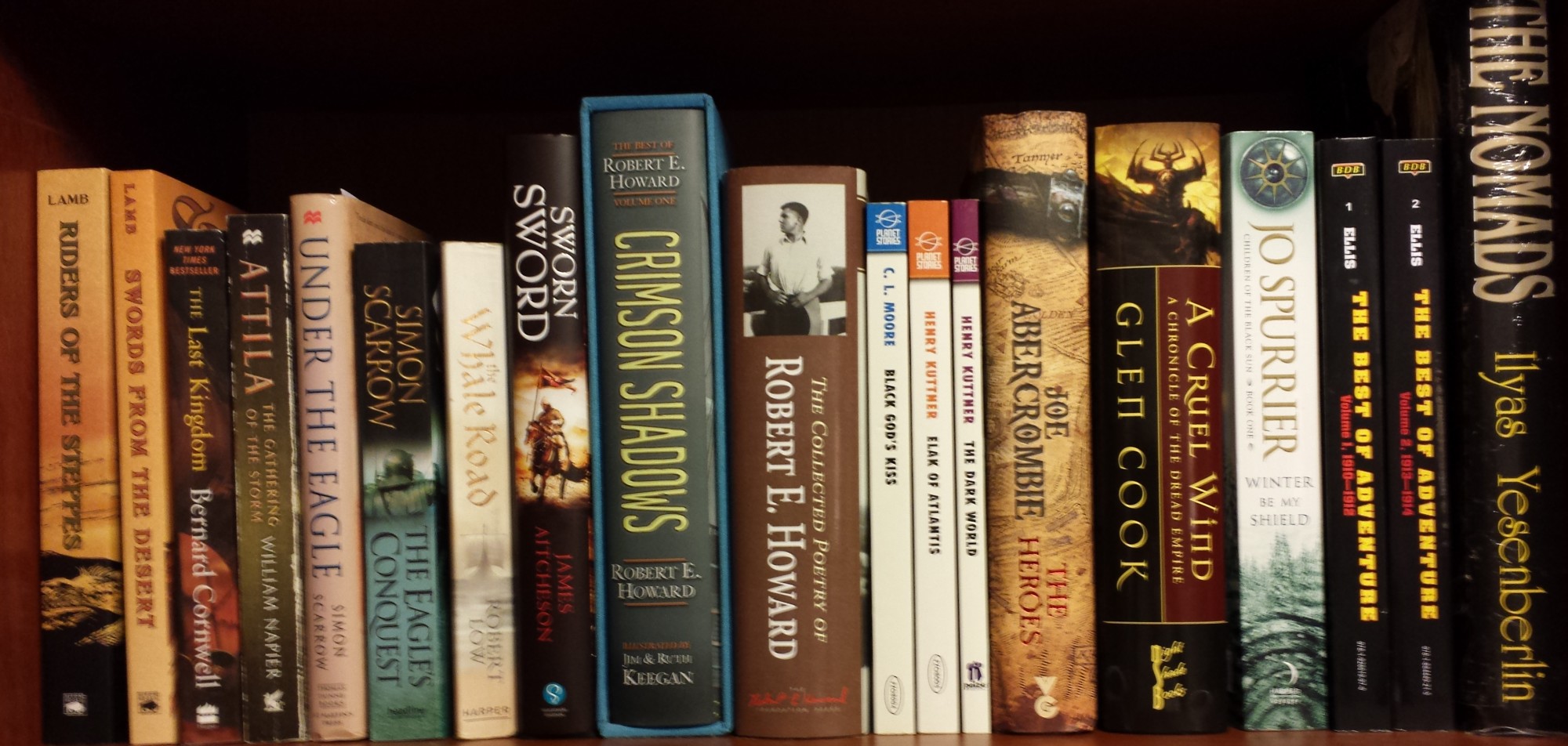
Today is October 11. It is the birthday of Doris Piserchia (1928-2021) and G. C. Edmondson (1922-1995). We’ll also take a look at the Stellar series of anthologies, with a focus on a story by Edmondson.
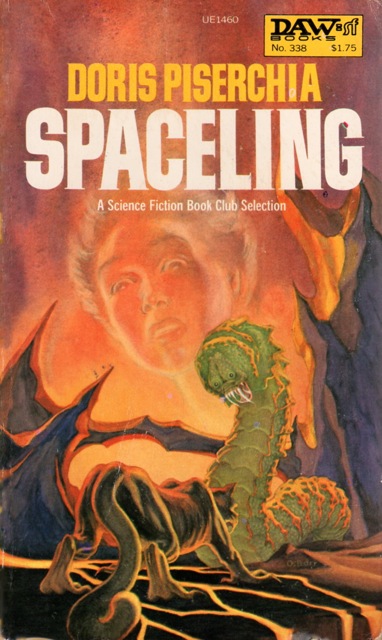 I’ll start with Piserchia since I don’t know much about her. Doris Piserchia had her first short story published in 1966. Her second was published in 1972, the year before her first novel. Her final novel was published in 1983. There was a final short story that was supposed to be in Last Dagnerous Visions. It was not included when that book was finally published. I’m not sure if the story will ever be pusblished.
She didn’t write many short stories, but she wrote enough for a decent sized collection.
 I remember seeing Piserchia’s books when I was in middle school and high school. At least two, Spaceling and The Spinner, were picked up by the Science Fiction Book Club. I have always intended to read some of her work but have never gotten around to it. If anyone knows anything about her or why she quit writing, please let us know in the comments.
I don’t know much about G. C. Edmondson, either, although I have also seen his books while I was growing up. The most well-known was The Ship That sailed teh Time Stream. Like Piserchia, he was basically a novelist, although he also wrote enough short stories to put together at least one collection. And like, Doris Piserchia, he also had a story that was supposed to have been publishe in LDV that wasn’t included when the book was published. There is afterword in which J. Michael Straczynski discusses putting the book together. I’ve not read LDV yet. That might be a good topic for a post.
I haven’t read any of Edmondson’s novels, but he is going on my look-for-when-I-go-to-a-used-bookstore list. So is Piserchia. Unlike Doris Piserchia, whose work is availabe in electronic format, Edmondson’s isn’t. I do have at least one of Edmondson’s stories, “All That Glitters”. It appeared in Stellar Science Fiction Stories #5. More about that anthology series in a bit.
 “All That Glitters” is a novelette set somewhere in the Alaskan wilderness. The time isn’t specified, but it seems to be set in the 1800s or perhaps the early 1990s. Frank is an aging prospector, who along with his (also aging) dog Shep. He came to Alaska to hunt for gold and never left.
He never found mjuch gold, either. But at some point, he realized that the quest for gold is one that can never be satisfied. Now he lives with Shep in an isolated cabin. He finds just enough gold to pay for a few staples when he goes to town. In the meantime, he and Shep hunt and live off the land.
While hunting, he sees something. At first it’s blurry. Tehn it resonvles into a man and a dog. They look like him and Shep. The man tells Frank that his name is Fred.
Frank begins sharing food with Fred while Freds sets up a sluice to find a certain metal. He finds plenty of gold, more than Frank ever found. Gold isn’t what Fred is looking for. Although the metal he wants isn’t given a name in the story, the astute reader will recognize what it is.
Uranium.
Fred isn’t human. He needs the uranium to get home.
There’s more to the story. Frank is a fascintaing and mostly sympathetic character. Where he’s not sympathetic is in the brief flashbacks to when he’s young.
 I thoroughly enjoyed reading “All That Glitters”. If the rest of Edmondson’s work is this good, it will be worth seeking out.
Stellar Science Fiction Stories was an original anthology series published by ballantine books. the first volume appeared in 1974, with a new volume published every year from 1976 until 1981, when volumes six and seven were published. There was also Star Short Novels (1976), which had three novellas.
There are a number of recognizable names in these antholgies. Clifford D. Simak. Alan Dean Foster. James P. Hogan. Jack Chalker. Larry Niven. James Tiptree, Jr., Charles Sheffield. Hal Clement. Gordon R. Dickson. Anne McCaffery. Jack Williamson. Issac Asimov. Robert Silverberg.
Most, but not all, were published by Ballantine. I think Sheffield wasn’t published by Ballantine until years later. Likewise for Asimov. Some of the authors listed only had one story. Others, such as Simak and Hogan, appeared in nearly every volume.
 That’s not imporotant. I’ve only read one Stellar all the way through (that I can remember). That was number four. I remeber I hunted down a copy (it was in print) because I had seen an interview with Alan Dean Foster in which he said there was a Flinx and Pip story in the anthology. I was a huge fan of Foster’s Commonwealth, espcially the Flinx and Pip subseries at the time. (I still am.) This particular volume also had a Science Fiction book Clulb edition. The cover illustrates the story by James Tiptree, Jr.
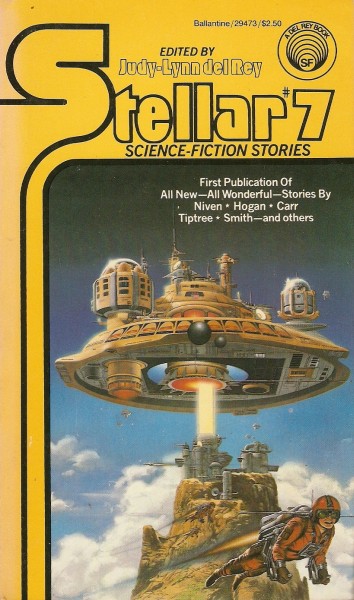 I have no idea why Stellar ended when it did. A number of original anthology series ended in the early eighties.
Maybe the market had become saturated, with anthologies published to catch a trend producing som much mediocre work that it poisoned the well for the higher quality series.
Or maybe not. I don’t know.
I do know that I like original unthemed anthologies. I wrote a post earlier this year about them, I had intended to read some at the end of that post. The problem I ran into was that I read a short story or two between novels or to take a break from a long novel. It takes a while to read a single anthology. I tend to forget the details of many of the stories I’ve read when I come back to a particlu book. I need to figure out a fix for that problem. Probably just read one all the way through.