
Tag Archives: Robert A. Heinlein

Morrow and Heinlein

Today is Julyl 7. It is the birthday of W. C. Morrow (1854-1923) and Robert A. Heinlein (1907-1988).

Morrow wrote weird fiction. He wasn’t very prolific, and I’m not sure how easy his work will be to find these days. The last English publication of his works was in 2012. The most complete collection of his short fiction seems to have been His Unconquerable Enemy in 2006 from Midnight house. The print run was only 460 copies, and I don’t want to think about what it would cost today, assuming you can find a copy. Midnight House books are collectible.

“His Unconquerable Enemy” is the story he is best known for these days. If this had been the only story Morrow had written, it would be enough to keep him from total obscurity.

I read it over foroty years ago, and I can still remember where I was when I read it. I read it in Horror Times Ten, edited by Alden H. Norton.

Sitting in the middle of a gravel road, waiting for the crop duster to come back with another load of spray. I was working as a flagger that summer. Several of us would walk waving yellow flags on tall poles so the crop duster could spray mesquites in a pasture and get a good coverage. I would always carry a paperbak in a backpack so I could read between loads. I was walking along the fence, staying in the road so I could see any snakes that might take exception to my presence.

[SPOILER ALERT]

The story concerns a man who has offended an Indian rajah. The rajah has the man’s arms and legs amputated and keeps him in a large birdcage suspended in the throne room. One particularly hot night the rajah decides to sleep in the throne room because it isw cooler there. The story is told from the point of view of a visitor who happens to see how the amputee gets his revenge.

The amputee gets the bridcage swinging. He uses his teeth to open the door of the cage. With perfect timing, he thrusts himself out of the cage so that he lands on the rajah’s chest.

And uses his teeth to tear the rajah’s throat out.

Pretty grisly stuff.

[END SPOILER]

Morrow showed his skill in making the story believable and suspenseful. It made enough of an impression on me that I can remember the story and where I was when I read it. This story has been reprinted many times, most recently in 2024.

Robert A. Heinlein once cast a long shadow of the science fiction field. To some extent he still does. But its been nearly forty years since his death. His books are mostly out of print. Starship Troopes, Stranger in a Strange Land, The Moon is Harsh Mistress, and maybe a few others.

I saw a post a few years ago where the author, whom I will not name out of courtesy (most of you would recognize the name), said he thought Heinleiin would become a forgotten author.

Is that really true?

It’s pretty much a given, I think, that when a writer dies, only the best, or most notorious, of his works (or hers) will stay in priint, and those are what they author will be remembered for. There are exceptions, of course, but by and large, that has been the trend I’ve seen.

But will Heinlein be forgotten?

Sure, many of his ideas are out of favor these days. That could be said of most writers who worked in the middle of the Twenntieth Century. Fiction gets dated.

A certain author, who will also remain unnamed except that I’ll say they recently won a major award for essentially lifetime achievement even though their career hasn’t been as long as previous winners, said they read one of his books and found it to be, if I recall the quote correctly, “racist as f***”. I thought at they time they probably read Farnham’s Freehold. I found out later that was the book.

Yes, some, probably most, of Heinlein’s works may be forgotten. But will all of them? Will he?

I don’t know. I don’t care for everything I’ve read by him, but I do like his work. I haven’t read much of what he wrote the last decade or so of his life. I may not, since what I know about some of the books makes me think they won’t be to my taste.

But as influential as Heinlein was, I hope he isn’t completely forgotten.


Robert Anson Heinlein

Today, Julyl 7, is the birthday of Robert Heinlein (1907-1988). Heinlein when I was growing up was considered one of the top science fiction writers working. As in the top two or three writers, if not holding the number one spot.

In the years since his death, his star has faded a good deal. Some of this is natural after an author dies, especially if there isn’t a perdon or organization that works to keep that author’s works in print.

You can still find his work in bookstores, although there are only a few titles on the shelf. Stragner in a Strange Land, The Moon is a Harsh Mitsress, Time Enough for Love, and I Will Fear No Evil. That list is based on memory. I don’t live near a bookstore anymore, so it’s been more than a month since I looked. Continue reading

C. L. Moore, Pioneer of Fantasy and Science Fiction

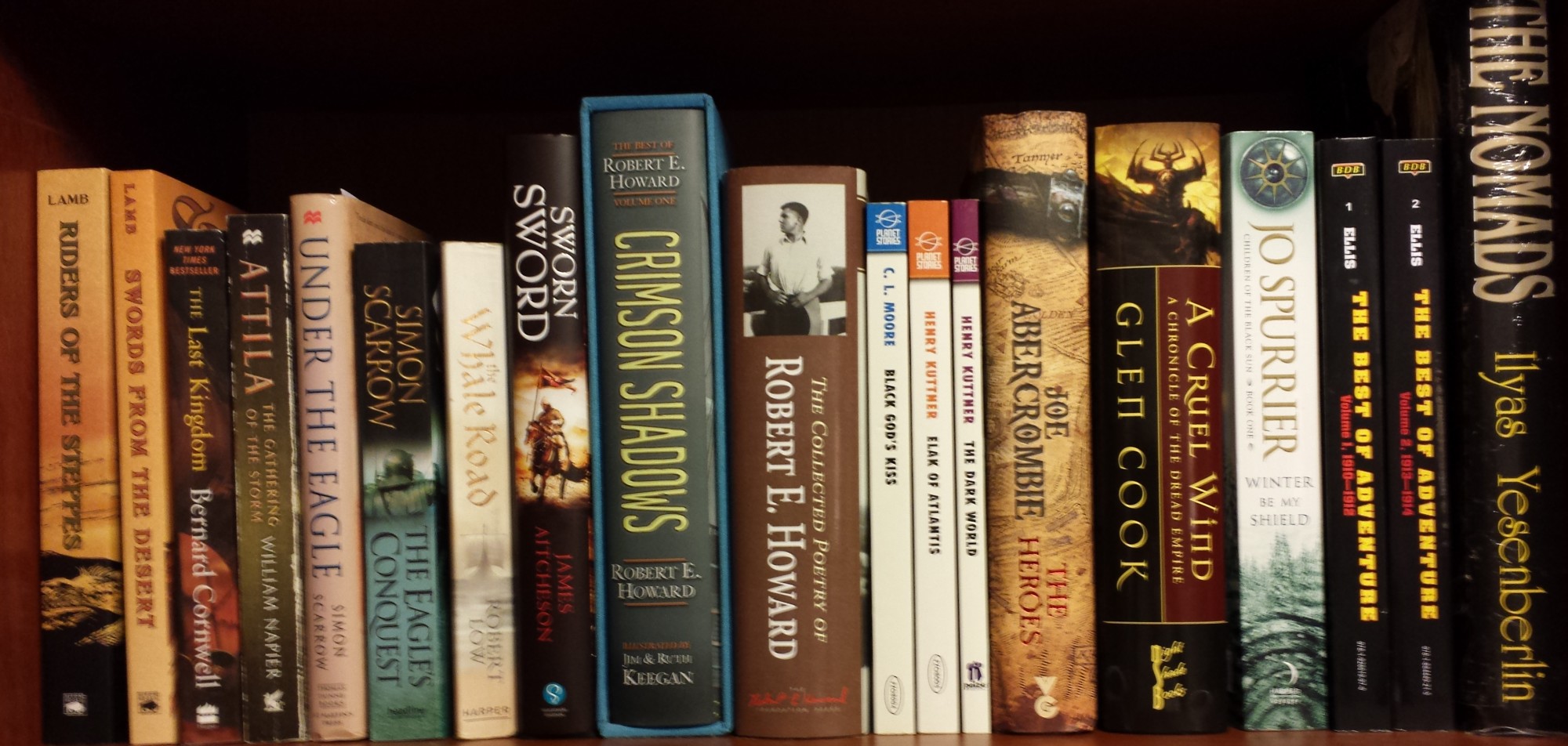
Catherine Lucille (C. L.) Moore (1911-1987) was born in Indianapolis on this date, January 24. She is the third of three major fantasy writers whose birthdays are every other day in January. The first was A. Merritt, and the second was Robert E. Howard.  She is someone whose work should not be forgotten. If you haven’t read her work, or if it’s been a while, do yourself a favor and do so.

Like Howard, I’ve written about Moore so many times over the years that it’s becoming a challenge to come up with something  new. Work and some travel have kept me from doing much reading for the last week, so there won’t be a review of any particular story.  Forgive me if I rehash things from older posts. Continue reading

Blogging Northwest Smith and Jirel of Joiry: “Quest of the Starstone”

C. L. Moore

Today, January 24, is the birthday of C. L. Moore (1911-1987). She was one of the best practitioners of the weird tale, and later, mostly with her husband Henry Kuttner, of science fiction.

Today for her birthday, I’m going to look at “Quest of the Starstone”, in which Northwest Smith and Jirel meet. This story was a collaboration with her future husband, Henry Kutner. This story was originally published in the November 1937 issue of  Weird Tales. Catherine and Hank didn’t marry until 1940.

His his introduction to the story in Echoes of Valor II, Karl Edward Wagner says it was a collaboration by mail. I’m going to rely heavily on that volume and a couple of others when I look at the two remaining stories in the Northwest Smith series. “Quest of the Starstone” is the final Jirel story. Continue reading

Catching Up I: Catching up on the Classics

So lately I’ve been catching up on some of my TBR pile, or in many cases by TBRR (to be reread) pile. There’s not a huge amount of new fantasy and science fiction being published these days that appeals to me. There’s some, just not a lot. I went to B&N last night and left without buying anything.

I’ve been spending a good deal of this year trying to get caught up on books that fall into two broad (and occasionally overlapping) categories, classics of the field and series I’ve either started but not finished/series I’ve bought but not started at all. Many of the latter haven’t been finished because I started them when they were only one book and never worked later books in. Then there are the stand-alones I got distracted while reading and haven’t finished yet. So I guess there are three categories.

The focus of this post is what would be considered classics in both the science fiction and fantasy fields. Much of my catch-up reading has been science fiction the last half year or so.  Not all of it has been titles I’d not read. Some of it has been rereading things I read so long ago but have little to no memory of now. I’ll list a few things I’ve been reading and then solicit suggestions. Continue reading

Thoughts on the Retro Hugos and a Question

The nominees for the Retro Hugos were announced yesterday.  If you aren’t familiar with them, they are given for the best science fiction or fantasy for the previous year, only for a year 75 years prior. In this case, it’s the 1945 Retro Hugos for the works from 1944.  Here are the fiction nominees.  I’m not going to worry about editors, artists, fanzines, or any of the other categories.  I’ll have a few things to say below the list, as well as a question for you. Continue reading

Astounding Lives

Astounding:  John W. Campbell, Isaac Asimov, Robert A. Heinlein, L. Ron Hubbard, and the Golden Age of Science Fiction
Alec Nevala-Lee
hardcover $28.99
ebook $15.99

This one seems to be getting some buzz, although I have to admit I hadn’t heard of it until I saw it in B&N.  This review is probably more appropriate for Futures Past and Present, but I’m posting it here because this is the main blog and gets more traffic.

I’ve always been interested in the Golden Age of Science Fiction, as Campbell’s first decade as editor of Astounding has often been called.  Not because I remember those years.  I’m not that old ya disrespectful young punks; now get off my lawn. I did grow up reading many of the authors from that period in paperback reprints.  So when I saw a history of that time period, I grabbed it. Continue reading

Blogging Northwest Smith: The Cold Gray God

150px-Weird_Tales_October_1935“The Cold Gray God” adds a slight Lovecraftian element to the Northwest Smith saga.  First published in the October 1935 issue of Weird Tales, the story opens with Smith being accosted on the street of Righa, a city in the polar regions of Mars, by a fur clad woman.  Smith thinks she’s a Venusian, but she behaves in a way a Venusian woman wouldn’t.  Fro one thing, she touches him.  I couldn’t help but think of women in Islamic countries from the way she is describes.

Although he’s somewhat repulsed by her, there’s something familiar about her, too.  At her request, Smith accompanies her back to her house.  There he discovers she’s a famous singer who simply vanished a few years earlier.  She asks him to help her retrieve a box from a man who is frequently a notorious bar.  She tells Smith he can name his own price, hinting that he can have her it that’s what he wants.  Leery, Smith still accepts her offer, asking for ten thousand dollars. Continue reading

Fifty Years on the Glory Road

Glory RoadGlory Road
Robert A. Heinlein

This year marks the 50th anniversary of Robert Heinlein’s novel Glory Road. It’s the closest thing to heroic fantasy he ever wrote, although by the end of the book it’s clear that science fantasy is a better (but not entirely accurate) label.

This wasn’t the first Heinlein I ever read. That would be Have Spacesuit, Will Travel. (I’m planning on reading the Heinlein juveniles in the order they were written and writing about them at Futures Past and Present next year.) I’d read a number of the juveniles by the time I read Glory Road.

Nor was it the first adult novel by Heinlein I read. I’d read Sixth Column in paperback, plus the omnibus A Heinlein Trio from the Science Fiction Book Club containing The Puppet Masters, Double Star, and The Door into Summer. I probably had read Universe by that time, although my memory isn’t clear on that one.

What Glory Road was, however, was the first adult Heinlein I read that actually had adult content. And by adult content, I mean sexual content. I was 14 or 15 at the time I read it. It was something of a shock, since nothing I’d read by him was that sexual in nature, or if it was, either I was too naive to pick up on it or it didn’t make enough of an impression that I remembered it. Continue reading