
Author Archives: Keith West

The Rest of the Summer

Just a quick note to let you know what I’ve got on my plate leading up to Worldcon. 

Speaking of Worldcon, I’m going to read at least some of the short fiction nominees, as many as time will allow, and give my thoughts.  I don’t think I’m going to try to read all the novels.  The publisher of two of them put a security code of the ebooks that went out in the Hugo voters’ packet.  I don’t appreciate what that implies.  I’m not going to upload the books to a file sharing site.  I’m not a crook, nor do I care to be treated as though I were.  Therefore, I won’t be reading (or voting for) Blackout by Mira Grant or 2312 by Kim Stanley Robinson.  I do have some comments to make about this year’s nominees in general.

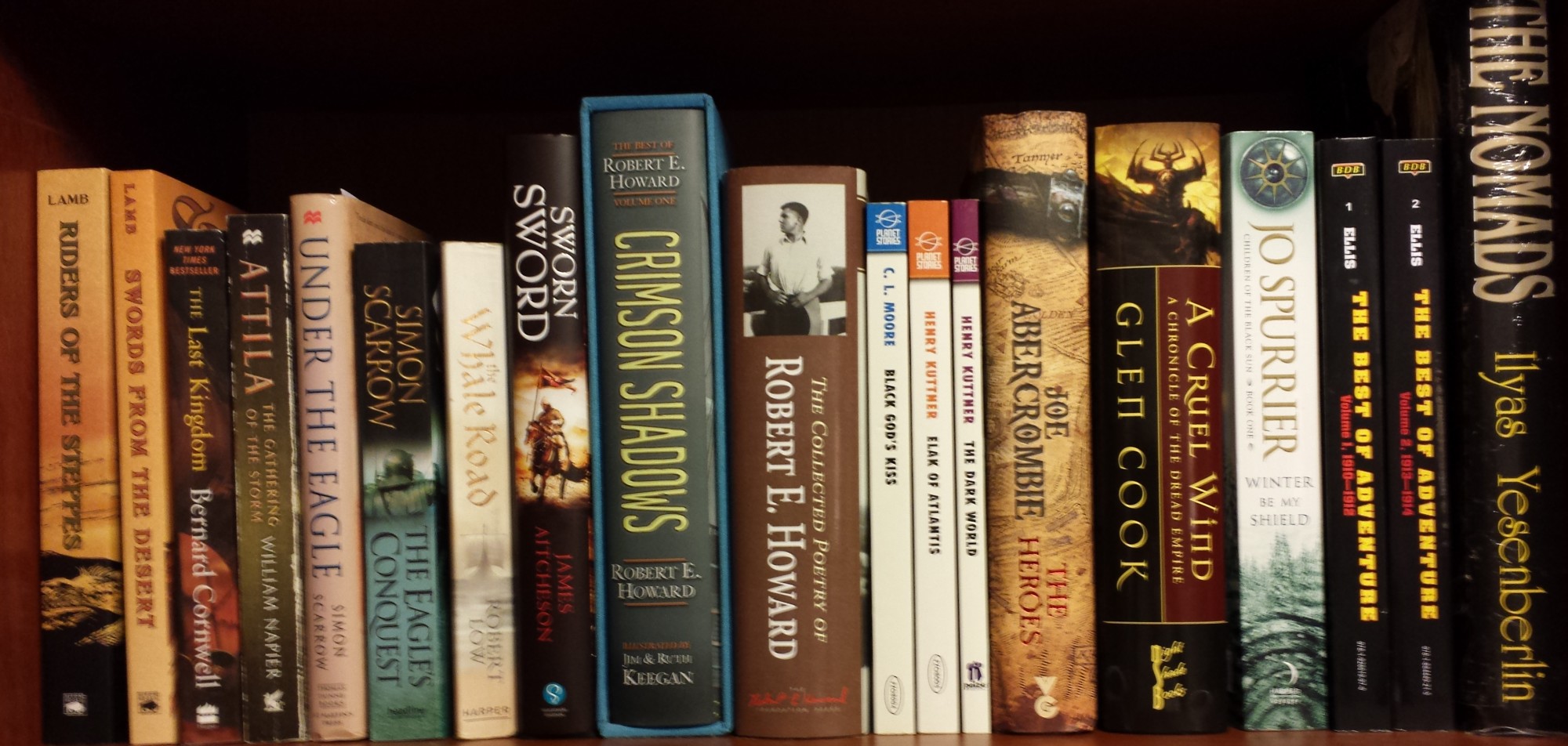
The Gemmell Awards are a bit later than usual this year to coincide with the World Fantasy Convention.  My review copy of Winter Be My Shield by Jo Spurrier arrived the other day.  It’s on the long ballot for the Morningstar Award.  I’m looking forward to reading it.  I’ll post the review on the Gemmell Awards site and a notice here when it goes live.  After the awards are given out, I’ll post the review here.

I’ve got a number of titles from Pyr.  The ones I intend to review in July are The Doctor and the Kid by Mike Resnick, Kindred and Wings by Phillipa Ballentine, and Wrath-Bearing Tree by James Enge.  Then there’s The Scroll of Years by Chris Willrich and The Doctor and the Rough Rider by Mike Resnick.  Those I probably won’t get to until August.

I’ve had a copy of the conclusion of Joshua P. Simon’s Blood and Tears Trilogy, Trial and Glory on my ereader for far too long.  It’s going to be reviewed within the next four to six weeks. 

I don’t know what order I’m going to read them.  It will depend on my mood and what I feel like reading.  I’m also going to throw in a bit of shorter works, both here and over at Futures Past and Present.  There are also a couple of other novels I’d like to read by the end of the summer.  And somewhere in there, I’ll be reading things for my column at Amazing Stories (TM). 

John D. MacDonald’s One Fearful Yellow Eye

One Fearful Yellow Eye
John D. MacDonald
trade paper $16.00
Kindle Nook $11.99

It’s been a few years since I read any MacDonald, and a few years more since I read one of the Travis McGee novels.  I’d been reading them in order, and this one was the next in sequence.  It was also the only one I was missing.

I’d had an urge to read MacDonald for a while, sort of a mental itch that wouldn’t go away, and so I decided to pick up this series where I’d left off.  A quick online check found a good copy in the editions I was collecting for a few bucks plus shipping, so I placed my order.

Much of this one takes place in Chicago in the winter, not your typical setting for a McGee novel.  Travis gets a call from an old girlfriend.  Her rich older husband has died of cancer.  This was expected.  His fortune, which he had said he would divide between her and his two grown children, has vanished.  Over a period of several months before his death, he quietly liquidated most of it.  This was not expected.

Now the children are accusing the stepmother of being a gold-digging treasure seeker who has hidden the money somewhere.  It’s up to Travis McGee to find out what’s really going on.

This one had lots of twists, along the usual amount of casual sex and philosophy one would expect from a Travis McGee thriller.  Initially the setup looks pretty hopeless.  The grown kids aren’t friendly.  The trail has gone cold.  The widow is completely in the dark about her husband’s motives.  So is the husband’s former mistress.  Everything looks like a dead-end.

The first Travis McGee novel appeared in 1964, which means MacDonald was probably writing the first couple in 1963 or perhaps as early as 1962.  Four were published that first year, with three more following in 1965.  One Fearful Yellow Eye was the sole title published in 1966.  After that, the pace slowed down considerably.  Looking at the bibliography on his Wikipedia page, I was surprised to see that after the mid-60s, most of MacDonald’s output was Travis McGee.  He wrote so many novels, I thought he had continued on with stand-alones while writing the McGees.

The books are products of their time.  LSD figures into the plot of this one, the second novel in which this happens.  Some of the language is different from what you would hear today, for instance referring to a man’s secretary as “his girl”, smoking occurs in all sorts of places where it is no longer permitted.  McGee’s philosophizing about his society is a bit old-fashioned in some respects, and a few of the cultural references would probably be lost on younger readers.

Overall, though, the story has aged well.  The things that are clearly period add to the charm of the book.  The action and the characterization, the knight errant aspect of Travis McGee, these are the reasons people read this series, nearly 30 years after the last one was written.  MacDonald’s influence can be seen in the works of numerous writers in crime and suspense.  Read him and see why.

I’m embarrassed to say how long it’s been since I read one of these.  I’d forgotten how much fun they can be.  Also how dark some of them are when you get down to the core of book.  Still, I’m looking forward to the next one. 

Also, MacDonald wrote a great deal of science fiction, most of it at shorter lengths.  The SFBC collected his three novels (Wine of the Dreamers; Ballroom of the Skies; The Girl, the Gold Watch, and Everything) back in 1980 in the omnibus Time and Tomorrow.  There were also a couple of short story collections which aren’t too hard to find (End of the Tiger and Other Stories; Other Times, Other Worlds).  I may take a look at them soon.  Still there are enough uncollected sf tales to make a fine collection or two.  (Mr. Haffner, are you listening?) 

Further Thoughts on Marvin Kaye and Weird Tales, Plus Some Suggestions

Last fall I wrote a detailed review about the first issue of the latest version of Weird Tales.  One of the commenters, Chap O’Keefe, said he had sold a pair of stories that were scheduled to come out in subsequent issues.

Since then, there’s been little news about when those issues would appear.  At least until last Monday (June 24).  Mr. O’Keefe updated the status of his submissions in a follow-up comment.  I’m reproducing it in its entirety: 

Since the above was written, including my comments, much has changed at the new WT.My own latest shock came in an email from Marvin Kaye earlier this month in which he welshed on his acceptance of the two stories he was going to run in his magazine. Once upon a time you could count on an editor’s word, and his written word was as good as a handshake. The whole sorry tale is told in full in the introduction to my new Amazon Kindle eBook Witchery: A Duo of Weird Tales You might like to run the guts of it as a post in your new blog — a salutary warning to all who rely on gatekeeper publishers! In fact, it gives my small ebook a third, very weird tale. Story is “excellent” but editor and co-publisher Kaye must put it aside so he can re-open his “submission portal” to other, unseen stories … Huh? Has the man lost lost it?

And here’s a follow up comment with more information:

 I understand this situation affects several more writers, too. Kaye said, “I regret to inform you that the publisher of Weird Tales has decided to pass on quite a few stories, yours included. This is a measure to reduce our huge fiction inventory.” Kaye owns the rights to the Weird Tales magazine title and is co-publisher, so there is little we can do about what, as you say, is a pretty unheard-of thing to do, except WARN OTHERS. Kaye has offered no fee, just a promise that “If you have not sold your submission elsewhere, try us again in 9 months. If we have room at that time, it will be an automatic sale.” Note the “ifs”; note what his previous promises were worth.

I bought and read WitcheryI reviewed it at Amazing Stories, since the traffic is higher there.  I found both stories to be quite enjoyable and recommend the book.  It’s only $0.99, so it’s a steal.  The introduction alone is worth that.  If you’re interested in Weird Tales, you should read the introduction.

My purpose here isn’t to repeat the review, but to discuss some of the implications of what’s happened.  I’m not privy to Mr. Kaye’s counsel, and in fact have never met the man.  I’ve always enjoyed the anthologies he’s edited along with the first issue of the new Weird Tales.  My overall opinion of his taking the reigns of the magazine was that This Is A Good Thing.

Now I’m of a different opinion.  Frankly, I can’t begin to imagine what’s going through the man’s mind.  Why on Earth would he reject stories, perfectly good stories that he’d already accepted, just to reopen to submissions?  If he’s the editor can’t he open the slush pile when he’s good and ready?

Of course, if you recall, Kaye announced that excerpts of the novel Saving the Pearls would be appearing in the first issue he edited.  This is a book that many people in the sff community believed to be racist.  Publisher John Harlacher eventually (and belatedly) nixed that idea.  (Events summarized here.)  Maybe Harlacher is the one insisting on reopening for submissions?  I don’t know, but at this point it’s a possibility I’d consider until I learn otherwise.  None of which helps Mr. O’Keefe or any of the other authors who have received these letters.

I’ve seen reports that the magazine is foundering, at least in part because it has lost newsstand distribution.  I don’t see why that should be a problem.  There are a number of magazines that seem to be doing quite well that don’t have newsstand distribution or even print editions.  They run on some version of a model of electronic subscription and free stories online.  Perhaps you’ve heard of some of them.  They include but aren’t limited to:  Lightspeed, Beneath Ceaseless Skies, Apex, Nightmare, Clarkesworld, and Galaxy’s Edge.

So here are my suggestions.  Mr. Harlacher can take it for what he thinks it’s worth, assuming he ever sees this.  First, change your business model.  Adopt the basic model of the magazines listed in the previous paragraph.  Forget about newsstand distribution.  The print format genre fiction magazines such as Asimov’s, Analog, F&SF, EQMM, and AHMM saw their circulations drop for years until they began to produce electronic versions.  Since then things seem to have improved.  Magazines such as Realms of Fantasy have tried to make a go of it as print periodicals and are no longer with us.  Learn from these publications, both print and electronic, what works and what doesn’t.

Replace Marvin Kaye.  As much as I enjoyed his anthologies for the SFBC, and as much as it gives me no joy to write this, Kaye seems to have gone around the bend as an editor.  Find someone who will find new and exciting weird fiction while respecting the history of the publication, avoiding unnecessary controversy, or poor editorial decisions.  Kaye’s selection as editor was too divisive, and his decisions since then have only made things worse.  Someone who can restore faith in the publication needs to be the editor.  (Good luck finding this person.)  Ann Vandermeer brought new readers to the magazine while alienating many of the long-term fans.  I think at least for the near future, the publication should have a mix of fiction that is broader than anything Kaye or Vandermeer published.  Ideally, if WT published 4-6 stories a month or 2-3 every 2 weeks, there should be plenty of variety to please a majority of readers in both camps.  Not all, but a majority.

Those are my thoughts on how improve the magazine and get it back on its feet, as well as restoring its reputation.  I realize not everyone will agree with them.  That’s fine.  I’m making these suggestions in the interest of initiating a dialogue.

I’d like to thank the person who linked to my review in the Wikipedia article on Weird Tales

The Return of Egil and Nix

A Discourse in Steel
Paul S. Kemp
Angry Robot Books
UK Print
Date: 4th July 2013
ISBN: 9780857662521
Format: Medium (B-Format) Paperback
R.R.P.: £8.99
US/CAN Print
Date: 25th June 2013
ISBN: 9780857662538
Format: Small (Mass Market) Paperback
R.R.P.: US$7.99 CAN$9.99
Ebook
Date: 25th June 2013
ISBN: 9780857662545
Format: Epub & Mobi
R.R.P.: £5.49 / US$6.99

In my review of the first book in this series, The Hammer and the Blade, I said that it reminded me why sword and sorcery was fun in the first place.  The same is true for A Discourse is Steel.  This is adventure fantasy at its finest.

Egil and Nix befriended two young ladies at the conclusion of the previous book.  Early in this one, one of them (Rose) is reading the mind of a master criminal (at his request) when he’s assassinated.  Some of the information he knows ends up in Rose’s head.

So a very dangerous criminal organization tries to kill her, and in the process nearly kills her sister Mere, Egil, Nix, and a number of their friends and associates.  In the words of the great general Bugs Bunny, “Of course, you know this means war.” Continue reading

RIP, Richard Matheson 1926-2013

This is still breaking news, and I don’t have a lot of details.  Renowned fantasy and horror author Richard Matheson has passed away at age 87.  According to Matheson’s daughter Ali, from a statement on John Shirley’s Facebook page:  “My beloved father passed away yesterday at home surrounded by the people and things he loved…he was funny, brilliant, loving, generous, kind, creative, and the most wonderful father ever…I miss you and love you forever Pop and I know you are now happy and healthy in a beautiful place full of love and joy you always knew was there…”

Matheson had been ill for some time.  His most famous work was the novel I am Legend.   He also wrote The Shrinking Man, screenplays for many of the best horror films of the 1960s, and a number of Twilight Zone episodes, including the classic “Nightmare at 20,000 Feet”, starring William Shatner.  I’m working on a deadline tonight and will post a longer tribute in the next day or so.  I’ll just say for now that Matheson was one of the major fantasy authors to come out of what became known as the California School in the 1950s, which included such authors as Ray Bradbury, Charles Beaumont, William F. Nolan, and George Clayton Johnson.  I devoured his stories when I was a teenager.

A Superman for a New Generation, but not my Superman

So my son and I went to see Man of Steel yesterday.  He loved it.  But then he’s 11 and hasn’t really grown up with Superman the way I did.  I, on the other hand, am, um, slightly more than 11.  I started reading comics a few years before video games took over the world became so ubiquitous.  And I have mixed feelings about the movie. 

Fair warning:  There will be spoilers.  I’m going to discuss some details that you might not want to know about if you haven’t seen the film but are planning to.  Just so you know.

First, I’ll discuss what I liked about the movie.  The casting was spot-on, overall.  Laurence Fishburne is a great Perry White.  Diane Lane and Kevin Costner are perfect as Ma and Pa Kent.  Russell Crowe’s protrayal of Jor-El adds life to a character to whom, in my opinion, the movies have never done justice.  The only miscasting is Amy Adams as Lois Lane.  She fits my ideal of Lana Lang more than Lois.  Not that I’m complaining much.  Any film Amy Adams is in is one I’m interested in seeing. Still, this isn’t quite the Lois we’ve seen in previous incarnations of the character.  She’s neither the damsel in distress, the woman hoping to marry Superman, or the hard-hitting reporter or more recent decades.  Although the film tries to make us think she is.

The opening sequence on Krypton was mind-blowing.  We’re shown a weird alien world, one that’s both exotic and full of dark wonder.  The special effects here were top of the line, and the concept artists for this part of the film really let their imaginations go.  It’s what a science fiction film should be.

Unfortunately, most of the movie took place on Earth.  That in and of itself isn’t a bad thing.  It’s what director Zack Snyder and screenwriters David Goyer and Christopher Nolan do with the story that ruins it for me.

First, two major flaws in the logic.  First, and this was a biggie for me, Lois first encounters Clark when she’s investigating the Air Force’s discovery of something under ice.   Core samples show the ice to be 20,000 years old.  It’s a space ship, one that has Jor-El’s consciousness uploaded into its computer system.  How it got there is never explained.

The other is that the Daily Planet building is destroyed in the final fight between Superman and General Zod.  A few days later (or so it seems), it’s all in one piece.

Amy Adams as Lois Lane

There were some other changes that irked as well.  Lois discovers Superman’s secret identity before Clark ever adopts the persona of Superman, much less gone to work at the Daily Planet.   Lana Lang is only in one scene when Clark is a young boy.  Lana was a big part of Clark’s childhood and should have been given more screen time.  Jimmy Olsen is completely absent from the film.  Instead, he’s replaced with an obnoxious guy who hits on Lois in the film’s final scene.

The thing I most objected to, though, were the changes in Superman’s character.  All of Clark’s youth is shown in flashbacks.  In one, an essentially grown Clark is traveling with his parents along an interstate when there’s a tornado.  Everyone takes shelter under an overpass.  Jonathan goes back to rescue their dog and is injured, preventing him from making it back to the overpass before the full force of the tornado hits.  Clark is about to save him when Jonathan shakes his head no, in essence telling him to keep his powers secret.  (This is a big deal with Pa Kent in this movie.)  So Clark watches as his father dies, never doing anything to save him.

I call BS.  The Superman/Clark I grew up reading about would never have allowed that to happen.

Nor would he have fought the Phantom Zone criminals in the middle of Smallville, pretty much trashing the entire downtown and putting hundreds of residents at risk, especially when the fight spills into the local IHOP.  The same goes for the final fight in metropolis, in which Superman and Zod trash the city to the point that the movie begins to look like a post apocalyptic film.  With the amount of destruction they wreak, there has to be a major loss of life.  Yet in both cases Superman doesn’t try to take the fight somewhere else, where fewer people can be hurt.  Nor does he stop to help those on the ground until the finale of his fight with Zod.

But the thing that most goes against the role of Superman, at least the one I grew up with, is that he never, ever kills people.  Yet he kills General Zod at the end.  He’s got his arms around Zod’s neck, and Zod is using his heat vision to try and kill some innocent bystanders.  Superman breaks his neck.  I wanted to know why he simply didn’t fly off with Zod.  Or why Zod didn’t move his eyes rather than his head and zap the bystanders before Superman could do anything.

Superman’s grief and torment over killing Zod is to engage in a primal scream and give Amy Adams a hug.  I understand that during one of the reboots of Superman that happened during a period when I wasn’t reading comics, something similar occurred.  The repercussions went on for quite a while. Here he just had a good cry, and it was done.

I understand about updating characters.  I really do.  And in principle, I don’t have a problem with it.  But what should be updated are the details, not the heart and soul of the character.  When changes are made on too fundamental a level, the character isn’t the same any more.

Anyway, as visually arresting as much of the film was, it was ultimately unsatisfying.  At least from my perspective.  This isn’t the Superman I grew up with, in any of his incarnations.

Mark Finn has a detailed examination of how Superman has changed through the years, in both comics and film here

A Visit to Joyland

Joyland
Stephen King
Hard Case Crime
trade paper, 285 p., $12.95
no electronic edition

So on Friday night I took my family to Joyland, and we had a great time.  The weather was unseasonably cool albeit a bit muggy.

What?  No, really, we did.  That’s the name of our local amusement park.  Has nothing to do with the novel by Stephen King other than it helped with the mood.  I finished the book after we got home.

Anyway, the day the book came out, I stirred my stick and went and bought a copy.  At Wal-Mart.

For a Stephen King novel, it’s pretty short.  It’s also not really the sort of thing you usually expect from him.  For one thing, it’s not a horror story.  Oh, sure, there are hints of a ghost (well, more than hints, actually, but not much more than that), and at least one of the characters has the Sight, but for the most part it’s a coming of age story, with a murder mystery thrown in for spice.

 Set in a failing North Carolina amusement park during the summer and fall of 1973, it’s the story of Devin Jones, who takes a summer job at Joyland and gets a great deal more than he bargained for.  For one thing, a murder occurred in the fun house a few years previously.  Since then the place is rumored to be haunted.  Jones is trying to forget the girl who broke his heart, and no, he doesn’t fall in love with the ghost.

He does heal.  And he does stay on after the summer season ends.  Eventually he meets Annie and Mike, a single mother and her dying son.  And through them, he learns to live again.  At least he will if he can survive a chain of events he’s set in motion, in part by befriending them.

The book didn’t resonate with me the way “Rita Hayworth and Shawshank Redemption” or The Green Mile did.  For one thing, the book starts off kind of slow.  Still, I quite enjoyed the story.  Most men can relate to the heartbroken  young man who narrates the novel from the perspective of late middle age.  And I’ve always been a sucker for carnival/circus stories, holding Something Wicked This Way Comes and Blind Voices up as masterpieces of the form.  There’s something appealing about working as a carny, although I wouldn’t want to try it at my stage of life.

There were moments of pure creepiness, but not many, and it seemed King didn’t milk them for all they were worth.  Not that I’m complaining; it wasn’t that kind of book.  I’ve not read a great deal of his work, more short fiction than novels.  But a number of the touches I’ve admired King for were there.  The foreshadowing that’s also misdirection.  The details that appear to be window dressing but turn out to be significant. 

Joyland probably won’t be considered one of King’s major works, but it’s a solid piece of storytelling.

In Thunder Forged Rocks

In Thunder Forged:  The Fall of Llael Book One
Ari Marmell
Pyr Books
Trade Paper 320 pp $18.00
ebook Kindle $8.69 Nook $10.31

If you’re a fan of dark, gritty military fantasy, then In Thunder Forged is the book for you.  Ari Marmell is a superb writer, and he’s at the top of his game in this first volume of The Iron Kingdoms Chronicles.  The series is based on the Warmachine Steam Powered Fantasy Wargame and the Iron Kingdoms Role Playing Game.  They’re produced by Privateer Press.  I have to admit that I wasn’t familiar with them, not really having time to add gaming to my already full schedule.  After reading In Thunder Forged, I’m going to check them out. Continue reading

Howard Days 2013, Part 2

Today marks the 77th anniversary of Robert E. Howard’s passing.  I’ll be raising a glass later this evening in his memory.

Lansdale and Truman

After lunch, I swung by the post office and picked up some post cards with this year’s commemorative cancellation.  Then it was back to the library for the panels.  The first one featured GoH Tim Truman.  Joe Lansdale interviewed him.  Joe wasn’t on the original schedule but had driven over to see Tim.  They’ve worked together on a number of projects, including a Conan comic, The Songs of the Dead.  As is typical with old friends, their conversation flowed smoothly.  This panel was one of the highlights of the weekend.

I have to say that both of these guys were some of the most open and approachable pros I’ve ever met.  I’ve met Lansdale at a number of conventions, but this was my first time to meet Truman.  They never hesitated to sign something, pose for pictures, or just chat with fans.  They were both gentlemen.  The fact that they’re both fans of Howard helped, I’m sure, but that’s just how these guys are.  I hope they come back.

Rob and Bob Roehm

The next panel was Rob Roehm and his father Bob discussing how they got started traveling around doing research on the places Howard visited in his travels and identifying some of the places in the photos we have of Howard.  They showed the latest results of their research, identifying the bridge on which Howard and one of his friends are posing in a boxing stance.

Afterwards, I hung out at the Pavilion visiting with folks until it was time to go to the Banquet.  The Staghorn Cafe catered chicken fried steak, and it was excellent.  I put in some bids on a few items in the silent auction, winning most of them.  The speaker’s stand is in the photo to the left; the initials are old Conan comics.  There weren’t as many fans this year as in the past few years, but more people from Cross Plains attended.  This is a good thing because it means the community as a whole is getting more involved in continuing Howard’s legacy.

Tim Truman spoke how he discovered the works of Robert E. Howard and the impact that discovery has had on his life.  The REH Foundation Awards were given after dinner.  A complete list of the winners can be found here

Fists at the Ice House: (l. to r.) Gruber (foreground), Shanks, Finn

The last panel of the night was presented by Mark Finn, Chris Gruber, and Jeff Shanks.  “Fists at the Ice House” has been a popular panel for several years.  Started by Finn and Gruber, it takes place at what was once an ice house where Howard boxed in his early 20s.  Because the panel takes place outside, it was moved to an after dark event due to the relentless Texas sun and heat.  With the publication of the first volume of the collected boxing stories, Finn announced that this panel is going to be retired for a while.  I’ve never really gotten into boxing, but after listening to these guys discuss the role boxing played in REH’s life and read from his boxing stories, I’ve really come to appreciate that aspect of Howard’s work and personality.

Saturday was another great day (except for when I discovered the hard way the location of a yellow jacket nest outside the library).  The morning panel was Mark Finn interviewing Tim Truman and Joe Lansdale about working for Dark Horse comics.

Lunch

Lunch was the REH Foundation Legacy Circle luncheon.  The Tex-Mex was good (few people can make rellenos right), the company was great, and the perks were outstanding.  Although this year’s commemorative pin wasn’t ready, there were two newsletters.  The first was the regular newsletter.  The second was a special edition containing drafts of letters Howard wrote to HPL but never sent.  These letters are not included in A Means to Freedom and have not been published anywhere else.  Truly, membership does have its privileges.

After lunch Rusty Burke, Paul Herman, Joe Lansdale, and Mark Finn discussed Howard’s Texas.  The what’s up with REH panel back at the pavilion was pretty short.  No one from Paradox Entertainment, which owns the rights to Howard’s work, was in attendance this year, so there wasn’t any news about film deals.  The Foundation publishing schedule was announced, consisting mostly of boxing and westerns.

Jeff Shanks on Caddo Peak

Dinner that night was the traditional barbeque at Caddo Peak Ranch.  I hadn’t intended to climb the peak this year, but with the temperatures so low, I decided to make the trek.  At least this year there were no snakes. After dinner, picture taking, and watching the sunset, many of us returned to the Pavilion for poetry reading and general socializing.  I stayed until everything started to break up, then headed home.  Howard Days 2013 was over, and it was one of the best.

A special thanks is due to the members of Project Pride:  Arlene and Tom Stephenson , Era Lee Hanke, Diana Miller, Tom and Anne Rone, Larry and Nora Pointer, Betty Sue Adams, Don Clark, Janette Dugger, Kennith and Ann Beeler. Without those folks and their tireless work, Howard Days wouldn’t be what it is.

Photos continue below.

Watch out for the thorns.

The Guests of Honor pose with no one important.

Al Harron strikes a Howardian pose

Gruber and Finn discuss Howard’s works.
Sunset on the ranch

Howard Days 2013, Part 1

I’ve been attending Howard Days for approximately a decade now.  I think this was the most enjoyable one of all.  The weather couldn’t have been better.  It was unseasonably cool, so much so that I never worked up a sweat.  Joe Lansdale was the surprise guest, and he really added to the experience.  I got to meet a reader of this blog I’d not met before (Hi, John!), renewed some friendships, and had a fantastic time.

I’ll break this post up into parts for a couple of reasons.  First, I don’t think I can get everything written tonight.  Second, I’ve got a lot of pictures, so I’m going to break things up to keep the post from getting too long.

The official events started on Friday, but there’s always an informal kickoff dinner at a steak restaurant in Brownwood.  This was the first year I’d managed to make that part of the weekend.  Robert E. Howard is buried in Brownwood alongside his parents.  I’d not visited the grave before; I’ve always stayed at my parents’ house for Howard Days and they live an hour in the opposite direction.  So I made sure I had time before dinner to swing by the grave site and pay my respects.

Then off to dinner.  The food was good, and there were over two dozen people there, scattered over at least 5 tables.  I was at the largest, and as in any gathering of Howard fans, the conversation was far ranging.  Among the topics discussed were movies, the differences between male and female Howard fans (Ain’t opening that can of worms here; ya had to be there.), comics, auto repair, and the food.  We also got to see two recently uncovered photos of Howard that haven’t been published yet, although there’s some uncertainty about whether one is really him.  After dinner, people split up.  Some went to back to Cross Plains to the Pavilion while others went to the cemetery.  I went back to the cemetery with that group.  That’s most (but not all of them) in the picture. They are (l. to r.) Lee Breakiron, Jeff Shanks, Deuce Richardson, John Bullard, Tim Arney, Al Harron, Barbara Barrett, Bill “Indy” Cavalier. 

Greenleaf Cemetery is one of the old style, elegant cemeteries you don’t see much of anymore.  There are a lot of tombstones, small statues, and obelisks, but not too many of the flat markers meant for lawn mowers to run over.  It was a peaceful place.

After visiting the Howards’ gravesite, we stopped at Tevis Clyde Smith’s grave.  It was getting late by the time everyone left.  While I would have liked to have gone back to the Pavilion and socialized, I went on home and got some sleep.

Don Clark (l) leading the tour

The next morning, I made it down to the Howard House just as the tour was starting.  The tour varies every year so that it’s not the same thing all the time.  This year, local historian Don Clark (who always does an outstanding job) took us to the nearby communities of Cross Cut and Burket, where the Howards lived before moving permanently to Cross Plains.  There’s not much left of either town, although in the early part of the century they were both boom towns.  We saw the gazebo in Burket where Hester and her young son would read together.  The house is gone, the gazebo being all that remains.

Harron, Truman, Shanks, Finn

We drove back to Cross Plains, and I visited the House, bought some items in the gift shop, and head downtown to the library for the first of the panels.  The morning panel consisted of Al Harron, GOH Tim Truman, Jeff Shanks, and Mark Finn discussing the history of REH in the comics.  It was extremely educational.  I didn’t know that Conan’s first comic appearance was in the 1950s in a Mexican comic.  Conan was blond and was a supporting character.  The main character was Belit.  The comic was titled La Reina de la Costa Negra (the Queen of the Black Coast).  The comic ran for a number of years in two formats.  Not much is known about it.  When the panel was done, I headed off to lunch (fresh grilled chili dogs) at the Pavilion.

Mexican REH comics
Closeup of Mexican comics
Mark Finn defending his position at dinner.

I’ll discuss the other panels and the rest of the events in the next post.  For now I’ll leave you with some pictures.