Author Archives: Keith West

Happy Birthday, Henry Kuttner

Henry Kuttner and C. L. Moore

Henry Kuttner was born this day, April 7, in 1915.  He passed away far too young in 1958.

Kuttner got his start in Weird Tales, his first story being “The Graveyard Rats”, a grisly little piece.  Other stories for WT followed, and soon he was branching out into science fiction and the shudder pulps.  Legend has it that he started using pseudonyms after writing stories that appeared in the first two issues of Marvel Science Stories, stories that almost got the magazine shut down for pornography.  Supposedly no editor would buy stories with Kuttner’s byline for a while.  Mike Resnick reports in his introduction to Girls for the Slime God (in which the above mentioned stories are reprinted) that in a late 1940s poll of sf readers, two of Kuttner’s pen names came in higher than his real name.  Those pen names were Lawrence O’Donnell and Lewis Padgett.  Not surprising since his best regarded stories are under those names.

Kuttner’s best work was done in collaboration with his wife C. L. Moore.  The story is that Kuttner wrote her a fan letter, not realizing that “C. L.” stood for “Catherine Lucille.”

Kuttner wrote in a wide variety of genres, including sword and sorcery.  His tales of Elak of Atlantis (reviewed here, here, here, and here) as well as his two stories of Prince Raynor (reviewed here and here) helped fill the gap left by Robert E. Howard’s death.

It was in science fiction that he made his reputation.  Stories such “Mimsy Were the Borogoves”, “The Proud Robot”,  “The Twonky”, “When the Bough Breaks”, the Baldly stories (collected in Mutant), the Hogben stories, and countless others have remained popular and readable to this day, showing only a few signs of not aging well.  His story “What You Need” was filmed as an original series Twilight Zone episode.  Kuttner wrote a lot of what at the time was considered novel length work in the pulps, much of it still unreprinted.  A few years ago I managed to get most of the pulps containing these stories, and over the next year or two I hope to make time to read and report on them.  It’s also been long enough since I read some of them, that I need to refresh my memory.

There’s a lot of great Kuttner material that either hasn’t been reprinted or has been reprinted in such obscure places that it doesn’t matter.  For example, “We Kill People” from Astounding‘s March 1946 issue is every bit as good as the stories that are the most well-known.

Kuttner’s work was marked by a dry, cynical sense of humor and a pessimistic outlook on life, and the stories often ended on a note of horror.  As the 1940s turned to the 1950s, the Kuttner quit writing so much for the pulps.  Part of this was burn-out, part of this was Kuttner was finally getting his college degree and then a master’s.  He authored several mystery novels during this period.  He passed away from a heart attack.

I first encountered Kuttner on a hot, humid afternoon the summer before I entered high school.  I was taking a break and pulled out the SFBC edition of The Best of Henry Kuttner, which had arrived in the mail a few days earlier.  Although I don’t recall why I purchased it, I suspect it was because Ray Bradbury, who was something of a protege of Kuttner’s for a while, wrote the introduction.  The first story was “Mimsy Were the Borogoves”.  My mind was blown.  My life would never be the same.

Of all the science fiction and fantasy authors I’ve ever read, Kuttner is still my favorite.  I thank God frequently that Stephen Haffner has reprinted so much of his early work.  (I just wish he’d done it before I spent all that money tracking down those pulps.)

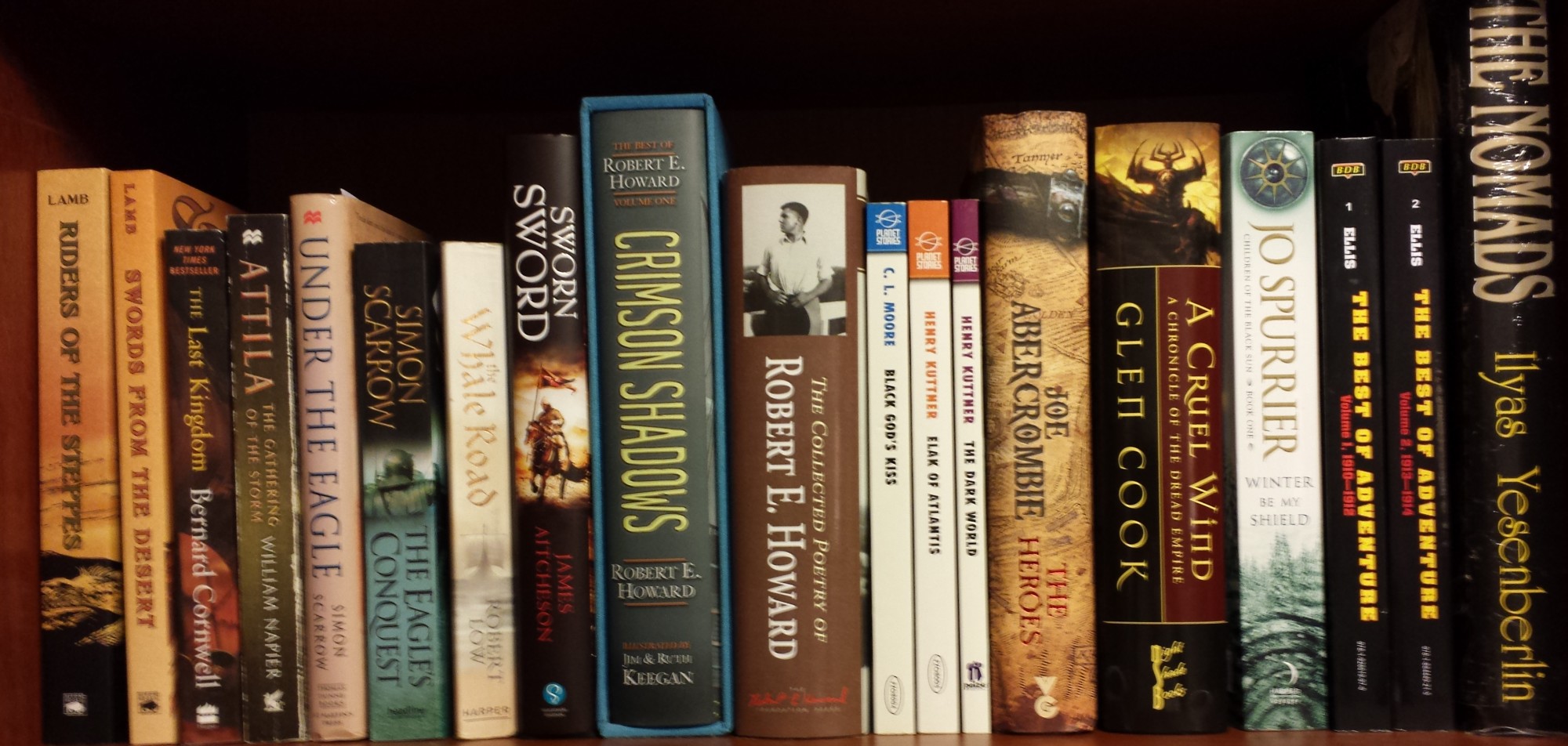
Kuttner (along with his wife C. L. Moore) is one of the few authors who has his/her own shelf in my library.  (The others are Ray Bradbury, Leigh Brackett and her husband Edmond Hamilton, and Robert E. Howard, who books take up two shelves.  Charles Beaumont would have his own shelf if he had written more books before he died.)

Much of Kuttner’s early work is clunky, but if you read his stories in chronological order, you can see him maturing.  He was a writer who wasn’t afraid to stretch himself, to take chances and do something different.  Just read “Happy Ending” as an example.  The story is told in reverse, Ending, Middle, Beginning, and it works.

If you’ve not read Kuttner, you should.  A large of number Big Names (Mariam Zimmer Bradley, Ray Bradbury, Richard Matheson, Robert Silverberg, Mike Resnick) list him among their influences. Find out why.

Happy Birthday, Hank.

Further Details About Night Shade Books

Additional information about Night Shade Books has become available.

First, Night Shade co-owner Jeremy Lassen has posted an open letter at Locus Online.  In it he explains his reasons for making the deal with Skyhorse Publishing.  He does not discuss the terms of the letter sent to Night Shade authors.

Second, Michael Stackpole does discuss the terms and why he won’t sign the letter in this post on his website.

I’m not going to comment at this time, other than to say that the loss of Night Shade is a nontrivial matter that will have a major impact on the field.  Some time in the next week, I’ll try to put some thoughts together in a coherent manner.

Night Shade Books is Being Bought

Editor Jeremy Lassen is reporting via Twitter that Night Shade Books is being bought by a larger publisher.  Authors with Night Shade are being contacted.  Lassen’s words were “being bought” not “being sold”, which I think is an interesting distinction.  No word of the sale is one the Night Shade homepage as yet.

I’m sure more details will emerge over the next few days/weeks/months.  I only hope the authors currently with Night Shade come through the process relatively unscathed.  I say “relatively” because this has got to be a nerve wracking experience.  Hopefully no one’s books will be orphaned by the new owners.  Somehow I’m not gonna hold my breath.  Regardless, Adventures Fantastic wishes all the Night Shade authors the best when the dust settles.

I’ll update as more details become available.

UPDATE:   Jeff VanderMeer has posted on his Facebook page a partial copy of a letter he has received about the sale.  It doesn’t look particularly promising.  A transcript of what he posted is below; errors are on the part of author of the letter.  VanderMeer says in the comments that he’s been advised not to sign, as have several other authors he doesn’t name.

NIGHT SHADE BOOKS
1661 TENNESSEE STREET #3H
SAN FRANSICO, CA 94107

April 1, 2013

Howard Morhain Litery Agency, Inc.

Dear Jeff & Ann Vandermeer,
Provided that a sufficient number of Night Shade authors agree to certain changes to their contracts with Night Shade, Skyhorse Publishing, Inc. and Start Publishing, LLC have agreed to acquire all Night Shade Books assets. To be clear, this is an acquisition of assets, not a purchase of the company as a whole. The revenue received from the sale would go towards paying off the debts of the company. If you sign below, and a sufficient number of other Night Shade authors and other creditors also agree to these terms, you will receive full payment to bring all royalties and overdue advances current.

Your payment would be in the amount of $0.00.

By signing this letter, you agree that:

END  OF TRANSCRIPT

I’m not a lawyer, so I’m not entirely sure about this, but it sounds like the publisher is sacrificing the authors and their works on the altar of the publisher’s debts.   I really hope I’m wrong.  If there’s a Night Shade title you’ve been wanting, you might go ahead a get it now.  No telling how much longer they’re going to be in print.  I should probably get caught on reading Eclipse Online this weekend.

Discriminating Taste

In yesterday’s post about not being a literary snob, I made the comment that I’ve become more discriminating as I’ve gotten older.  I said I would explain what I meant by that today, and I will.

When I was in school, I was one of those students who would finish early and use the extra class time to read.  I discovered many of the major sf writers through the anthologies of Robert Silverberg.  The library at the junior high I attended in 7th grade had a number of them.  These were the reprint anthologies he edited in the 60s, not the New Dimensions series.  I doubt those would have been deemed acceptable, or as we would say today, age appropriate.

On the weekends (provided I could talk my father into taking me) I would also go to the mall, where there was a Waldenbooks, or the flea market, which had a couple of used book stalls.  One of them sold paperbacks with the covers torn off for a quarter.  I didn’t realize at the time that these were stolen books, reported to the publisher as having been pulped.

It was through these venues that I discovered the works of Jack Williamson, James H. Schmitz, L. Sprague de Camp, Fritz Leiber, Isaac Asimov, Eric Frank Russell, Poul Anderson, and Silverberg himself, not to mention the juveniles of Robert Heinlein. Fantasy was just entering a boom phase, and before long I was reading that as well.  When I joined the Science Fiction Book Club in 9th grade, I first encountered the writers who made the greatest impression on me:  C. L. Moore, Edmond Hamilton, Fredric Brown, Frederik Pohl, C. M. Kornbluth, Leigh Brackett, and the writer who had the greatest impact on me, Henry Kuttner.  (I’d been reading Ray Bradbury since 5th grade, and Robert E. Howard was still a few years in my future.)  Outside the genre, some of the biggest influences I encountered during high school were Raymond Chandler, Rafael Sabatini, and Humphrey Bogart.

As I got into college and then graduate school, I continued to read widely in the field.  Until I got married, there was usually plenty of time to read a book or two a week plus a variety of short stories and comics.

It was during this phase that I developed some of the attitudes I discussed in yesterday’s post.  I began taking my reading seriously, at times too seriously.  I followed the award nominations and tried to read the titles that got the most buzz. 

After marriage and then parenthood came along, time began to be more and more at a premium.  Books began to pile up faster than previously.  And I realized something.  Reading wasn’t as fun as it used to be.  Or rather, make that what I was reading wasn’t as fun as what I had read when I was younger.

Over the last decade, I’ve reached a decision.  It is very likely I’ve passed the halfway point in my life.  If I haven’t I’m approaching it.  My father’s side of the family tends to live into their 90s and beyond on a regular basis if they take care of themselves.  I may not be at the halfway point yet, but time is slipping away.

Life is too short to read things because You Should or Everyone Is Reading This or It’s Going to be on All the Award Ballots or This Book Has Something Important to Say.  Especially that last one.  There are more good books out there that I haven’t read than I’ll ever be able to.  Unless I get locked into solitary confinement for twenty years with access to the world’s libraries, I’ve come to see the need to be more discriminating.

Not discriminating on  the basis of prejudiced against because of the publisher or the franchise, but discriminating on the basis of is this something I’m going to enjoy as much as I would that pulp over there?  In other words, more selective.  I’m trying to read more to my established tastes than to what certain voices in the field say I need to read.

So what am I trying to focus on?  Well, if you’ve read much of this blog, you know sword and sorcery is a major part of that.  So is epic fantasy, at least during periods when I have plenty of time to block out for reading, i.e., when classes aren’t in session.  As far as science fiction goes, space opera, especially space opera with a hard science bent, but also hard science in general, followed by time travel.  Historical adventure has been growing as a percentage of my reading over the last few years.  Horror is still there, but I’m pretty discriminating about it.  In the mystery field, PIs tend to be what I gravitate to, with police procedurals coming in second.  Cozies I can do without.  I consider noir and crime to be different from mystery, but they also get a lot of my attention.  And of course, I love short fiction of almost any genre. 

You can see the trend here, can’t you?  Adventure in some form.  Sense of wonder.  An exhilaration at being alive.  Optimism coupled with a thread of darkness.  Anyway, those are the things I look for in fiction.  You can keep the books written to promote your agenda or expand my consciousness.  I’ve got a villain to fight, a princess to save, and a monster to slay.

Overcoming Literary Snobbery

When I was a lad, just discovering how vast the field of science fiction and fantasy was, I was firmly in what David Hartwell has referred to as the omnivore stage.  To put that in plain English, I read everything I could get my hands on with no regard to author, publisher, or to a limited extent, quality.  If it had anything to do with spaceships, other planets, or aliens, then I was interested in it.  (This was shortly after a certain fantasy movie in science fiction drag hit it big.)  I soon branched out to other subgenres.

As I grew older and more discerning, I also grew more discriminating.  As in discriminate against.  I became interested in only reading works of originality.  My definition of originality was pretty rigid.  The work had to be something created by an author on spec that had been published by an established publishing house or the continuation of such a work.  Franchise work, by its very nature, had to be substandard.

At least that was my thinking at the time.  This years before electronic publishing leveled the playing field.

Fortunately, my thinking has changed and changed for the better. I came to realize that franchise, or work for hire, had value.

At first it was just the acknowledgement writing a novel, say, in a franchise owned by a major studio could teach authors the skills necessary to succeed on their own when they wrote “good” books.  There is some truth in that, but it’s still a pretty snobby and condescending attitude.  It didn’t occur to me then, when I was younger and had all the answers, that there were other reasons authors wrote in a franchise.

For one thing, it was (and is) a way of keeping a career alive.  I didn’t understand about the returns system and Bookscan numbers.  It also never occurred to me that authors might write in franchises simply because they loved the characters or world.

Things have changed in my world.  I hope I’ve become wiser, humbler (relatively speaking), and more open minded in my reading tastes.  As well as more discriminating in a positive way.  I’ve become educated in the way publishing works.  I’ve gotten over the “if it’s not from a major publisher, it probably isn’t any good” syndrome.  In fact, if anything, I’ve swung more to the other extreme.  I’m finding the works from the big houses tend to be the more bland, safe, paint-by-numbers type of book.  Yes, I realize there are exceptions to this, and that there are a number of fine and innovative authors doing groundbreaking work.  But what I’m discovering is that if I want to read something that breaks the mold, a work in which the author is taking chances, or a story without an Important Message, then the indies and small presses are the way to go.

There are a number of authors I’ve discovered through their work for other publishers who started out in franchise work.  Franchise work that I’ve started to seek out.  Warhammer is at the top of the list, but there are others.

There are still some work for hire type books I’ll tend to give a wide berth.  There are still media tie-ins written by someone with no love of the genre or the property they’re writing, works designed to fatten the corporate bottom line. To the extent I can distinguish them, I’ll give them a pass.  I’m looking for good story-telling, vivid description, in-depth characterization, fast-paced action, and crackling dialogue. 

Those are the things I’m looking for.  And I don’t care if it’s a franchise or a stand-alone novel, from a major publisher or an indie author.  As long as the tale is well-told, the source doesn’t matter.

I’ll explain in my next post how I think I’ve become more discriminating in a positive way.

Blogging Northwest Smith: Juhli

With “Juhli”, C. L. Moore returned to the formula that had been successful in her first few Northwest Smith stories.  The previous installment, “Dust of Gods“, was most a straight-forward adventure tale, with little of the weird science fantasy elements in prior stories, and certainly none of the erotic imagery.

The opening paragraph discusses Smith’s myriad scars, focusing on one particular scar over his heart.  The next paragraph finds Smith waking up in a dark room with no idea where he is or how he got there.  He manages to find a wall and put his back to it.  This is a good thing because there’s something else there with him.  Whatever is there touches him, delivering a strong electric shock.  When he wakes up, the thing is still there somewhere, but there’s a young girl as well.


The girl, who is named Apri, is the servant of Juhli.  Juhli is a fearsome member of an alien race that lives in the city of Vonng.  Vonng exists in two planes.  In Smith’s the city is in ruins, but in Juhli’s plane the city is still quite inhabited.  Smith learns that he’s been captured, but his capture is an error.  He’s been captured to feed Juhli.  The error comes from Smith’s notoriety.  Normally those taken are folks who won’t be missed.

Juhli makes her appearance and takes Smith and Apri to a structure that loops back on itself.  What I mean by that is when Smith walks in a straight line between the columns supporting the roof, he eventually returns to his starting point.

Juhli isn’t human, although there are some superficial resemblances to humanity.  For starters, she’s basically humanoid from the waist up.  Moore doesn’t give a clear description of her from the waist down but implies she has the body of a snake.  Her facial features are definitely not human.  Her mouth is circular and doesn’t close, and she only has one eye in the middle of her forehead.  Above that is some type of organ that resembles a feather.  In spite of this inhuman appearance, Juhli is described as being beautiful.

Juhli wants to feed on Smith’s life force, and takes him in her arms.  She places her mouth on his chest, which is the source of the scar mentioned in the opening paragraph.  During the process, Smith experiences emotional extremes:  exhilaration, terror, any strong emotion Juhli forces him to experience.  In the process Smith sees the universe and Juhli’s world through her eyes.

I’ll not spoil the ending by saying how Smith manages to escape.  I will say the ending is particularly bleak.

In “Juhli” Moore returns to the themes she used early in the series.  There’s a beautiful, inhuman woman (or at least female) who tries to kill Smith through some type of psychic means.  There’s some sexual imagery, although it’s not to the level of “Shambleau” and certainly not to the level of “Scarlet Dream“.

Yet the whole thing seems tired, like Moore is just going through the motions.  We’ve seen this before.  It’s not really new.  Instead the story has an air of familiarity about it.

In spite of this, I liked the story.  This is, after all, C. L. Moore we’re talking about.  Her prose is superior to most of what you’ll find, even when it’s not necessarily her best.  The woman could make long descriptive passages interesting, something that’s not easy to do.  So, while not as strong a tale as some of the earlier entries in the series, “Juhli” is still a decent story.


Writing Fantasy Heroes Giveaway

Writing Fantasy Heroes
Jason M. Waltz, edl
Rogue Blades Entertainment

I recently wrote a post about my copy of Writing Fantasy Heroes arriving and how eager I was to dive into it.  That post got more traffic, and certainly more comments, than most of the posts I’ve done in the last couple of months. 

Since then, two things have happened.  First, I’ve read about 1/3 of the book, and it’s every bit as good as I hoped.  I’ll review the book once I’ve finished, so I won’t go into details here.

The second thing that  happened, and the one that has a direct bearing on readers of this blog, is that I received an email a few days ago from Jason M. Waltz, the publisher of Rogue Blades Entertainment and the editor of the aforementioned book.

It seems a couple of years ago, I took advantage of a special RBE was running and prebought several titles.  Writing Fantasy Heroes wasn’t one of them, probably because it wasn’t conceived of at the time.  That’s a guess on my part.  What isn’t a guess is that this is the book Jason had intended to make a part of the prepurchase deal, subbing this book for another one.  But then I went and bought the book before he had a chance to send me my copy.  He asked what I wanted to do about it, and I quickly decided to do a giveaway.  Since Jason is the person who has the copy of Writing Fantasy Heroes in his possession and will be handling the mailing, this is a joint giveaway between Adventures Fantastic and Rogue Blades Entertainment.

So, here’s the deal.  Between now and when I post the review, which will probably be just after Easter if I can keep the schedule I’ve sketched out, anyone who posts a comment here answering the following question will be entered.  The question is:  What one characteristic above all others is essential for a fantasy hero and why?  Your answer could be long or short, but you have to say why that characteristic is the one you think is the most essential.  Hopefully, this will generate some thought provoking discussion as well as a little buzz for RBE.

Once the review of Writing Fantasy Heroes goes live, I’ll put all the names in a hat and draw one at random.  Actually, I probably have my son draw the name.  He’d enjoy my involving him like that.  I’ll announce that person’s name the day after I post the review.  I’ll also contact that individual directly and/or pass that person’s name directly on to Jason.  He will be mailing the book.  This is an unread copy, not the copy I’ve got.

There is one other thing.  The winner will be requested, but not required, to post a review of the book once they’ve read it, either on their own blog, Goodreads, Amazon, or some combination of the above.

Writing Report, 3/20/13

I only got 378 new words tonight, and I’m pushing it to write this post.  I’m that exhausted.  The only reason I am writing this is I changed directions tonight.  I didn’t scrap the two previous night’s work so much as set it aside. I realized that the story I was writing was too complex to be told in the amount of time and within the word count limitation I’m dealing with.  I started another story, same characters, same series, but this one should be short and more straight forward.  I fully intend to finish the one I started two nights ago, but as it’s going to have elements of mystery in it, I’ll need some time to make sure all the details and clues are where they need to be in order to play fair with the reader.  The one I started on this evening is more pure sword and sorcery with a straightforward plot, emphasis on action rather than intrigue and suspense.