Author Archives: Keith West

Amazing Stories (TM) is Now Live

Hey, everyone.  The Amazing Stories (TM) blog is now live.  I’ve got several pieces up, with more to come on a weekly basis.  The link is Amazing Stories (TM) .  There’s a lot of great stuff over there, and I don’t mean the things I’ve posted.  There are posts about Robert E. Howard, fantasy, science fiction, writing short fiction, indie publishing, and tons more cool stuff.  So head over there and check it out.

What follows is the press release that should be on various media outlets today: 


Amazing Stories, the world’s first science fiction magazine, is now open to the public.

Social Magazine Website Offers Nearly Sixty Writers and Social Networking For Fans!
Experimenter Publishing Company
Hillsboro, NH
January 19, 2013
The Experimenter Publishing Company is pleased to announce the  reintroduction of the world’s most recognizable science fiction magazine – AMAZING STORIES!
Following the completion of a successful Beta Test begun on January 2nd, 2013, Amazing Stories is now open to the public.  Fans of science fiction, fantasy, and horror are invited to join and encouraged to participate in helping to bring back a cherished icon of the field.
For the past several weeks nearly sixty fans, authors, artists, editors and bloggers have been producing articles on your favorite subjects – the literature of SF/F/H, its presentations in media such as television, film, poetry, literature, games, comics and much more.
All contents of Amazing Stories are free to the general public. 
Membership is also free – and entitles members to participate in the discussion, share information and engage in many other familiar social networking activities.
Membership also represents a stake in helping Amazing Stories return to publication.  The more members the site acquires, the faster Amazing Stories can become a paying market for short fiction.
Every genre fan now has a chance to help support the creation of a new market for the stories, artwork and articles they all love so much.
To visit the site and obtain your free membership, go to AMAZING STORIES, and don’t forget to invite your friends too!

This reincarnation of Amazing Stories could not have happened without the generous support of Woodall Design LLC and the members of the Amazing Stories Blog Team:
Cenobyte, Karen G. Anderson, Mike Brotherton, Ricky L. Brown,
Michael A. Burstein, Catherine Coker, Johne Cook, Paul Cook, Gary Dalkin,
Jane Frank, Adria K. Fraser,  Jim Freund, Fran Friel, Adam Gaffen,
Chris Garcia, Chris Gerwel, Tommy Hancock, Liz Henderson, Samantha Henry,
M.D. Jackson, Monique Jacob, Geoffrey James, J. Jay Jones, Daniel M. Kimmel,
Peggy Kolm, Justin Landon, Andrew Liptak, Bob Lock, Melissa Lowery,
Barry Malzberg, C. E. Martin, Farrell J. McGovern, Steve Miller, Matt Mitrovich,
Aidan Moher, Kevin Murray, Ken Neth, Astrid Nielsch, D. Nicklin-Dunbar,
James Palmer, John Purcell, James Rogers, Felicity Savage, Diane Severson,
Steve H. Silver, J. Simpson, Douglas Smith, Lesley Smith, Bill Spangler,
Duane Spurlock, Michael J. Sullivan, G. W. Thomas, Erin Underwood,
Stephan Van Velzen, Cynthia Ward, Michael Webb, Keith West, John M. Whalen,
Karlo Yeager, Leah A. Zeldes
For more information about Amazing Stories, please contact the publisher at

It’s Been Awfully Quiet Around Here…

…and for a good reason.  Or not, depending on how you want to look at it. 

My day job is in academia.  Normally, the first part of January is a little hectic as things gear up for the new semester.  When I came back from the break, I discovered I had a new class to teach in addition to my regular class and supervisory duties.  One of our faculty was awarded an endowed chair at another institution, and he and his wife, also a faculty member, are in the process of relocating even as I type this.  I was assigned one of her classes.  It’s intro planetary astronomy, a course I’ve taught before, but it’s been a few years, and I don’t have lecture notes ready.  Classes just started, so once I get the holes filled in the TA teaching schedule, things should fall into a routine.

Also, my in-laws are celebrating their 50th anniversary, and we’re traveling this weekend for the dinner.  I hope to get some reading and writing done while I’m gone.  We’ll see.

Anyway, I’ve spent three weeks trying to finish two books, one for review at Futures Past and Present, and one for Amazing Stories (TM).  Normally, I would finish both within a week.  I think I can finish them this weekend.  Then I’ll dive into the stack waiting for me that just keeps getting larger.

I’ll try to get a short fiction review or two up here in the next few days as well.  As well as writing some of my own.

Anyway, that’s why I’ve been kinda quiet except for a couple of news items.  Thanks for your patience.

RIP, Steven Utley

Lawrence Person is reporting that science fiction author Steven Utley has died.  Utley announced on December 27, 2012 that he had been diagnosed with Stage 4 cancer.  On January 12, he slipped into a coma and died that night.

Along with George W. Proctor, Utley was coeditor of Lone Star Universe, an anthology consisting of Texas writers, many of whom went on to become major figures in the field.  Utley wrote mainly at short lengths.  For the past decade much of his output centered on his Silurian Tales, regarding time travel to, what else, the Silurian Era.  I met Utlely only once, at an Armadillcon a few years ago.  I found him to be a soft-spoken, quiet man.  We only spoke for a few minutes, and I wish I had visited with him more. 

The only current US edition of his work is The Beasts of Love, and I’m not even sure that is in print anymore.  That none of his other work is in print in this country is a disgrace.  If you can find any of his work in anthologies, or if you are fortunate to get your hands on a copy of one of his collections, I encourage you to read it.  I especially recommend “The Country Doctor”, most recently reprinted in Where or When from PS Publishing.  Unfortunately, that volume is out of print. 

Mike Resnick Launches New Short Fiction Magazine

Back in the late 80s/early 90s, there were a number of theme anthologies edited by Mike Resnick.  Really Mike Resnick and Martin H. Greenberg, but you know what I mean.  Resnick wins awards, especially Hugos, at a rate that turns most writers green.  He’s a fantastic writer if you haven’t read him.  I’ve got some of his titles in the queue.  Well, now he’s launching a new short fiction magazine, Galaxy’s Edge.  It goes live on March 1.  You know I’m going to be there.  Look for a review either here or at Futures Past and Present. 

Goals Followup + Amazing Stories

This post will be both a followup on the goals post plus an update on the status of things at Amazing Stories (TM).

First, I hit my writing goal of at least1500 words a week with 1664.  I’m counting a week starting with Sunday.  I wrote 311 last night before I had to stop and think about what comes next.  Not sure how much I’ll write in a few minutes.  I’m thinking of putting a little box up in the corner of the blog with the date I last wrote and word count in it.  If that information is there for all the world to see, I’ll be more motivated to write.  I think I can do that without everybody who follows the blog getting a notice each time it updates. 

Of course, things might be about to slow down.  I found out over the weekend there’s an unexpected vacancy in the department, and I’ll be teaching an additional course this semester.  I go back tomorrow, with classes starting next week, so I’m not in my routine yet.  My son went back to gymnastics tonight and starts back with diving tomorrow night, so once I get into a routine, I may be cursing those 1500 words.

My first post went live at Amazing Stories (TM) today.  The site is still in beta and not accessible to the general public yet.  It should be live for everyone in a week or so unless something unforeseen  happens.  All the posts that have gone up since Thursday, the first day they were up, will be available when the site opens to everyone.  I’m not sure if the present posts will be reposted with everything starting over from scratch or if they will be archived and new material will continue without interruption.  I’ll let you know when that decision is made.

My first post is about some of the changes in publishing and why I think small presses and indie published books are important, and the second will contain the terms I’ll be using and what I mean when I say them (as opposed to what someone else means with the same words).  Then I’ll start in on reviews.  The first is written and ready to go.  It will be a review of Five by Five.  The next review will be of Space Eldritch (which I’m reading now), followed by Frogs in Aspic.  After that is a little up in the air still.  I’ll have my own email address at Amazing Stories (TM).  It’s keith.west@amazingstoriesmag.com.  Once everything’s a go, I hope you’ll drop by and check it out.  And not just my stuff.  There’s some really cool things being posted. 

A Thought or Two on The Hobbit: An Unexpected Journey

We finally got our act together and saw The Hobbit:  An Unexpected Journey.  It was better than I was expecting.

I’m not going to try and do an in-depth analysis of the movie.  There are other people who are much more qualified than I am for that.  I’ve only read the book twice, most recently prior to the release of the first LOTR movie.  Some of the details are a little blurry, to say the least.

On the whole, the movie matched the book quite well, at least to the best of my memory.  There were a few details I thought were different.  I know Jackson is embellishing the story a little, drawing on sources in Tolkien’s writings other than the novel itself.  Those scenes were fairly obvious.

The cinematography was great.  Every time I see one of these movies, I want to move to New Zealand. 

One thing I did find interesting.  With all the running the party did, I was impressed that no one ever seemed out of breath, especially since it was in the mountains. 

On the whole I was impressed.  This is one I’ll be getting on DVD. 

Goals for 2013

I’m not much for resolutions, but I do believe in setting goals.  So I thought I’d set out a few goals for 2013. 

First, I want to write more.  And by that, I mean fiction.  Blogging is fun, but if I’m not careful, it can take over all my time.  So I want to write at least 1500 words of fiction a week.  That’s a minimum, and if I see that I’m hitting that without breaking a sweat, I’ll probably up that amount.  I’m looking into ways to keep documents in the cloud so I can work in multiple locations and not be constrained to a single computer.  Or have to keep up with a flashdrive. I’m thinking about posting a weekly recap on what I’ve accomplished here.  Maybe a little positive peer pressure will work in my favor.

Second, I want to post more often at Futures Past and Present.  By more often I mean more frequently than once every few months.  I’d like to post at least twice a month.  We’ll see if that happens.  I posted there earlier this evening, and the next several novel I’m planning on reviewing will be science fiction, so I should meet that goal at least one month.

Of course I want to keep posting regularly here.  Since I’ve expanded my focus, I’ll be able to write about things other than just fantasy and historical fiction.  I’m also going to look at more short fiction, which should make things easier.

I’d like to make all my deadlines at Amazing Stories.  If I can stay ahead, then I should be able to do that.

One of the things I’m going to do to help manage my time is to not spend so much time on Twitter.  I’ll still check in, but it may not be every day.  Beyond that, I’ll tell myself that Free Cell is broken.  It all comes down to time management, which is mainly self-discipline.  Not one of my strong points.  But I’m going to try.  Not that I’ve said publicly what I hope to achieve, all the world will be watching if I fail.  No pressure.

2012 in Retrospect: Short Fiction

This past year was a good year overall for short fiction.  And some of the most exciting short fiction was published online with or without the option of subscribing.  There were also the usual print venues, both periodicals and anthologies.  In this post, I’m going to try to provide an admittedly incomplete overview of the short fiction field in 2012, emphasizing online venues.  I didn’t read thoroughly enough in the print periodicals (Asimov’s, Analog, Hitchcock’s, Ellery Queen, or F&SF) to have a feel for them.  And there were enough original anthologies that flew past my radar that I’m not even going to try to discuss any of them.

And as for the electronic magazines, with one exception, I’m only going to mention the ones I read at least once this year.  I’m not going to discuss individual stories; I don’t have that kind of time.  Rather, I’m going to try to give a general idea of what the magazine was like.  Links and subcription information (where applicable) will be provided.

The year didn’t start off all that well.  The electronic magazine Something Wicked ceased publication.  I’m not sure how well known this title was in the States.  I’m not certain, but I think it was out of South Aftrica.  It started as a print magazine before moving to electronic only.  With a focus on science fiction and horror, it published three short stories and one novella plus some nonfiction each issue.  I had a subscription and got a few issues before it was canceled.  I hated to see it go, because it was different than what was being published here in the States, and I enjoyed what I read.

Beneath Ceaseless Skies was probably the go-to place online for high quality fantasy, with an issue every two weeks.  BCS had a great year, publishing their 100th issue.  They’re still going strong and required reading for anyone wanting to keep up with the field.  Subscription info here.

Heroic Fantasy Quarterly is your next best bet for great adventure fiction, especially if your tastes run to sword and sorcery.  It’s also the strongest competition BCS had at the first of the year; with Black Gate publishing fiction once a week, that’s changing.  I found the quality of work at HFQ to be on par with BCS and Black Gate.  If you aren’t reading this one, you should be.  It’s free and updates every three months, just like a quarterly should, not that all publications that call themselves that do.

In October, Black Gate, which had stopped publishing in print format, began posting a new piece of fiction every Sunday.  They’ve published a mix of new stories, reprints from the print incarnation, and excerpts from novels.  So far the quality has been high, which is what I would expect from BG

In my opinion, these were the best markets for sword and sorcery and adventure fiction, and are the top venues in the field.  They weren’t only markets for S&S, nor were they the only markets for great fiction of a fantastic nature.

Lightspeed is probably the main online source for fantastic fiction.  In January, it combined with Fantasy.  This is the publication I had the most trouble fitting into my schedule this year, managing to read only one or two stories.  Edited by John Joseph Adams, it’s going strong, publishing the top names in both science fiction and fantasy.  Subscription info here.  I promise I’ll do a better job of reading this one in 2013.

Clarkesworld published some solid science fiction this year, although most of what I read was more literary than than action orieinted.  I don’t recall seeing any fantasy, but I wasn’t able to read each issue.  Subscription info here.

Apex publishes stuff on the darker side of the fantastic.  Lynn Thomas took over as editor from Cathrynne Valente near the beginning of the year.  It’s another one I intend to read more of next year.  What little I managed to fit in was good stuff. Subscription info here

Subterranean had another great year.  This is a quarterly publication.  They went from publishing their content over a period of weeks to putting it all online at once.  There is no subscription option like there is for some of the titles listed above, but I wish there were.  I’d rather read on an ereader than a screen. 

Combine these publications with the traditional print ones, and it’s hard not to conclude the short fiction market is healthy.  There were several new publications that started up this year as well. 

First there was Swords and Sorcery Magazine, an online-only publication that premiered in February.  Publishing two stories per issue, it met its publication schedule, something that new publications don’t always do.  It’s not a professional paying market at the moment, although I hope it can achieve that status soon.  As a result, the quality of the fiction wasn’t up to what you find in BCS or HFQ.  In spite of that, the issues I read were quite readable, and I enjoyed the fiction I found there.  It was certainly the most promising debut as far as S&S is concerned.  In spite of the fact that it can’t yet pay professional rates, there’s nothing unprofessional about the editorial tone.  This is one worth supporting.

Another new publication was Nightmare Magazine.  Edited by John Joseph When-Does-the-Man-Sleep? Adams, this magazine was crowdfunded by Kickstarter and has taken off.  It’s one of the best, if not the best, publications devoted solely to horror fiction out there.  I’ve been very impressed by what I’ve found.  Subscription info here.

Another Kickstarter magazine was Fireside.  This quarterly hasn’t taken off like Nightmare, and I hope it does.  It doesn’t limit itself to any particular genre, which is both a strength and a weakness.  A strength because it can publish those cool stories that defy classification, and a weakness because it will probably take a little longer to find its core readership that a genre publication would.  Subscription info here

Another high profile debut, which publishes both fantasy and science fiction, is Eclipse Online.  Edited by Jonathan Strahan, it’s a continuation of the critically acclaimed anthology series of the same title.  It publishes fiction twice a month and is worth checking out.

In many ways the most anticipated debut, and certainly the most controversial, was the relaunch of Weird Tales with Marvin Kaye as the editor.  Kaye wanted to return the magazine to its roots, something that didn’t sit well in certain circles.  The first issue was IMO a success.  Here’s hoping the best days of the publication are ahead of it.  Subscription info here.

In the interest of being balanced, I’m going to mention Shimmer, even though I haven’t read it yet.  As part of the reaction to Marvin Kaye replacing Ann Vandermeer as editor of Weird Tales, Mary Robinette Kowal underwrote the magazine so that it can pay professional rates.  The idea is that this will attract writers who would have submitted to Vandermeer had she continued to edit WT.  In other words, what we have here is a literary smackdown.  Like WT, Shimmer is a quarterly publication.  I’m going to review this one, probably after the next issue is published.   I want to evaluate it on the basis of what it publishes after paying pro rates.  Subscription info here.

These weren’t all of the fiction outlets, but with the exception of Shimmer, these were the ones I at least attempted to read.  Other major venues included, but weren’t limited to, Tor.com and Strange Horizons.  These two are also on the list to read next year.

So anyway, that’s a (very) lopsided look at the electronic world of fantastic fiction in the year 2012.  There was a great deal of good stuff published.  I’m going to try to do more reading at short lengths in 2013.  For one thing, I like short fiction.  It fits my time contraints better than doorstopper novels.  Also, with my new gig at Amazing Stories (TM), I’m not going to have as much time to read novels for my personal blogs.


2012 in Retrospect: Publishing

Rather than doing a single post about what I thought of the past year, I’m going to break things up into some smaller posts.  There will be on short fiction and one on titles I especially enjoyed.  But I thought I would start with publishers.

Last year, I wrote about the publishers I thought you should be reading this year.  That list hasn’t changed much.  The day before I posted that list, I gave reasons why I wasn’t going to be reading much from the main imprints.  Those reasons haven’t changed much, either.  If anything, they’re more valid than ever.

What I’m going to attempt to do here, in this present post, is to assess some of the things I said in those two posts.

First, I said I wouldn’t be buying many titles from the major publishers.  What constitutes a major publisher is probably going to vary among individuals.  That’s fine; it will give us something to talk about.  So many publishers are trying to grab as many rights as they can from authors and paying them so little once you take a close look at the numbers, that I have trouble with supporting such a system, just as a matter of conscience.  Add to that the fact that most of the major publishers are pricing their ebooks way too high, and in some cases as much or more than the paper editions, and I really don’t see the point.

Second, I said I would be reading more indie published authors.  I have.  The mistake I made was listing the authors whose work I intended to read.  The reason that was a mistake is that I haven’t gotten to everyone on the list yet.  Since I’m going to be focusing on small and indie presses in my column over at Amazing Stories (TM), those authors will be moving to near the top of the list.

Here’s the thing that might suprise some people.  I haven’t really missed reading books published by the majors.  I’ve still read a few here and there, and have a couple in my TBR stack.  But for the most part, I’ve enjoyed the small press and indie published works I’ve read.  I’m very selective about what I pick up these days simply due to time considerations.  Most of these works have been as good as what the Big 6 5 However-many-are-left-after-the-mergers are publishing.

So I think my decision to read indie published works has been a good one, and I’ll keep doing it.

Now, as for publishers.  I’m not going to numerically rank them.  I’m going to stick to the same list, but I’ll add a couple of publishers to it.  These are what I would call midsized publishers, in that they get national or international distribution and have major authors in their stables, but they haven’t been around for decades like some publishers have.

First, I included Prime Books as a runner-up because at the time I hadn’t finished any of their titles.  While I still dip into their anthologies without reading them all the way through, I maintain that Prime is one of the best publishers around.  I’ve got collections by Elizabeth Bear and Richard Parks to read, as well as many anthologies.

Orbit Books didn’t make the list last year because I hadn’t read any of their titles.  That hasn’t changed much, but there are some titles I very much want to read, starting with the latest Joe Abercrombie.  That alone puts Orbit on the list.  The fact that they also publish John R. Fultz and Michael J. Sullivan, two other writers I’m looking forward to reading doesn’t hurt, either.

Next is Solaris and its companion imprint, Abaddon.  This is Eric Brown’s publisher, and Brown is one of the best science fiction authors working today.  He writes good space opera, and I love space opera.

Nightshade published some interesting books this year, most of which I still haven’t gotten around to reading yet, including titles Misere, Southern Gods, The Scourge of the Betrayer, and The Pillars of Hercules, plust the more recent Siren Depths and The Tainted City.  Part of the reason I haven’t read these yet is time, but also because Nightshade no longer seems to be responding to requests for review copies.  I try (and occasionally succeed) to post a review around the time the book comes out, and since I ended up buying these titles, the books had in some cases been out a while.  The most significant thing Nightshade did this year, though, was to start the online publication, Eclipse Online, a continuation of their successful anthology series.  I’ll talk about that more in the forthcoming short fiction post. 

I probably read more books by Angry Robot this year than any other publisher, in part because of how their Robot Army program worked and in part because I really like their line.  This is one publisher I’ll keep reading and reviewing, although I probably won’t read quite as many title from them this year simply due to time considerations.  I had three titles I was planning to review when we ended up moving.  In all the commotion, I never read them.  I’m going to try to work them into the queue soon.

Pyr was top of my list last year, and this was another good year for them.  Pyr seems to be shifting its focus a bit, publishing more science fiction and YA titles than fantasy in recent months, but that’s not a bad thing necessarily.  I certainly don’t hold it against them.  They are in business to make money, after all, and markets do change.  I’ve got more titles from Pyr than any other publisher in the queue at the moment, mostly science fiction from Brenda J. Cooper, Mike Resnick, Allen Steele, and Mark Hodder.

These are all publishers who publish mass market and trade, and thus within the budgets of most readers.  Among the more expensive collectible and limited edition publishers, Haffner Press stands out as my favorite, primarily because Haffner publishes some of my favorite authors.  Cemetery Dance and Subterranean are the other two publishers I’ve bought a lot from this year.

These are the publishers I’ve read this year because these guys, from what I can tell, are not only publishing some of the best fantasy, science fiction, and horror, but they also have some of the best business practices around.  With limited time and monetary resources, I want to get the best value I can and support the players (publishers and authors) I respect.  These publishers and many of the indie authors I’ve read have more than provided that. 

So as far as publishers go, these are the one I will stick with in 2013.

And This is My Room…

It’s taken me a while, but I finally got my office in the new house in some semblance of order.  I say “semblance” because I need to rearrange some of the things on the shelves.  I also need to add a shelf to the book case in the center of the second photo.  And put up some curtains.  And…

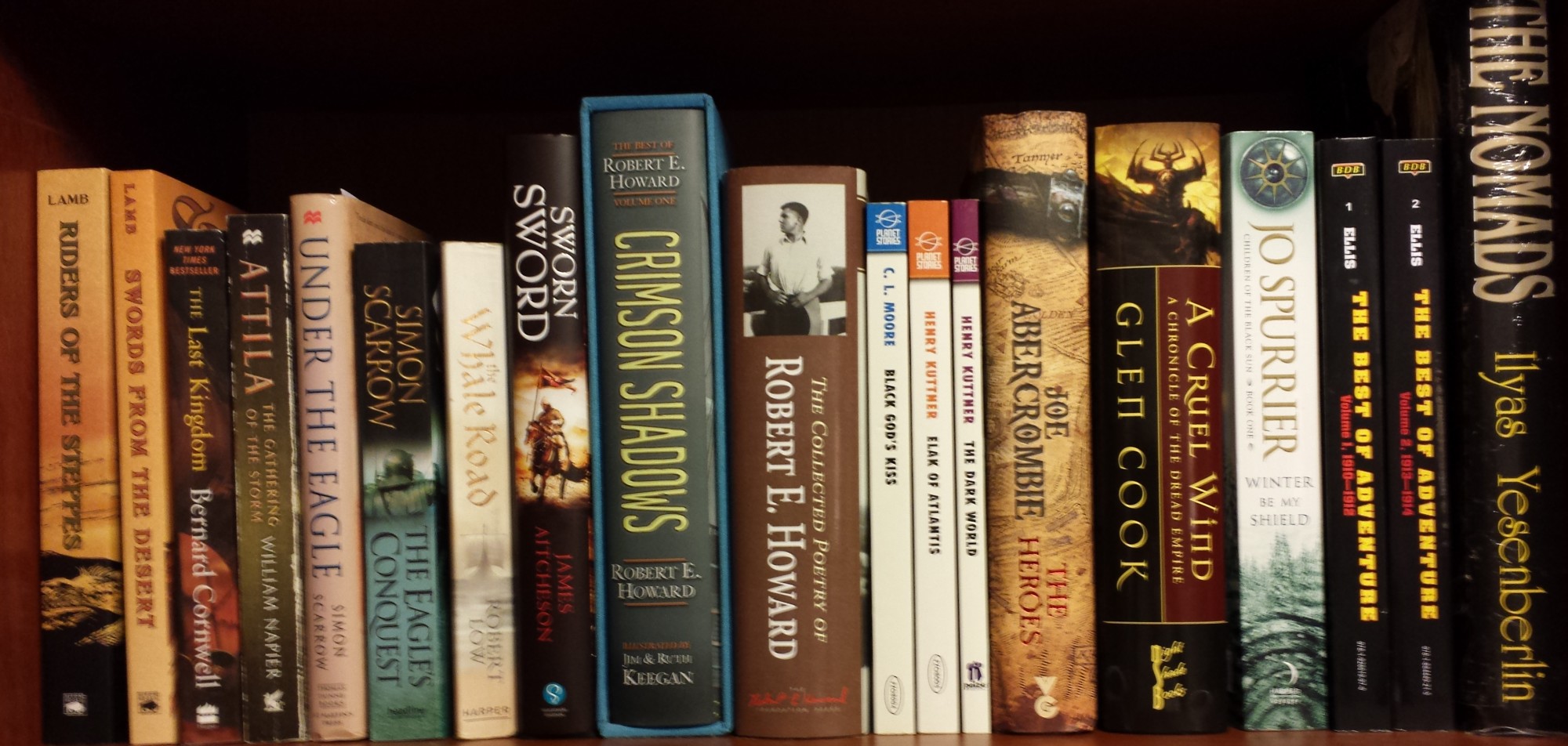
But I digress.  This is my writing/blogging/reading room.  And no, this isn’t all the books.  Most of the mass market paperbacks that have been unpacked, many of the hardcovers, and the digest magazines from the 80s and later are housed in the Library Annex, formerly known as The Guest Room.  (Please don’t tell my wife I said that; she still thinks it’s The Guest Room.)  This room has the collectibles, the graphic novels, the mysteries and crime, autographed books, and trade books by my favorite authors.

The photos go from left to right.  This is what would be the formal living room in a normal person’s house.

Some items of interest:  In the first picture, the lamp is an antique I’ve had for years and just had repaired this past week.

In the second photo, the bookcase in the center is not flush against the wall.  It’s the endcap for two foot long bookcases that come off perpendicular to the wall.  I bought them as a set.  The blue bookcase to the left facing out is designed to hold paperbacks.  It’s one of two I bought when one of my favorite second hand stores (Book Tree in Richardson, TX) closed.  I wish I’d bought more even though I had to go into debt to get them.  The small bookcase with the R2D2 nightlight (yes, it works) contains the pulps.  And, yes, that is a sword hanging on the left side of that bookcase.

You can’t see it in this shot, but behind the bookcases coming off the wall is the second paperback shelf.  It contains early copies of F&SF, Astounding, and other digests along with select paperbacks.  The shelf facing the pulps has the Ash-Tree Press, Midnight House, and Darkside Press volumes as well as most of the other horror.  The top shelf in the right bookcase (not the top of the bookcase) is everything I have by Leigh Brackett.  The shelf under that is everything I have by Henry Kuttner and C. L. Moore.  The middle shelf and second from the bottom contain the Robert E. Howard collection.
This last photo shows where genius happens.  I hope.  The items on the wall are for inspiration.  The poster on the left is a typewriter with the first page of a chapter with a noir novel; a gun, bottle of whiskey, and a pack of cigarettes are next to the typewriter.  The Planet Stories poster shows the cover  of every issue except one.  One was duplicated in the wrong spot.  All I need is to frame my picture of Robert E. Howard and add it to the wall.
Anyway, that’s a quick tour of my office, which I designed to be an extension of my mind.  Now you see how cluttered it is inside my head.