Author Archives: Keith West

David Gemmell Awards Shortlist Announced

The shortlist for the David Gemmell Awards was announced over the weekend.  There were some other award announcements in the last few days, so if you missed this one, that’s understandable.  This is the one I’m most interested in, since this is the type of fantasy we try to focus on here at Adventures Fantastic.  More information and a list of previous winners can be found on the David Gemmell Award site.  Adventures Fantastic would like to congratulate all authors and artists who were nominated and especially the shortlisted nominees.  Voting on the shortlist opens in a few days and will remain open until sometime in June, so if you want to vote and aren’t a member, there’s a link on the Award site where you can join.

Legend Award
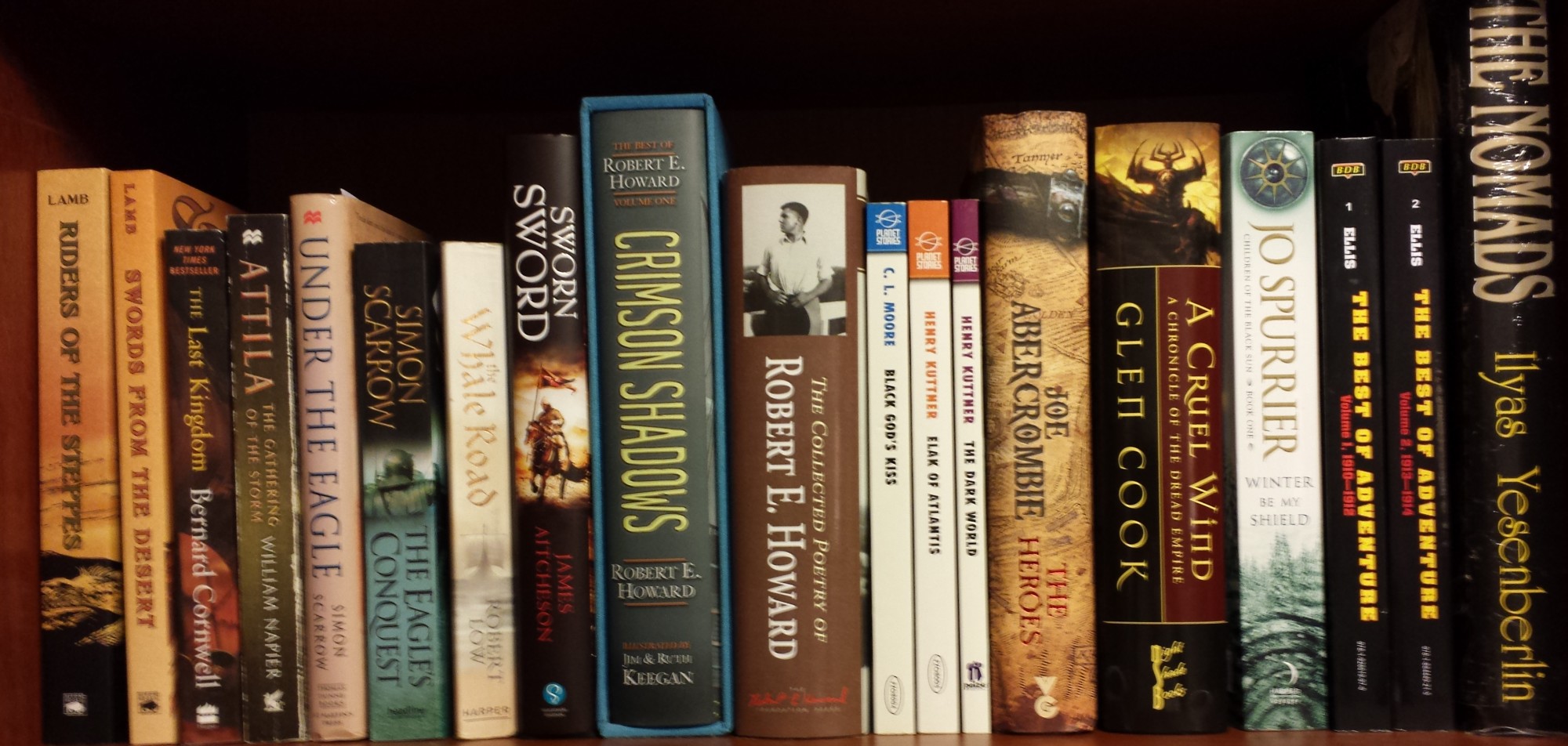
The Heroes – Joe Abercrombie
The Wise Mans Fear – Patrick Rothfuss
Blood of Aenarion – Willian King
Alloy of Law – Brandon Sanderson
Black Veil – Kristen Britain

Morningstar Award
Prince of Thorns – Mark Lawrence
Among Thieves – Douglas Hulick
The Unremembered – Peter ORulloan
The Heir of Night – Helen Lowe
Songs of the Earth – Elspeth Cooper

Ravenheart Award
Blood of Aenarion – Raymond Swanland
The Heroes – Didier Graffet and Dave Senior
Oracles Fire – Frank Victoria
Among Thieves – Larry Rostant
Journey By Night – Aaron Briggs

Award Announcements and a Few Initial Thoughts

The shortlist for the Hugo Awards was announced yesterday along with the Campbell Awards.  Locus Online (among others) has posted the list.  I’ve included the fiction and some fiction related categories below for easy reference (stolen cut and pasted from Locus Online). 

Congratulations to all the nominees.

Here are a few initial thoughts on some changes I see and potential changes down the road.

First, of the nominees, only two of them have been publishing since I started reading f/sf in my teens.  (It wasn’t that long ago, wiseass.)  Those would be George R. R. Martin and Mike Resnick.  Ryman has been publishing since the early to mid-90s.  Walton, Mie’ville, and Scalzi have been publishing for around a decade, give or take a few years.  The others are either relatively new or have been around for (I think) less than a decade, with the possible exception of one or two I’m not that familiar with.

What does this mean?  I don’t know that it means anything.  A lot of the stalwarts from the 70s, 80s, and 90s who got their start in those decades (as opposed to stalwarts who started in earlier decades) are still publishing, in some cases quite prolifically.  Alan Dean Foster and Orson Scott Card come to mind off the top of my head, although I don’t know if Card published anything during the period of eligibility.  Some of the big names from previous decades have either moved on to other genres, slowed their rates of production, or quit writing entirely.

In short the field is changing.  Whether for good, bad, or neutral will remain to be seen and depend on what your tastes are.  Except for the novels, I’m going to try to read the nominated fiction by Worldcon.  Not that I can afford to attend or anything, but so that I can cheer (or rant) from a position of knowledge after the awards are announced.  I intend to read Leviathan Wakes and A Dance with Dragons, just not sure I’ll have them read by the time the awards are given out.

I have to admit I haven’t read any of the nominees this year.  That’s unusual.  Usually, I’ve read a few, at least.  I don’t know if that means that I’m out of step with the rest of the field or that the rest of the field hasn’t caught up with me yet.  

The thing that got me thinking about the awards was this post about writers making a living by publishing online rather than through traditional venues.  More and more authors seem to be sidestepping New York or at least publishing some stuff on the side.  As far as I know, and you can correct me if I’m wrong on this point, none of the major awards recognize indie published works.  I’m wondering how long that position is sustainable if the awards are to be taken seriously.  If some of the top selling titles in the field aren’t considered for the major awards (Hugo, Nebula, World Fantasy, etc.) , how meaningful are the awards?  At that point, I think the awards become an elitist exercise of self-congratulation within a small group.  I’m not saying we’re at that point yet, but we seem be moving there fairly quickly, as these numbers and these numbers indicate.

Print still dominates overall sales, but that’s changing. Perhaps it’s time for the field to change how it recognizes quality.  I’ll have more to say on this topic at a later date.  This has just been a snapshot of the direction my thoughts have been going in the last few hours.

BEST NOVEL

BEST NOVELLA

  • ‘‘The Ice Owl’’, Carolyn Ives Gilman (F&SF 10-11/11)
  • ‘‘Countdown’’, Mira Grant (Orbit Short Fiction)
  • ‘‘The Man Who Bridged the Mist’’, Kij Johnson (Asimov’s 10-11/11)
  • ‘‘Kiss Me Twice’’, Mary Robinette Kowal (Asimov’s 6/11)
  • ‘‘The Man Who Ended History: A Documentary’’, Ken Liu (Panverse Three)
  • Silently and Very Fast, Catherynne M. Valente (WSFA)

BEST NOVELETTE

  • ‘‘Six Months, Three Days’’, Charlie Jane Anders (Tor.com 6/8/11)
  • ‘‘The Copenhagen Interpretation’’, Paul Cornell (Asimov’s 7/11)
  • ‘‘What We Found’’, Geoff Ryman (F&SF 9-10/11)
  • ‘‘Fields of Gold’’, Rachel Swirsky (Eclipse Four)
  • ‘‘Ray of Light’’, Brad R. Torgersen (Analog 12/11)
BEST SHORT STORY
  • ‘‘Movement’’, Nancy Fulda (Asimov’s 3/11)
  • ‘‘The Paper Menagerie’’, Ken Liu (F&SF 3-4/11)
  • ‘‘The Homecoming’’, Mike Resnick (Asimov’s 4-5/11)
  • ‘‘Shadow War of the Night Dragons, Book One: The Dead City (Prologue)’’, John Scalzi (Tor.com 4/1/11)
  • ‘‘The Cartographer Wasps and the Anarchist Bees’’, E. Lily Yu (Clarkesworld 4/11)
JOHN W. CAMPBELL AWARD FOR BEST NEW WRITER [NOT A HUGO AWARD]
  • Mur Lafferty
  • Stina Leicht
  • *Karen Lord
  • *Brad R. Torgersen
  • E. Lily Yu
BEST SEMIPROZINE
  • Apex Magazine
  • Interzone
  • Lightspeed
  • Locus
  • The New York Review of Science Fiction 

Long Looks at Short Fiction: Blackskull’s Captive by Tom Doolan

Blackskull’s Captive
Tom Doolan
Kindle ebook format, 0.99

If this short story, the first publication by Tom Doolan, is any indication of what we can expect from him, then he’s someone you will want to add to your list of must-read authors.

“Blackskull’s Captive” is a delightful and thoroughly entertaining blend of fantasy, space opera, and old fashioned pirate adventure.  Written in part as an homage to Treasure Island, it’s the story of Jack Munro, an orphan who is captured by Orcs and forced into being the cabin boy of the dreaded Captain Blackskull. 

Now Orcs in space (or Orccss innn Spaaacce! – sorry, I couldn’t resist) may sound at first glance like it won’t work, but I assure you it does.  Part of the reason is the voice.  The story has the tone of a novel or journal from the 1700s or 1800s.  The only difference is that this one is readable, quite readable.  I’m sure being a history major helped as far as the style is concerned, but Doolan has crafted a character who is both courageous and resourceful, yet not without flaws, which makes him all the more engaging.  Young Jack Munro learns from his mistakes and grows, turning from frightened victim to hero.  Doolan manages to stuff more character development into a few pages than some epic fantasies do in five times the number of pages.

The thing I found intriguing, and my geek is showing here, is that the universe is a blend of the 17th century and the 21st.  The costuming, for lack of a better word, is out of Treasure Island, while the science (with the exception of one mention of the aether) is out of Stephen Hawking.  Artificial gravity and plasma guns alongside cutlasses and sailing ships in outer space.  I want to know more about how this universe works.  Aether and super science?  Definitely cool.

Fortunately I’ll get the chance.  Doolan said on his blog when he announced the story that he’s completed one sequel and is working on a second.  I had a blast reading this story.  Doolan’s prose pulled me into the story, and the unique setting and well realized characters made me want to stay.

As is my custom when reviewing indie published works, a few words on the production values.  The cover art is a perfect fit for the story.  There were no typos or formatting problems.  This was what an ebook should be like.  Why can’t New York figure that out?

This little ebook is a great buy.  Check it out.

Long Looks at Short Fiction: Harvest of War by Charles Allen Gramlich

“Harvest of War”
Charles Allen Gramlich
Razored Zen Press, 0.99

In the afterward to this story, the author mentions that it was written for an anthology about orcs Scott Oden was putting together which unfortunately didn’t work out.   That’s a shame, because if the other stories were as good as this one, we’ve missed out on some fine reading.

The point of the anthology was to present orcs as more three dimensional than what we see in Tolkien.  Gramlich succeeds.  This is a moving and intelligent tale.  Because it’s a short story, I’m not going to discuss the plot much, but I will tell you why I liked it. 

Khales is the sole survivor of a battle between orcs and humans.  Wounded and taken captive, he’s imprisoned in a cage.  It’s been said that there are only a small number of plots but an infinite number of ways to execute them.  Parts of what happens after Khales is taken captive are not hard to guess.  It’s how Gramlich handles the events that propel the story.  That, and the ecological role the orcs play.  This was something I’ve not seen other writers deal with, and as I read the story, I wondered why someone hadn’t thought of this before.  It was what made the story for me and lifted it above being just another fantasy story.

The character development was believable, and much of it arose naturally from the situation.  Nothing felt forced, either in the plot or the characters.  The action was well balanced with the character development.  The story is told in present tense, which added to the sense of urgency in the battle scenes.

The production values are professional.  There were no typos.  The cover art fit the piece well.  Overall, a quality product that was professionally done.

I’ve decided to try something new.  With the price of gas continuing to rise, I’m not going to be going home or out for lunch.  Instead I’m going to brown-bag it, and read some short fiction while I eat.  I’ll blog about what I read either during lunch or when I need a break for a couple of minutes.  This way the blog won’t be so dormant while I’m reading long novels.  My goal is to have at least one post a week result from this practice.  “Harvest of War” was the first of these posts.  The ones that follow will have a high standard to meet.

More Science Fantasy at Beneath Ceaseless Skies

I’ve been swamped lately between dayjobbery and trying to finish a novel for review at Futures Past and Present, which is why I’ve not posted anything for almost a week.  The current issue of Beneath Ceaseless Skies went out to subscribers nearly two weeks ago and live on the web a few days after that; I finished reading the stories last weekend.  It’s late Friday night and I’m just now getting time to sit down and write it.

Not that you want to hear about my chronological issues.  You want to know if the current issue is worth reading.  The answer is, of course.  The real question is, what are the stories about and how do they compare with the previous issue, which kicked off the science fantasy month?
While I enjoyed this issue’s stories, I didn’t think they were quite as good as “Scry” by Anne Ivy, which I consider to be outstanding, they were better than what you find in many publications these days. 

The first story is “The Book of Locked Doors” by Yoon Ha Lee.  It’s set in an occupied country that could be in Southeast Asia in the future or on another planet.  The author didn’t say, and I’m not familiar enough with the mythology and religion from that part of the world to know based on what was included in the story. 

The story concerns a woman who is a resistance fighter.  She carries a book along with her written by her dead sister.  Only this book talks to her.  Sometimes she takes its advice, and sometimes she doesn’t.  During a mission, one of the priests, who have been outlawed and killed by the conquerors manifests.  The death and destruction are appalling, affecting both conquerors and conquered. 

It took me a while to get into this one, but before it was over, I was hooked.  As the crisis of conscience the protagonist experiences grows, I was compelled to follow along on her search for answers.  I’ve not read much of Ms. Lee’s work up to this point, but I will gladly read more of it.

The second selection of the issue is “Juggernaut” by Megan Arkenberg.  This one had more of a space opera feel to it.  Normally that would be a big draw for me, but I had trouble buying into some of the setup.  The story is told from the point of view of a young man who, through fear of being arrested and tortured to death by the conquering evil space empire, allows himself to be used as a pawn in a political maneuver by the woman who controls the mines in one of the last free areas of this particular solar system.

I had trouble believing some of the decisions the nonviewpoint characters made.  The villains struck me as being a little too over the top evil for the sake of being evil.  Maybe I didn’t pick up on the political details well, but I struggled with suspending my disbelief for this one.

Still, the story was well written, the pacing was good, and to the extent I could buy into the characters’ actions, the character development had some depth to it.  While not my favorite, I would certainly give Arkenberg’s work another try.  I’ve discovered that my level of fatigue makes a huge difference in how well I enjoy fiction.  My fatigue levels have been growing for the past couple of weeks, in part due to allergies and in part due to an overload of commitments.  I’ve been so busy in the evenings that I’ve not been able to do much reading without staying up later than I normally would, and this has made a difference in more than one area.  My point is that you might have a more positive impression than I did.

So, while I didn’t like this issue of BCS as much as I liked the previous one, I still think it was worth the time invested.  “Scry” was an outstanding story, and I know on some level I’m comparing these two stories against it in a semi-subconscious evaluation of the Science Fantasy emphasis this month.  The author interviews were interesting and informative.  And BCS provides some of the most varied and interesting fantasy around. Furthermore, I think the Science Fantasy Month was a great idea and should be done again.

While it’s free on the web, I’ve found I prefer to pay a small amount for the convenience of reading the magazine on my ereader.  All proceeds of subscriptions go to pay authors and artists for their work, which was a major reason why I decided to subscribe.  Subscription information is here

A Little Something for the Discerning Steampunk Gentleman (or Lady)

Gearheart’s Steam-punk Glamor Revue
$4.99
Antarctic Press Entertainment

Okay, I know this isn’t the usual thing I feature here, but a little variety never hurts.  I met the editor Guy Clayton Brownlee and associate editor Patricia Ash at ConDFW, where they had a copy of the first issue.  I was impressed the production values; this publication was clearly a labor of love.  Patricia Ash was kind enough to send me copies of the first two issues.

What Gearheart’s Steam-punk Glamor Revue is about is beauty, whether that beauty is the female form, well-designed costumes, or colorful art.  Just for the record, it isn’t porn.  The raciest the photos get is cleavage and/or thigh.  Each of the first two issues contains a piece of original short fiction as well.  The ladies in the photos aren’t professional models.  Rather they are steampunk aficionados who made their own costumes.  In keeping with steampunk culture, the magazine is, as stated in the editorial of the first issue, hands-on and do-it-yourself.

Here’s what the first two issues contain.

The first issue, coming in at 28 pages, contains a frontispiece of gorgeous artwork by Chris Ortega, an editorial by Brownlee, four photospreads each containing an interview with the lady featured, two art profiles (Brian Kesinger and Mahmud Asrar), and a short story by Patricia Ash.  Oh, and a photo on the back cover of a young lovely not featured in any of the interior spreads.  Plus a few pages of ads.

The second issue, the cover of which heads this post, had a little more variety and 32 pages.  There were only three photospreads.  The artwork for the frontispiece was by Brian Kesinger and was different in tone and execution from his art featured in the first issue.  Brownlee returned with another editorial.  Featured artist was Micheal Dashow.  The fiction in this issue was by Jules Cox; it was longer than the fiction in the first issue.  Of course there were some ads, all steampunk in theme, and another back cover with a different model than the interior shots.  What was new, and what I thought had the second issue a more interesting one than the first were the interview and the phony ad.

The interview (accompanied by several photos) was with Gail Carriger, author of the Parasol Protectorate series.  The ad, though, was the most fun.  It was for Dr. Oh’s Octopodiform Deterrent.  Cthuloid repellant, in other words.  It was illustrated in the style of a Victorian newspaper ad, and I found it quite clever.

While the fiction in the first issue was more to my taste, overall I liked the second issue better.  (Isn’t that what a publisher wants?  For a reader to like the new issue better than the previous, not the other way around.)  The addition of the interview added some depth to the magazine.  The ad for Dr. Oh’s added some levity.  I thought this combination made for a stronger issue.

I realize the fan bases of heroic fantasy and steampunk may not overlap that much, but those of you who enjoy a good zeppelin chase might want to check it out.  The photography is professional level, as is the art.  The fiction does more than allow one to say, “But, dear, I only read it for the short stories.”  Both stories were quite readable, although completely different in tone.  I suspect Patricia Ash intends her story to be the first in a series.  My feeling is that a sequel to the Cox story would probably destroy the tone established at the end, but I could be wrong.

I am confused about one thing, though.  The cover price, at least on the copies I have, is $3.99, while on the website the price is listed as $4.99.  Either way, I think the price is reasonable.  The production values are quite high, and the creators clearly care about what they’re doing.  This isn’t something churned out to make a fast buck.  That fact alone puts the publication miles ahead of much of what’s being published today.  Check them out.

Credits:  First issue cover model Katy Dehay photographed by Greg Daniels; second issue cover model Taja Varem Mohsen, photography by Malfice.net, styling by Aeternis.net

Announcing the Human Wave

If you’re tired of fantasy and/or science fiction that has no story, tries to shove a political or philosophical viewpoint down your throat, seeks to improve you, or engages in literary navel gazing, well, pardner, you’re not alone.  If you’ve read many of my posts here, especially the (for lack of a better word) editorials, you know I don’t care much for that sort of thing either.

It seems neither does science fiction and fantasy author Sarah A. Hoyt.  Yesterday she issued a manifesto for a new movement within the genre that she calls the Human Wave.  Today she followed that post up with this one, in which she laid out the characteristics of what makes an individual a Human Wave reader/writer.  In short, she defines Human Wave fiction as fiction that is concerned with story, you know, that plot, character, something-happens, beginning-middle-end thing.  If this is the sort of fiction you like, check out what Sarah has to say.

New Online Magazine: Swords and Sorcery

I don’t remember now how I became aware of it, but there’s a new online fantasy magazine entitled Swords and Sorcery.  It’s a monthly, and the March issue is the second issue.  I read the two stories in it last night.  Here’s my overall impression.

The first story is entitled “Redwater” by Noleen Cavanaugh.  It’s about a lowland woman named Sorcha who is a guest in a highland home.  While there, the homeowner’s cattle come down with a disease called redwater, which similar to mad cow disease, except it’s a lot more fast-acting.  The homeowner is an old woman who has the ability to bind the disease.  It turns out Sorcha does, too, which is something that has almost been eradicated from the lowlands by the Red Priests. 

This story, while competently written, didn’t do as much for me as I’d hoped for two reasons.  For starters, it read like a first chapter in a novel, and there were parts of the backstory I would have liked to have known.  The crisis only serves to bring Sorcha into contact with the person who reveals to her the abilities she didn’t know she had, but other than that, we don’t learn much about her.  Based on the ending, there is clearly going to be more to come.  The second reason this one didn’t do a lot for me was that I’ve seen enough variations of the wise woman taking in an apprentice who was totally unaware of her power to get too excited about it again. 

Who the Red Priests are, or why Sorcha is in the highlands is not information we’re given. I’m assuming that information will be imparted in future installments.  I can’t imagine this story not being the inaugural installment in a series given how it ends.  In spite of this one not being entirely to my taste, I see a lot of potential here.  Kavanaugh implies that Sorcha is quite powerful but also lacks control of her abilities.  It would be nice to see a sorcerer/mage/adept who is either unable to control her gift or has some other obstacle to overcome in order to use it.  I’m sure that type of story is out there, but I’ve not seen much of it.  Since Sorcha has only discovered her talent, neither she nor the reader really has a clear idea of the extent of her abilities.  Depending on how Kavanaugh chooses to develop Sorcha’s talents, this could be a breath of fresh air, in spite of my previous comments.  I enjoyed the writing enough to be willing to read one or two more installments.

The other story in the issue was more along the lines of what I look for in a fantasy story.  “Hel Awaits” is a historical adventure by David J. West.  While David and I share a last name, we have never met in person, and we are not related (as far as I know).  Whereas “Redwater” had no physical action, “Hel Awaits” was brimming over with it.  It’s the story of Tyr, a Norse mercenary who has been hired to assassinate a caliph. 

The Robert E. Howard influence can be seen in this one, but that’s not necessarily a bad thing.  This story moves at a breakneck pace, and I found myself being swept up in the action.  While Tyr is almost more superhuman than I like at times, the tale had a nice twist at the end, where we learn why he accepted a commission to assassinate the caliph.

There were no fantasy elements in this one, or if there were, they were so minor that I missed them.  It was all straight-out action-adventure in a historical setting.  That’s not something you see much of these days, and I for one would like to see a lot more of this kind of thing. While the first story emphasized the sorcery, this one emphasized the sword.

So, overall, what did I think of this issue of Swords and Sorcery?  I liked it.  Will I read the next issue, or go back and read the first issue?  Yes.  In addition to trying to support a new S&S publication, I enjoyed the stories, even if one of them wasn’t entirely the type of thing I generally read.  These aren’t award winners, but with a new publication, that isn’t surprising.  The authors are more than competent storytellers, which is more than I can say for some of the work I’ve seen printed in more prominent publications.  I hope Swords and Sorcery succeeds.  I’ll be adding it to my list.