Author Archives: Keith West
Henry Kuttner’s Prince Raynor: The Citadel of Darkness
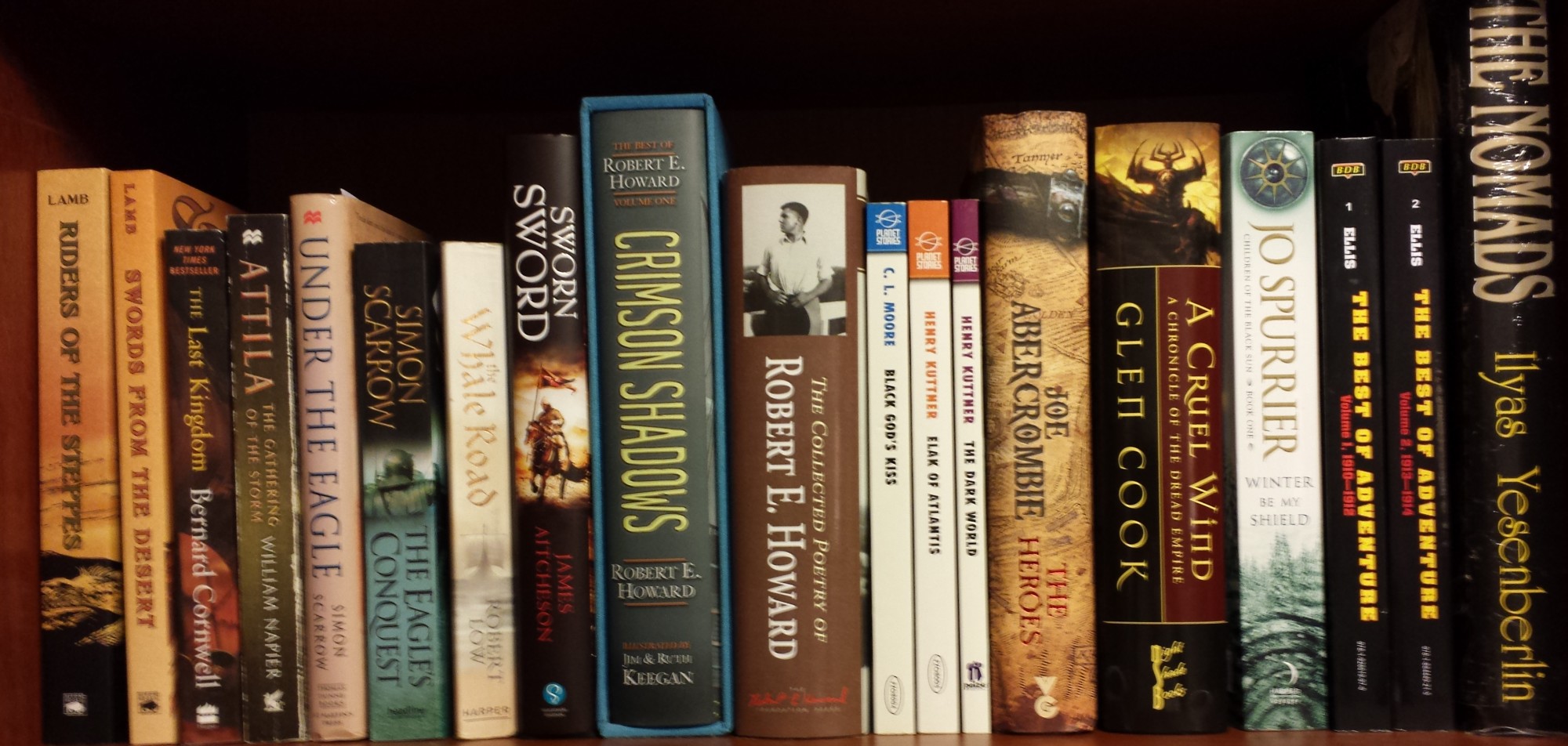
Elak of Atlantis
Henry Kuttner
Planet Stories
$12.95, trade paperback, 224 pgs.
This is the second and final tale of Prince Raynor that Kuttner wrote. I don’t think it’s quite up to the standards of “Cursed be the City”, which I discussed earlier in the week. But it’s still a good yarn.
The story opens with Raynor and his Nubian servant Eblik coming upon a dying archer in the forest. He’s part of a group of refugees they, along with the warrior maid Delphia, had put together after the close of the previous story. Prince Raynor’s horse had gone lame the previous day, and he and Eblik had fallen behind the group. The archer is the only survivor except for Delphia, who has been kidnapped. Raynor and Eblik set out in pursuit.
While waiting for the moon to rise, they are approached in the forest by an old man in a robe. From his description, he sounds a lot like Gandalf, and his name, Ghiar, isn’t that far off. Only this story predates The Lord of the Rings by a number of years.
Ghiar tells them Delphia has been kidnapped by Baron Malric and gives them a talisman by which they can recover the girl. There’s a lot of talk about the zodiac, but it’s a different zodiac from the one today. The signs are different, and there are only seven of them.
Raynor and Eblik go to Malric’s castle and in the commotion of rescuing Delphia, Ghiar shows up and takes off with her. Seems he needs her for a sacrifice in order to renew his youth. Things get nicely weird when they arrive at Ghiar’s castle, which is on an island surrounded by black flowers. Of course they’re the kind that induce sleep. It’s only the thought of Eblik in danger that enables Raynor to overcome their effects.
Once inside there are several fights and eventually they overcome Ghiar. The manner is a little unconventional in that both magic and strength are used. Ghiar’s motivation and actions don’t always make a lot of sense unless you remember his early speech about signs of the zodiac and which ones are in ascendance.
I liked the weird elements in this one, especially the battle with the serpent inside Ghiar’s castle and the consequences of that. The black flowers were a nice touch, if not particularly original. Both of these elements reminded me of Robert E. Howard (which is probably why I liked them). It’s an established fact that Kuttner was influenced by Howard, and many of his early stories show the influence Howard as well as other writers in their contents. Still, if you’re going to copy another writer, always copy from the best.
While the influence of Howard is definitely here, Kuttner by this time was too good of a writer to simply cut and paste another author’s style. Kuttner shows a greater depth in the interactions between Raynor and Eblik than in “Cursed be the City”. Early in the story Raynor calls him a fool and orders him about, something that would be entirely appropriate for a prince to do to a servant. Still, when Eblik needs his aid, Raynor manages to find the motivation to save him where he wasn’t finding the motivation to save himself.
![]() |
| Henry Kuttner and C. L. Moore |
The Raynor stories were both published in Strange Stories in 1939, which implies, given the delays between composition that were common in the pulps in those days, that the first of the two had to have been written in 1938. Kuttner was beginning to transition at this time to science fiction, where he would ultimately write in collaboration with his wife C. L. Moore some of the great classics of the field such as “Mimsy Were the Borogoves”, “The Twonky”, “The Proud Robot”, and “Vintage Season.” Just to name a few. We’ll look at some of these in an in-depth post I’m working on.
It’s easy, and perhaps oversimplifying things, to say that Kuttner wrote no more Prince Raynor stories because the market folded. Strange Stories only ran for 13 issues between 1939 and 1941. But Weird Tales was still going strong. I’ve seen somewhere, and I don’t recall where or I would say, that Dorothy McIlwraith didn’t like the Elak stories and wouldn’t buy any when she became editor of WT. If I’m recalling correctly, the author of that statement was offering it as speculation.
I have a different idea. Kuttner was trying to establish a professional writing career. Weird Tales had a reputation, much deserved, for being slow in paying. And not always paying that well. There were a lot more science fiction markets than there were fantasy. Kuttner didn’t restrict himself to just fantasy and science fiction, but also wrote weird menace and mysteries, and he continued to write fantasy for a number of years, especially for Unknown. However, he had his greatest success in science fiction. It seems to me, and this is just speculation, that Kuttner began to focus on writing more science fiction because he could make a better living at it. The timing of the two heroic fantasy series ending coincides with an increase in Kuttner’s science fiction output and makes the possibility one that should be considered.
“The Citadel of Darkness” ends with the three companions, Raynor, Eblik, and Delphia, riding off together, one supposes to have more adventures. It’s a shame Kuttner never recorded them.
Sale at Norilana Books
The Adventures Fantastic Interview: Mark Finn, Part 1
Then in 2006, a bunch of things happened. Most notably, The Cimmerian magazine that Leo Grin was doing went monthly, and with the monthly schedule came all these finds, all this new stuff. That’s always the case, it’s never gonna be finished because if I wanted to stop right now and add new stuff, I could. But I had to have a cut off point because of the process they were using to do the book. There was a lot of stuff found in 2006, interesting speculations and some cool finds, subsequently, in 2007 and 2008, that weren’t in the first edition. I made a deal with Monkey Brain for the mass market in trade. So everybody was asking if there was going to be a hardcover. I shopped it around to a few people, including Del Rey. They liked the book, but it wasn’t in their cards to do it. They were just really wanting to concern themselves with the fiction. So I went to the Foundation [The Robert E. Howard Foundation] because, again, Rusty and Patrice are still working on their own stuff. Patrice is still preparing texts. They’ve got the boxing and the funny western stuff left to do. So that’s somewhere between six and eight more books if they do it right. Rusty, too, same thing. So I knew that those biographies they’re gonna have are eventually going to come out. But the Foundation could use a biography right now that they could market and sell, so I thought, I’ll just ask them. But I wanted to put in the new information, I wanted to rewrite the last chapter, which is very problematic in the first edition. I wanted to add a bunch of things people asked me about. One of the few negative comments I got on the book was “I really liked learning about all the other stuff, but I kinda wish there were more Conan stuff in there. He doesn’t spend a lot of time on Conan, aannndd I understand why, but it still would have been pretty nice.” With that kind of luxury, with another year to go back through the manuscript, I can clean up a bunch of stuff. Now it’s got 30,000 extra words in it. And all those things have been addressed. All the technical errors and lapses in concentration on my part have been fixed. I’m very happy with it. It’s a little weightier of a book. The last chapter got completely reorganized and feels a whole lot more focused and less chaotic. I would say probably four of the chapters at least have gotten a substantial revision or were completely revised. Another four of the chapters had extra bits and pieces and things inserted into them, so if you’ve read the first edition once or twice, you’ll quickly start hitting stuff where you go, “I don’t remember that from the first time I read the book.” Then you’ll go and get to the sections and go, “Wow, I don’t remember any of this.” That’s the new stuff.
MF: Weirdly enough, yes. (laughs) I want to do a biography of Jack Teagarden, who was a jazz trombonist during the Big Band era. He’s from the town I currently live in, Vernon, Texas. He’s the Jimi Hendrix of the jazz trombone. That kind of sounds like a trite way to say it, but he played the trombone in a way that it was not played before or since. His style was so singular and signature that jazz trombone died when he did. And so he’s largely forgotten by modern jazz aficionados. In the Big Band era, he was kinda on the second tier. People have heard of him, go “Oh,yeah, I know that, trombone, right?” He’s got a pretty big international following still. I recommend him. If anybody is reading this, do a google search for him on Utube and check out how he plays. The guy was a virtuoso. The kind of which, you won’t believe what you’re hearing is a trombone. He’s that good. I want to do a biography of him. I think he’s a fascinating guy. He’s another one of those Texas creators who took two disparate things and combined them to make a unique sound. I use him in the introduction to Blood and Thunder alongside of Howard Hughes and Bob Wills as inventive Texans who were able to take the best of two separate elements and combine them to make something new. He’s one of those kind of guys, and I’m fascinated by those type of guys. Historically, I’m attracted to subjects who displayed that kind of brilliance, maybe even to the cost of their own lives. Orson Wells. Benjamin Franklin. Howard Hughes. Harry Houdini.
Robert E. Howard. These guys, Jack Teagarden, all had this sort of intensity about them, this sort of effortless means of creation that was responsible for why they were the way the were but also made them so flawed and so tragic. I don’t have a timeline on the biography. I’m waiting for a bunch of stuff to come together. I’m probably through writing biographies for a few years. I really want some time to study Teagarden more before I get into it. But, yeah, I definitely want to tackle him. Now I have to be mindful of something. I do not remember who said this, but there’s a very famous quote from a critic. I should now who said this. The quote is writing about music is a lot like dancing about architecture. I’ve got to find a way to write about his stuff, maybe not in a way that you understand it, but in a way that makes you want to listen to it. That’s really the goal. If you’re a jazz fan and you pick up the book, I’ve got to be able to write about what he’s doing in a way that the jazz fan will say “Yeah, he totally nailed it.” And you, who have never heard him at all, will go, “I don’t what he’s talking about but, man, I got to check that out.” And that’s a balancing act. Who knows how long that’s going to take?
The other thing I’ve been working on, I’ve been researching this guy for years, and I’ve finally got the means to put it into a novel form. It’s about Sailor Tom Sharkey, who was an actual golden age boxer from the turn of the century. The story involves him and his adventures. He was a very larger than life character, and the model for Robert E. Howard’s Sailor Steve Costigan, at least in terms of physicality and fighting ability. So for me, what I like about that story is I’ve loved the funny boxing stories for forever. That’s no secret to anybody who’s met me for more than five minutes. And as much as I want to go play in that sandbox, I really have a problem with pastiche authors, particularly the ones who don’t get it. Or “I want to do my thing with Conan.” Well, if you do your thing with Conan, why don’t you go do something else? So I decided that what I wanted to do was something in the funny boxer genre, but not necessarily a Robert E. Howard turn. Because Howard’s sense of humor is not my sense of humor. My sense of humor is different. And it would be bad for me to try and imitate Howard’s sense of humor. This gave me an opportunity to do something really funny in stories with this unreliable narrator, kind of a la Steve Costigan, but not a direct rip off. We’re dealing with somebody who’s at the end of his life or he’s in the twilight of his career and he’s looking back and regretting some decisions he’s made. He decides to go on this vaudeville circuit, which actually happened. What he doesn’t realize is that the vaudeville circuit train he gets on turns out to be a quest for a golden belt he left back in New York City. Things get pretty weird after that. By doing a kind of fantastical historical, that’s something that Howard never did either. His funny boxing stories are pretty straight up. Definitely it owes a great debt to that work, but ultimately I’ve moved to where I feel far enough away from it that, again, only people who’ve read the boxing stories will go, “You know, that was a Costigan flourish.” I think everybody else is gonna read it and go, “Where the hell did you come up with this guy?” And I’m gonna have to tell them, he’s straight out of history. That’s a work in progress. I hope to have that done this year and shopped around.
If you want a taste of it, we’ve got a short story collection coming out here that will be ready before Howard Days. It’s called Dreams in the Fire: Fiction and Poetry Inspired by Robert E. Howard. It’s actually a REHUPA project. Current and former REHUPAns have donated stories to this anthology. And we got a couple of ringers in there. Bob Weinberg did a story for us; Don Herron has a good poem in there. The whole thing is a fiction anthology in the vein of Robert E. Howard. Everybody had different characters and different concepts. We’ve got some pirate stuff. We’ve got some American frontier stuff. We’ve a Sailor Tom Sharkey story. All kinds of things. The entire book will be sold online, through the usual outlets, also through the gift shop [at the Robert E. Howard House]. And all the money goes to Project Pride. So it’s going to be our fundraiser book from REHUPA. And we’ll keep that active for a year, and all the profits we’re going to give over to the Howard House to let them continue the good work and keep the place up. So hopefully I’ll have that out by mid-May, if not sooner. That’s in the final stages. Really, right now between the novels and some more comic work that’s coming down the pipe, I’ll have quite a few things out this year. I’m looking forward to having all this out and published.
Henry Kuttner’s Prince Raynor: Cursed be the City
Elak of Atlantis
Henry Kuttner
Planet Stories
trade paperback, 221, $12.99
In addition to the four Elak stories collected in this book, the only two stories Kuttner wrote about Prince Raynor are also included. These stories were published in Strange Stories, a rival of Weird Tales published by Better Publications. Started in 1939, this pulp was often seen at the time as a dumping ground for stories rejected by Weird Tales. It only lasted until 1941.
In a way I prefer the Prince Raynor tales to those of Elak. They are set in a more recent prehistory, one in which the ancient kingdoms we know existed are beginning to take shape, rather than some mythical past. As a result, any anachronisms are less glaring. Also, the prose is leaner and more polished than in some of the early Elak tales, especially the first one, “Thunder in the Dawn”.
Both “Cursed be the City” and its sequel, “The Citadel of Darkness”, open with quotes from something called “The Tale of Sakhmet the Damned”. What this is exactly, we’re never told, nor does anyone named Sakhmet ever appear. It’s a nice touch, though.
The story opens with the fall of Sardopolis, capital city of the kingdom of Gobi. The king is killed by the conqueror Cyaxeres, and the king’s son Prince Raynor is taken to the dungeon to be tortured. Cyaxares has a companion and adviser, Necho, who may not be human. Raynor is rescued by his Nubian friend and servant Eblik. Together they make their way to the temple of Ahmet. There a dying priest tells them that when Sardopolis was founded, a great forest god was displaced, but it was prophesied that he would one day return to set up his altar again in the ruins of Sardopolis. That day is at hand. Raynor and Eblik are given the task of going to a group of bandits led by the Reaver of the Rock and informing them of the fall of Sardopolis. They’ve been waiting for generations for the old god to return.
Cyaxares’ men follow them. The Reaver and his men stay to fight. Raynor and Eblik, guided by the Reaver’s daughter Delphia, a formidable fighter in her own right, take a talisman to free the forest god. Most readers will recognize the name of the forest god.
The story moves well and has a satisfying, if not exactly upbeat, resolution. In fact, the story ends on a pretty dark note.
Kuttner continues to break from pulp conventions here. Eblik is more than just a black sidekick, and Delphia takes an active role in the events. The tone and feel of this story, as well as that of “The Citadel of Darkness”, is much more Howard-esque than the Elak stories. In those, Kuttner tended to play the sidekick Lycon for comic relief. None of Howard’s fantasy heroes had true sidekicks, although at times they had companions, who were treated as equals. In the Prince Raynor stories, while Eblik may be a servant, and upon occasion is reminded that he is, he’s still portrayed as a companion, not a stereotype to be played for laughs. This was an uncommon portrayal of someone of African descent in the pulps of this era.
By this time C. L. Moore’s Jirel of Joiry had made her appearance, so a strong active woman wasn’t exactly groundbreaking. Still, to cast Delphia as a competent fighter and one of the leaders of the bandits was a departure from the typical standards of the day.
So to sum up, if, as some have stated, Kuttner was trying to fill the void in sword and sorcery stories left by Robert E. Howard’s death, I think he succeeded more with Prince Raynor than with Elak. It’s unfortunate that he only wrote two stories featuring the character. We’ll look at the other tale in a future post.
Need a New Place to Live?
Make sure to read the ad in the hypertext as well.
What is Best in Life?
Odds and Ends
I want to take a moment to thank everyone who’s visited Adventures Fantastic, especially in the last couple of weeks. Traffic seems to be picking up, and I appreciate your interest, support, and comments. I’ve got some cool things planned for the next couple of months, including a two-part interview with Robert E. Howard scholar Mark Finn, some Long Looks at Short Fiction, a review of Jasper Kent’s Thirteen Years Later, a look at Henry Kuttner’s Prince Raynor stories, and some more Kull. So stick around. It’s only gonna get better.
E-Book Prices: A Not-So-Brief Rant
I was browsing in the local Barnes and Noble over the weekend. There were a number of books there in multiple genres that looked intriguing (no big surprise). One in particular seemed to be a really good fit for this blog. It was a new release in mass market paperback, and no, I’m not going to tell you the title. I’ll refrain out of respect to the author. You’ll see why in a minute. It appeared to be something that would move quickly to the top of the TBR pile, both because it looked like something I would really enjoy as well as something the people who read this blog would be interested in.
Now, before I go any further, you need to understand something to get some context.
After moving to the house where we currently live, we had to make a decision about what to put in storage since this house is considerably smaller than the previous one. Over half my library is currently in boxes. Much of what isn’t probably should be for the simple reason that I don’t have much space. As in literally none. I don’t have room in the house to bring more books in. The shelves are spilling over, and my wife is starting to complain about tripping over the stacks on the floor. Which is why I got an ereader, specifically a Nook, because B&N is just down the road. When I buy a paper book, I need to clear space by either taking one (or some) to storage, selling them, or giving them to friends. I will still buy paper books from a few writers, either because those writers are ones I want to read in physical copies or because I want them signed. Also, there are some books that don’t have electronic editions, especially if they’re from small presses. But with those exceptions, all of my book buying for the foreseeable future needs to be in electronic format.
I’ve got my Nook with me at B&N, so I check to see if there’s an electronic edition of this particular book. Yep, sure enough, there is.
It costs the same as the paper edition.
Which means it will cost me more than the paper edition, because with a B&N card, I get a discount on the paper copy. While annoying, it’s not so surprising. I don’t have a problem with a business model in which electronic copies are similar or even identical in price to the paper copies initially, with the electronic copies dropping in price over the course of the next few months. I probably won’t buy the electronic copies until they’ve dropped in price. Not just because I’m cheap, but I’m so far behind on my reading that usually it takes a couple of months before most new books rise to the top of the TBR pile. So why not wait and pay the lower price? If I want the book so badly that I buy it when it’s first published, it’s probably one I would want in paper.
But that model not what I see happening. Most of the major houses that I’ve checked aren’t lowering the price of the ebooks after a few months, at least not by very much. Now, I admit I haven’t done anything even approximating a scientific survey. But looking at the things I read and the types of books I buy, I don’t see a lot publishers pricing their electronic copies much differently than their paper copies. (Angry Robot seems to be an exception.) For example, I would love to have the Del Rey Robert E. Howard collections in electronic format. That way I could read whichever story I wanted to wherever I am as long as I have the Nook with me. All of them as of this writing are either $12.99 or $13.99. The exception is the newest collection, Sword Woman, which is only $9.99. I have no idea why that one is priced so low now, because I bought it electronically when it was published a few months ago and paid $12.99. And, yes, I hear what you’re saying: I can get other electronic editions of Howard’s work. But I want the Del Rey editions because those are the ones that have the corrected texts, the alternate drafts, and the fragments, as well as other material. My point is I think these books are priced a little high.
I realize supply and demand, author popularity in other words, comes into play. I’m okay with that. A publisher expecting someone to pay more for a popular author than for an unknown is not unreasonable. That’s the way the free market works. It’s not just someone like Howard, an author has been around for a while and has a solid fan base that isn’t going to go away, whose books are being overpriced. I’ve looked at a number of titles from a variety of publishers, and most of them are priced the same as the paper editions or maybe a dollar less. (I’m talking mass market paperbacks here; electronic versions of books only available in hardcover are usually about half the hardcover price. But hardcovers are luxury items.) And not all of these titles are recent. And not all of the authors are well known. There are several first novels that look appealing by people I’ve never heard of before that have the same price in electronic and paper formats.
Before you conclude I’m one of these people who think ebooks should be priced at one or two dollars, I’m not. I don’t have a problem paying between $5 and $10 for an electronic version of a book, although I naturally prefer the lower end of that range, provided the paper copy is considerably more expensive. I see no reason to pay the same price for an electronic book as I do a paper copy, no matter what the price is on the paper copy. There’s no reason I should. There’s still editing, copy-editing, layout, cover art, and similar costs no matter what the format. These all need to be taken into account when pricing the book, which is why I don’t think one or two bucks is a reasonable price for many ebooks, especially those coming from major publishers. But there’s no printing costs, no shipping costs, no warehousing costs for electronic books. I find it hard to believe a dollar difference between electronic books and paper books covers all the cost of printing, shipping, warehousing, etc. The publishers shouldn’t expect me to pay for the rent on their Manhattan offices by gouging me on the price of the ebook.
If most of the difference in production costs between electronic and paper books went to the author, I would have a different opinion. But it doesn’t, and so neither do I. See J. A Konrath’s analysis for some numbers to get an idea of how much money most authors see on your average ebook compared to how much the publishers get.
So I find book I want to read, one that has an electronic version priced at or near the price of the paper version. I have some choices. I buy the paper copy, but with the spatial and spousal limitations I have, that’s not an option I can use very often. Let’s assume it’s not in this case, which is a safe assumption. I can buy the ebook, and sell out my principles, letting the publisher manipulate me to pay a price I think is too high. I have a really difficult time doing that. Or I can take what’s behind door number three, as they used to say on the game show Let’s Make a Deal. I can pass on buying the book and wait for a copy to show up in a used book store.
That last would be my default option except for one thing. There’s a writer who won’t get paid for the book. As an aspiring writer myself, I have as big a problem with that as with the first two options. I realize not everyone does. If the average book buyer thinks the cost of an ebook is too high, they won’t buy it. There’s more than enough to read out there that’s priced lower. More good and interesting stuff than any one person can ever read in an entire lifetime. With the internet connecting second hand book dealers with customers miles away, a reader can find the book he or she wants at a lower price by exercising a little patience.
And that’s where I think big publishing is going to hurt itself. By pricing itself out of the market. Publishing is very much a free market right now in the sense that customers have power and the publishers don’t. We have power, like I stated, to wait, read something else, or get it used. That power is only going to increase as more authors begin to self-publish, both backlist titles and new books, and price their books significantly below what publishers are charging. Readers are going to expect a certain price range on books, and books outside that range aren’t going to sell. With the cost of fuel rising and driving everything else up along with it, book buying is going to become more of a luxury. I know it is for me. That means that higher priced ebooks are going to be less attractive to readers. And the trend will probably get a lot worse before it gets better.
We need more variety in fantasy and science fiction, in detective fiction and historical adventure. Not less. There’s too much lowest common denominator crap on the shelves as it is. That means more writers need a way to get their books to readers and still make enough to keep writing. That won’t happen if their books, print or electronic, don’t sell. The publishers will drop them like hot rocks. And more voices will be silenced. More careers will end far too early. And everyone, readers and authors and publishers, will all be the poorer for it.
Oh, and if you’re wondering what I decided about that book I really want to read and review for you here? I’m still thinking about it.