Author Archives: Keith West

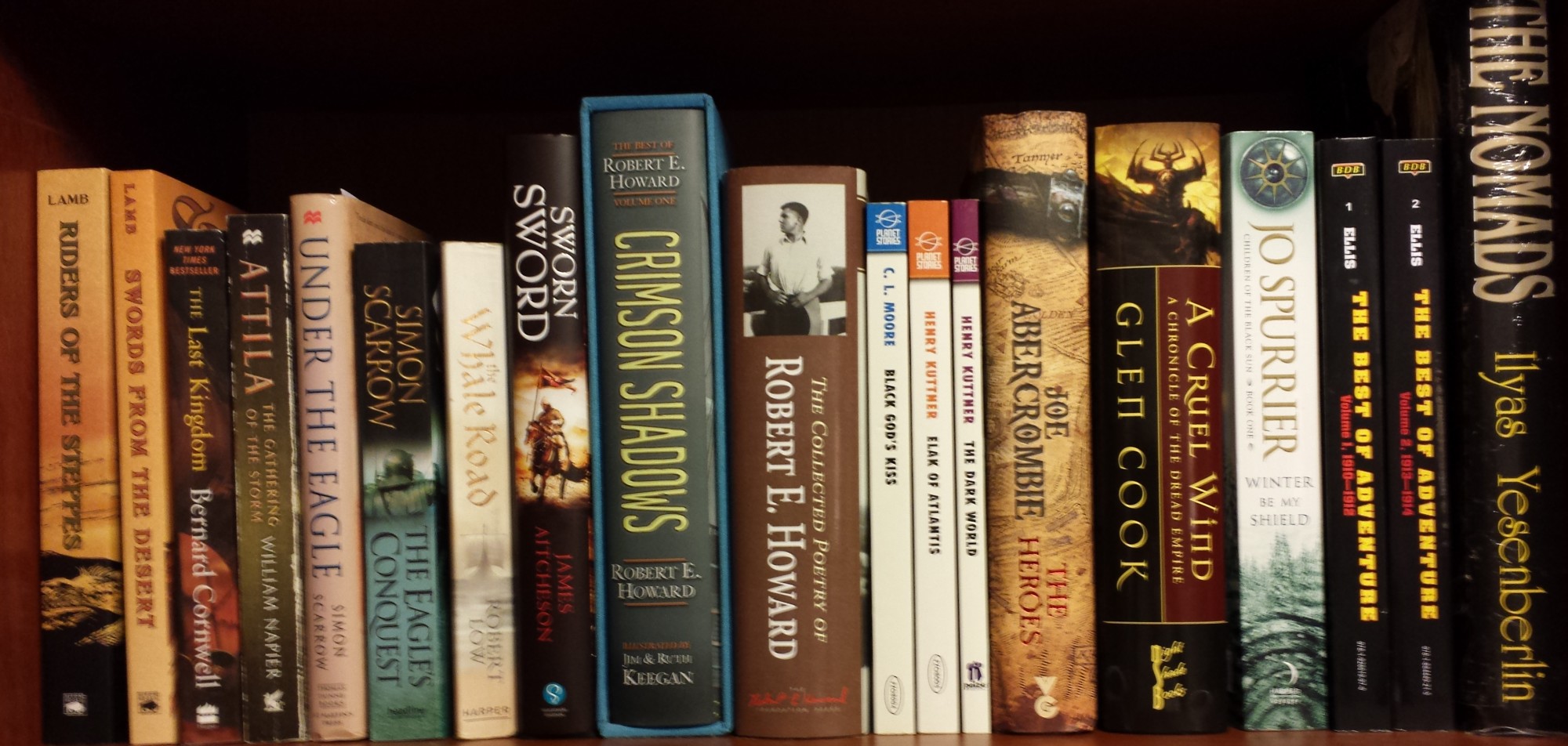
Kuttner’s Elak of Atlantis: Dragon Moon

“Dragon Moon” from Elak of Atlantis
Henry Kuttner
Planet Stories – Paizo Publishing
Trade Paperback, $12.95, 2007

“Dragon Moon” is the last of the Elak stories Henry Kuttner wrote.  It got the cover of the January 1941 issue of Weird Tales.  I was browsing recently on the Dark Worlds site and discovered that all but “Thunder in the Dawn” got the cover.  I shouldn’t say “discovered” so much as I was reminded.  I had seen all three of the covers featuring the Elak stories before and should have remembered them.  Rather than reproduce the rest of them here, I’ll let you view them over at Dark Worlds.  G. W. Thomas has put together an interesting website, and you owe it to yourself to check it out if you haven’t already. 

“Dragon Moon” opens very much like “Thunder in the Dawn”, with Elak and Lycon becoming involved in a brawl over a tavern wench in the port city of Poseidonis.  Once again the druid Dalan saves Elak and tells him his home kingdom of Cyrena is in danger.  At this point, the two tales diverge in their similarities.  An alien presence, not a demon or a spirit, but an alien presence (Dalan is quite clear on this point) called Karkora the Pallid One has taken over the mind of the ruler of the neighboring kingdom of Kiriath.  Karkora had begun to take over the mind of Elak’s brother Orander.  In order to prevent this from happening, Orander has taken his own life.  Elak is now heir to the Dragon Throne and the kingdom of Cyrena.  Kiriath is assembling an army to invade Cyrena.

Elak has no interest in ruling and sends Dalan away.  That night Elak has a strange dream in which he finds himself on a cold mountaintop being assaulted by a presence.  He is only able to escape by calling on the aid of his god.  This is a complete departure from Conan, who is well documented in his practice of not calling on gods and whose deity Crom hates weaklings.  Elak doesn’t give it a second thought.

This is the first dream sequence (or dream-like at least) in the story and is fairly short.  Unable to find Dalan, Elak and Lycon hire a skiff to take them to a boat that is just setting sail for Cyrena.  Upon climbing up the side and over the rail, they discovered the ship is captained by a man named Drezzar.  The same Drezzar Elak was fighting in the opening scene of the story.  He and Lycon are immediately taken captive and put to work at the oars as slaves.

This sequence, in which Elak is captured and eventually leads a slave rebellion, is the part of the story that most reminded me of Conan.  It’s a straight action-adventure sequence which ends with Elak assuming the captaincy of the vessel.

The next truly weird part of the story occurs after Elak has been instructed by Dalan in a dream to leave the ship at a certain location.  He eventually ends up seeking aid from a sorceress named Mayana.  She is the mother of the current Kiriathan king and a descendant of Poseidon.  In reaching her, Elak has to swim across a lake inhabited by the shades of a drowned city.  This is the closest Kuttner comes to including a bizarre otherworldly sequence of the intensity of the ones seen in the earlier stories.

Mayana is by far the most interesting character.  She fell in love with the former king of Kiriath and bore him a son with the aid of a sorcerer named Erykion.  He’s ultimately responsible for the Pallid One possessing the current king of Kiriath, who is Mayana’s son.  She holds the key to stopping her son, but is reluctant to aid Elak because it will mean her son’s death.  Yet, she also realizes that this is the right thing to do.  She withholds her aid but promises to give it to Elak in his hour of greatest need.  Mayana, in spite of being a child of the sea and not human, has fallen in love with the forests and fields of the land and longs to be able to walk them once again.

There’s more, but I won’t spoil it for you, except to say this.  It appears that Kuttner was intentionally ending the series with this installment.  Elak ascends the Dragon Throne and agrees to change his wandering ways, to settle down and rule.  While kings can certainly have adventures, (Kull and Conan did, after all) the tone implies Elak the king will have a more quiet reign than his predecessors in Weird Tales.  The ending of the story is the most bittersweet one of the entire series.

Whatever reasons Kuttner had for terminating Elak’s adventures, he ends the series on a high note.  The writing is probably the most polished of all the Elak stories.  The action flows smoothly.  I found the characters to be better developed, especially Mayana, who is by far the most complex of any of the characters in the series, especially given the amount of time she is actually in the story.

“Dragon Moon” was published in the January 1941 issue of Weird Tales.  “Beyond the Phoenix” made its appearance in the October 1938 issue.  That’s a gap of over two years.  All of the preceding Elak stories were published in 1938.  I’m not sure why there was such a long break.  The two Prince Raynor stories were published in Strange Tales during those two years.  It appears as though Kuttner left the character and came back to him, although that’s entirely speculation on my part.  Did Kuttner feel that his writing had matured since the first Elak story (it had) and want to try his hand at a different sword and sorcery setting?  Did Raynor not connect with the readers?  Did Kuttner submit “Dragon Moon”  in late 1938 or early 1939 and Farnsworth Wright delayed in scheduling it so that Kuttner had to create Prince Raynor for another market?  Hard to swallow considering all but one of the Elak stories got covers and Wright published Conan in a number of consecutive issues.  I don’t know the answers to these questions, but they’re interesting to think about.  If anyone out there knows why “Dragon Moon” was published later, I’d like to hear the answer.

So, to sum up the Elak of Atlantis series.  While the first has some definite flaws, the quality improves over the series.  While comparisons to Conan are inevitable, and most of them will probably be unfavorable comparisons, Elak is his own character.  He seeks help from the gods.  He is an adventurer by choice.  You can argue that Conan is as well, but the backgrounds of the two men are vastly different.  Elak turns his back on a throne before ascending it.  Conan, who has no such prospects due to his birth, makes his own opportunity.  This series, while maybe not a major sword and sorcery series, is certainly one worth reading.  Kuttner was expanding the genre, giving it a more weird and bizzare feel through the scenes where Elak goes to another realm, be it extra dimensional or in a dream.  To my knowledge, at this time only C. L. Moore had done that with her Jirel of Joiry adventures.  So, in conclusion, if you haven’t read the Elak stories, check them out, especially the second, third, and final tales.

We’ll look at the Prince Raynor stories next and see how they compare to both Conan and Elak.

Status Report

Well, finals are done and the grades are in.  It’s all over but the crying (in some cases literally) and the shouting (at me by students enrollees who didn’t come to class, do homework, pass tests, or simply make the grade and think they are entitled to an A).  I’m going to get some sleep and try to post tomorrow.  I’ll be on the road some for the next few days and then the holiday travel starts.

As for what’s up, I’m almost through reading for a post I’m going to do on Rogue Blades Entertainment.  I probably won’t get that one up until sometime next week.  I’ve read the last of the Elak stories by Henry Kuttner and will discuss it, I need to look at Jonathan Strahan’s ToC and see if I can determine where all his selections came from, print or electronic sources, and continue that discussion, and I’m going to start reading for a long post about some of the collections of Henry Kuttner that are available.  I’ve also picked up a fantasy or two by writers who are new to me that I want to read, as well as some historical fiction.  And I want to reread Robert E. Howard’s Kull stories.  It’s been a while since I last read them, and I want to look at them with (hopefully) wiser eyes.

That should keep me busy for a while.

Electronic Markets

I was browsing the Black Gate website the other day when I came across the post announcing that Matthew David Surridge’s “The Word of Azrael” had been selected for inclusion in the forthcoming The Year’s Best Science Fiction and Fantasy 2011 edited by Rich Horton.  Congratulations to Mr. Surridge.

The thing that intrigued me, though, was when I followed the link to the table of contents and perused the titles, and more to the point, the sources of these stories.  There are 28 titles listed, along with the venues in which they saw print.  Or rather were published, with that term being defined to include electronic media.  Of the selections Rich Horton chose as the best of the year (always a subjective list, as a perusal of the contents of the respective volumes in any given year will demonstrate), fifteen of them were published in electronic format in seven different venues:  Apex, Clarke’s World, Fantasy Magazine, Lightspeed, Strange Horizons, Subterranean, and Tor.com. Fantasy and Lightspeed each had four stories.  Tor, Apex, and Clarke’s World each had one.

Several anthologies were represented with single stories.  Among the big three of the print magazines, F&SF and Asimov’s each made the list with 3, while what is the magazine with by far the largest print circulation, Analog, didn’t make the list at all.  Neither did Realms of Fantasy, Interzone, Postscripts, or Weird Tales.  I find this interesting, especially given the much publicized death and resurrection of RoF last month and the various comments about why  it died posted several places on the web. 

The ToC of Johnathan Strahan’s The Best Science Fiction and Fantasy of the Year hasn’t been released yet, even though it has a March release date, nor have the contents of the Dozois or Hartwell and Cramer volumes, which typically hit shelves in the summer (although this year’s fantasy volume is still listed as forthcoming on Kathryn Cramer’s blog).  It will be very interesting to see where they chose their selections from, mostly print, mostly online, or about an even mix.  It will also be interesting to see whether the heavy- and middle-weights that didn’t make Horton’s cut make fare much better in the other volumes. 

There’s no doubt we are seeing a major change in the publishing of short fantastic fiction.  Not only are there more electronic periodicals out there than ever before, the print magazines may be seeing their first circulation increases in years thanks to Kindle, Nook, and other e-readers.  I for one am not about to try to predict where the trends are heading, for one reason because things are changing so fast that by the time some trends become evident, they’ve mutated into something else.  I will keep as much of an eye on things as I can, and you can bet I will write about them here.

Blogging the Future

Anyone who has much knowledge of the science fiction field knows the name of Frederik Pohl.  He’s been a fan, an agent, an editor, and a writer since before World War II, although not necessarily all at the same time.  This past year he won his seventh Hugo.  Back in the 70s several members of the Futurians, the famous (some would say infamous) fan organization, wrote memoirs.  Fred’s was called The Way the Future Was.  Well, that book has been out of print for quite some time.  But in recent years Fred has taken to blogging, with a blog aptly titled The Way the Future Blogs.   He’s been more active than usual of late, with some reminiscences of Judith Merrill posted over the last few days.  If you have any interest in the history of science fiction, especially written by someone who not only was there but helped shape much of it, this is one of the blogs you ought to be reading.

Smorgasbord

As the Christmas season is fast approaching, and has been for the last eleven months or at least feels like it anyway, people are beginning to think about parties.  And one of the things you often find at parties is a smorgasbord of delectable goodies.  Since I can’t serve you any food, I thought I’d offer up a different kind of smorgasbord, or a more literary nature.

So here’s a little list of a few items for your Christmas lists you may or may not be aware of.  This list is in no way intended to be inclusive.  Some deal with fantasy and some with pulp in general.  I offer the list with brief descriptions but no detailed comments since I haven’t had time to read more than one or two stories, if that, from any of these.

The Last Hieroglyph, The Collected Fantasies v. 5
Clark Ashton Smith
Night Shade Books
376 p. $39.99

A few years back, like say in 2004 or so, when I preordered my set, Night Shade announced they were doing a multi-volume collection of the fantasies of Clark Ashton Smith.  This is the final volume, which was just released a few weeks ago.  The stories are in the order of their composition rather than order of publication or by theme or setting as some earlier collections have, such as those edited by Lin Carter for the Ballantine Adult Fantasy series in the 1960s and 1970s.

Strange Wonders
Fritz Leiber
Subterranean Press
280 p. $40 (trade edition)
This is the book for the Fritz Leiber fan in your life, even if that fan is you.  Especially if that fan is you.  This is a collection of drafts, early stories, and poems by one of the greatest practitioners of sword and sorcery, science fiction, and horror who ever lived.  There was a limited edition of the book, but it is out of print.

The Year’s Best Dark Fantasy and Horror 2010
Paula Guran, ed.
Prime Books
575 p., $19.95
Unlike the much missed Datlow-Windling (later Datlow-Grant-Link) annual collections of fantasy and horror, this one limits itself to dark fantasy, with none of the more upbeat subgenres represented in those volumes.  I’m not familiar with Paula Guran, but having read the introduction and the afterwards to the few stories I’ve managed to ssteal time to read, I’m going to be watching for her name on a cover. (The books skips the traditional editor’s introductions and replaces them with afterwards.)

Best American Noir of the Century
James Ellroy and Otto Penzler, eds
Houghton Mifflin Harcourt
731 p. $30 list price.

Ellroy and Penzler have killed a lot of trees to bring you this book.  Which happens to have a few killings in it.  While there isn’t a story for every year of the 20th century, there’s a lot to go around.  Penzler’s introduction about how noir is the antithesis of the private detective story points out some differences between the two types of story.

The Black Lizard Big Book of Black Mask Stories
Otto Penzler, ed.
Vintage
1136 p. $25 list price

Proving he’s just a good an editor at disreputable pulp as he is at respectable noir, Penzler has put together a collection of stories from the legendary pulp Black Mask.  With over a thousand pages, this is the largest collection of tales from Black Mask.  The stories are reproduced exactly as they appeared including illustrations.  Add a cover showing a moll with a grimace, a tommy gun, and a blazing roscoe, and what’s not to love?

Thanksgiving Greeting

I just wanted to wish everyone who checks in here over the next few days a Happy Thanksgiving and safe travels if you’re going to be away from home for the holiday.  I’d also like to issue my followers an additional thank you for your support.

I’ll be traveling, so my opportunities to post anything will be limited.  My dayjobbery consists of academia, so as the old Andy Williams song says, “It’s the most hap-happiest time of the year.”  Not! Time will be quite limited over the next few weeks.  I’ve got exams to grade over Thanksgiving and finals coming up after that.  I’ll try to post as much as possible, but most things that go up will be short.  I’ll be doing an intermittent series of in-depth looks at various small presses and other venues for heroic fiction over the next year.  The first one will be Rogue Blades Entertainment.  I should have it up by the end of the year.  Heroic Fantasy Quarterly will probably follow.  I also intend to examine some more historical adventure novels, including a trilogy that as far as I know hasn’t appeared in the States, look at some fantasy that was well known in its day but hasn’t been in print for a while, showcase some of the collections in what is starting to look like a Henry Kuttner renaissance, and of course, review any new volumes of Robert E. Howard.  So stick around.  It’s gonna be good!

A Song Worth Singing

Winter Song
by Colin Harvey
Angry Robot
mass market, 407 p., $7.99

In Britain, the robots are angry.  I’m not sure why they’re angry, but they are.  So angry, in fact, that they are planning world domination.  They say so, right there in their books. 

The conquest has already started.  First Britain, then earlier this year, America.  Walk into any decent bookstore and you’ll find a number of books from Angry Robot on the shelves.  I first heard of this imprint earlier this year.  The only name I recognized on their list was Lavie Tidhar, although I’ve since learned that Chris Roberson and Tim Waggoner have been added to the lineup.  Roberson I like, a lot, and will feature here at some future point.  The only thing I read by Waggoner (a horror writer) I didn’t care for; too sick and twisted for my taste.

I’m going to be looking for more of Angry Robot’s stuff.  And not just because I liked this book.  On the back of every one of Angry Robot’s books I’ve picked up, there is a list of books you might enjoy if you enjoyed that one.  On the back of Winter Song we find the following volumes:  Seeker by Jack McDevitt, Spin by Robert Charles Wilson, and Helix by Eric Brown.  Now McDevitt is one of my all time favorites, as is Wilson, and Brown is rapidly becoming so.  I haven’t read Spin yet, but only because I missed it in hardcover.  The thing  that impresses me about Angry Robot providing these lists is that the books aren’t just by them.  The McDevitt was published by Eos, the Wilson by Tor, and the Brown by Solaris, if memory is correct.  To recommend your competitor’s books takes a lot of class.

Anyway, the story here is old fashioned science fiction adventure.  Karl Allman is cutting through what he believes to be an empty star system on a delivery run when his ship is attacked.  The ship’s AI, callled Ship, manages to eject Allman on a trajectory towards a planet on which Ship’s records show a partially terraformed colony was abandoned centuries before at the beginning of the Long Night.  The Long Night was a conflict between the Terraformers (name self explanatory) and the Pantropists, who wanted to reshape humanity.  Just why there are ships in this system is a question that is never answered.

This particular system is the Mizar system, a multiple star system.  It was colonized by a group from Iceland wanting to maintain their culture.  All of the planets have Icelandic names.  The planet, Isheimur, which is Icelandic for ice world, lies just outside the habitable zone.  Any survivors will be struggling to maintain that designation, as opposed to the title deceased.

Karl Allman manages to survive reentry, but not without damage.  Before Ship was destroyed, it downloaded into Allman’s brain a portion of a backup AI.  Unfortunately, the download wasn’t completed, and it is the personality that is in control when Karl wakes up.  If yo imagine a superintelligent child with no social skills, you probably have a good idea of the AI’s personality.  There’s a reason the colonists who find Karl name him Loki.

The chapters in the first part of the book alternate viewpoint characters.  The other two viewpoint characters are Ragnar, the chieftain of a settlement, and Bera, a young woman who was taken in by Ragnar as a young girl.  Ragnar to a large degree is a product of his environment, harsh and unfeeling in many ways.  Bera is treated like chattel by most of the members of Ragnar’s household, especially by his daughter Hilda.  Bera has recently given birth to a child out of wedlock and refused to name the father, for reasons we eventually learn are sound.  Because of her silence, she is denounced as a whore and the child left outside to freeze on Ragnar’s orders.  I told you he was harsh, but then so is the law of survival on this planet.  Ragnar’s actions are completely legal.

Karl lands shortly after Bera’s son has died, and she is given the chore of restoring him to health.  By rescuing Karl, Ragnar has placed on him a debt of repayment.  It doesn’t help matters that Karl and Loki, unaware of each other at first, switch back and forth as the dominant personality.  And Loki has all of Karl’s desires, but none of his socialization or self control.  Can you say “sexual tension”?

Ship had sent off a distress call just before being destroyed, and Karl wants to find a population center so he can send a followup message.  He doesn’t realize he is in a population center.  I won’t say too much more, because I recommend this book and don’t want to spoil all the surprises for you.  Needless to say, there’s more to the history of Isheimur than any of the settlers suspect.  The Winter Song of the title plays into this history. 

Harvey does a good job of showing the problems inherent in a small population struggling to stay alive in a harsh environment in which it has no long term prospects. He shows how the climate has influenced the culture that has developed as well as the internal politics, both strength based and sexual, that arise in a small group of people with what essentially amounts to an elected dictator as leader.  He also does a masterful job in one portion of the book of giving a tour of the environment on the planet, including the fauna.  There are some surprises here.  MAJOR SPOILER:  I especially liked that the other colonists, you know, the ones the Icelanders don’t realize are there, were from Kazakhstan.

Not all the questions are answered.  For one thing, as one of the characters points out, there’s an awful lot of activity in a supposedly abandoned star system.  Why?  The book ends on something of a cliff-hanger.  Harvey gives us a glimpse of the wider universe, but only a glimpse.  I want to know more.  His latest book just hit the shelves a few weeks ago.  Damage Time is a near future thriller.  I plan on picking it up.  But I want to know more about Karl Allman’s wider universe.  Hopefully Colin Harvey will show us some in a future book (or books, hint, hint, Colin).

In the meantime I’m going to await the coming of our robot overlords.  I should probably find something appropriate to read.  Maybe Lavie Tidhar’s The Bookman, or Kell’s Legend by Andy Remic.  Hmm….which to choose?

Further Thoughts on Story

Recently I posted my thoughts on why story is important, especially in short fiction.  Earlier today I came across this column from Kristine Kathryn Rusch, in which she discusses the importance of story and why it needs to be first in fiction.  Kris, in addition to being the former editor of F&SF, wrote a column for Jim Baen’s Universe until that venue closed.  The powers-that-be at Baen moved the column over to The Grantville Gazette, the online magazine for the 1632 universe.  Her columns don’t necessarily related directly to 1632, but they’re worth checking out.  Anyway, Kris has the credentials to know whereof she speaks and does so eloquently.

The Fantasy Fan

Over at the REHupa and REH:  Two Gun Racontuer sites, Damon Sasser recently made an announcement about Lance Thingmaker’s publication of the entire run of The Fantasy Fan in facsimile.  This was one of the earliest fanzines, running for 18 issues from September 1933 to February 1935.  The list of contributors reads like a Who’s Who of fantasy from the heydey of Weird Tales.  People like Robert E. Howard, H. P. Lovecraft, Clark Ashton Smith, August Derleth, Forrest J. Ackerman.  The editor, Charles D. Hornig was a high school student at the time.  His work on The Fantasy Fan caught the attention of Hugo Gernsback, who hired him to edit the pulp Wonder Stories.  Eric Lief Davin published two interviews with Hornig in Pioneers of Wonder (Prometheus Books,1999 ).

Damon quotes from Lance’s introduction, so I won’t repeat that here.  My copy came a couple of days ago, so instead I’ll talk about the book itself.  Original copies of the zine were scanned and have been reprinted as they appeared, with only minor touch-ups to improve legibility.  All the typos and errors are still in place.  The binding is hand-sewn.  This is clearly a labor of love. 

It’s a common practice of libraries to collect runs of periodicals and have them bound in hardcover.  The bindings are usually plain, with simple lettering.  That’s the effect here, except the result looks much better than the typical library binding.  I know partly because I’m looking at two examples on the shelf as I’m writing this:  Unknown October 1941-April 1943 and Astounding Stories January-November 1932.  (Yes, some of the old pulps did manage to make it into library bindings.)

So, what’s it like to read old copies of one of the most influential fanzines of all time?  Well, I can’t rightly say because I haven’t read the thing.  It just arrived a couple of days ago, and I’ve been swamped this week.  I have perused it, however.  This is not a book I’m going to rush through.  It’s one I’m going to savor.  Robert E. Howard’s “God’s of the North” was first published here.  (This was a rewrite of “The Frost Giant’s Daughter”, an early Conan storied that had been rejected by Farnsworth Wright.).  Lovecraft’s Supernatural Horror in Literature is here as well.  Poetry by Lovecraft and Smith.  Fueds in the letter columns by names you would recognize, such as Ackerman.  Columns by Julius Schwartz and Mort Weisinger.  A cornucopia of great stuff.

If you’re interested in Robert E. Howard, or H. P. Lovecraft, or Clark Ashton Smith, or Robert Bloch, or the history of early fandom, then this is probably the must-have book of the year.  The book is limited to 200 copies and only costs fifty-five bucks, including shipping.  A bargain at twice the price (no, Lance, that doesn’t mean I’m going to send you more money), I can’t imagine this one staying in stock long. If I were you, I wouldn’t wait for Santa to bring one.  That might be too late.

There’s no web page for The Fantasy Fan, but you can order it directly from Lance Thingmaker.  Just send him a email.  You’ll be glad you did.

Long Looks at Short Fiction: Skull-Face by Robert E. Howard

Tales of Weird Menace
by Robert E. Howard
The Robert E. Howard Foundation Press
Ordering Information Not Yet Available

The Robert E. Howard Foundation has, in the few short years of its existence, done a number of good things.  Such things as helping maintain the Robert E. Howard House in Cross Plains, Texas, and providing an annual scholarship to a graduating senior from Cross Plains High School.  As part of the Foundation’s mission, a number of works by Howard are being reprinted, including his collected letters (in 3 volumes) and a giant volume of Howard’s collected poetry.  The latter title has gone through three printings and is currently sold out.  Sales of these and other books help fund the philanthropic activities of the Foundation.

Next up on the Foundation’s schedule is the volume you see to the left.  This collection contains Howard’s Weird Menace stories, as you can probably tell from the title.  We’ll look at the best known of them, Skull-Face in this posting.

But first a word about the Weird Menace pulps on the off chance some of you aren’t familiar with them.  These were a blend of horror and super science, with a dash of the hero pulps (think Doc Savage or The Spider) and a good deal of implied or explicit eroticism and gore thrown in.  Often the supernatural aspect of the villain was revealed to be mundane, although you can be sure that won’t be the case with “Skull-Face.”  The weird menace pulps were fairly popular, but censorship and the real horrors of World War II ultimately did them in.

Howard tried his hand at writing some of this type of tale, like he did with most of the pulp genres that weren’t marketed to solely to women, such as romance pulps.  While this isn’t the sort of thing Howard is best remembered for, which would be his fantasy and horror tales, Howard was a diverse writer who was successful in a number of pulp genres, such as serious and humorous westerns, as well as boxing stories, a genre that was prominent at the time but has pretty much disappeared from popular fiction.

What I don’t understand is why “Skull-Face” seems to have fallen on, well, I guess you could call it a time of neglect.  I’m not sure the work has been out of print much since the Howard boom of the 70s when Berkley featured it as the lead in a collection of related tales.  But you don’t hear it talked about much anymore.  At least I haven’t.  It has all the ingredients of a classic pulp adventure:  danger, lots of action, a beautiful and imperiled woman, not one but two heroes, and of course, The Yellow Peril, Robert E. Howard style.

And it may well be that last ingredient which has made it less popular; I don’t know.  There is certainly a great deal said about race in the story, from more than one point of view.  And Skull-Face, or The Master, or The Scorpion as he’s also known, doesn’t fit the traditional Yellow Peril mold completely.  For one thing, Skull-Face isn’t actually an oriental, but beyond that I’m not going to spoil the fun.

To most modern readers, The Yellow Peril  might be unfamiliar, and to many would certainly be offensive.  In essence, it was a trope common to much popular fiction in the early 20th century.  Basically western (read white) civilization would be threatened in some way by an oriental menace, often in the form of an evil criminal genius who often had occult or scientific powers that were beyond anything the West was capable of.  The example the casual reader would most likely be familiar with is Sax Rhomer’s Fu Manchu.

Regardless, the whole concept of the Yellow Peril would not be politically correct in this day and age.  Far from it.  As a result it would be offensive to many modern readers.  I, however, hold the opinion that when you’re reading literature from a different historical period, you do yourself and the story a disservice if you try to evaluate aspects of it through contemporary lenses.  Instead, keep in mind the cultural context in which a particular story was written.

That’s just as true in the case of “Skull-Face” as it is for any other work of literature.  However outdated some of Howard’s views on race may seem to be to the reader of the 21st century, they weren’t that far out of the mainstream in the 20s and 30s.  (A topic that won’t be discussed in any detail here.)  And if the racial portrayals in “Skull-Face” are what have caused it to be eclipsed by some of Howard’s other work, then it’s a crying shame.

Because “Skull-Face” is fine story.  It was serialized in three parts in the October, November, and December 1929 issues of Weird Tales.  The first Solomon Kane stories were beginning to see print at this time, and Kull would had made his debut earlier that same year, with Bran Mak Morn appearing the next year.  The coming of Conan was still a few years in the future.  While Robert E. Howard had not yet reached the peak of his output, in both quality and quantity, he was no slouch either.  The prose was much more crisp and less purple than I was expecting.  The pace is the headlong rush with plenty of action we’ve come to expect in a Howard yarn.  Howard doesn’t shy away from violence or the seedy underside of the Chinese ghetto in London where much of the story takes place.  He shows us, through the eyes of Stephen Costigan (not to be confused by the boxing sailor of that name in other Howard stories) what life is like for the addict in an opium den.

And that may be another reason the story isn’t as popular as it once was.  Drugs are a constant fixation of the story (pardon the pun).  Costigan is an opium addict when we first meet him, and the cure of his addiction comes at the price of addiction to a more potent drug.  The fact that drug use plays a prominent role in the tale will make some of today’s readers immediately reject for that reason.  Which is another shame.  Because drug use is in no way gloried or romanticized at any point in the story.  Instead, Costigan at one point curses the weakness in himself that drove him to become addicted in the first place.  And the noble and wealthy patrons who visit Yun Shatu’s Dream Temple are not portrayed positively.  Anyone who gives the story more than a casual reading can’t help but come away with the distinct impression that Howard probably didn’t think much of drug usage.

Costigan is a wounded veteran of the Great War, who has fallen into his addiction in an attempt to ease his pain.  Noticed by the girl Zulieka, herself a slave of The Master as she refers to him, Costigan is given the chance to break free of opium and perform certain tasks for the Master, who at this point remains hidden behind a screen.  Trying to stop Skull-Face is British agent at large John Gordon.  Ultimately, Skull-Face’s demands are more than Costigan is willing to commit to.  He and Gordon join forces.

If you want any more information, you’ll have to read the story yourself.  There are indications that Howard may have been planning to create a series character with Skull-Face.  The Berkley edition has two associated stories plus “Taverel Manor”, an unfinished sequel.  Richard A Lupoff finished “Taverel Manor” for Berkley.  While he’s a good writer, Lupoff is not Howard.  The REH Foundation volume will contain “Taverel Manor”, presumably in its unfinished form, just the way Howard left it.

And Lupoff is probably right.  Howard may very well have been trying to develop a series character.  Weird Tales published at least two that I know of, Dr. Satan (whose adventures as far as I know have never been reprinted) and Jules deGrandin, whose adventures have.   Lupoff holds the opinion that editor Farnsworth Wright didn’t think much of “Skull-Face” and gave it only one cover.  He may well be correct in this as well.  Howard knew from experience that series characters were what sold, especially if they were popular.  His attempts to find a sustainable series character can be seen in Kane, Kull, and Morn, as well as his sailor Steve Costigan series, not to be confused with the Costigan who is the protagonist of “Skull-Face.”  And these aren’t the only series characters Howard created.  Why Howard didn’t develop this series further is a matter of speculation.  Howard’s most successful character would be, of course, Conan the Cimmerian.  It’s fun to speculate on what a “Skull-Face” series would have been like.  Too bad we’ll never know.

One of the names of Skull-Face is Kathulos.  Astute readers will immediately wonder about a connection to H. P. Lovecraft’s C’thulhu.  Considering how Howard and Lovecraft corresponded with each other to the point that their correspondence fills two volumes, it wouldn’t surprise me if there was a deliberate reference here.  However, I haven’t had the time to do the research, so I won’t speculate further.

I’m just glad “Skull-Face” is getting some attention again.  Wildside Press has collected the fantasy/weird stories of Howard in a 10 volume set, and “Skull-Face” was the lead story in volume 2.  The first time “Skull-Face” made hardcovers was in 1946, a decade after Howard’s death, in Skull-Face and Others.  This was the first volume of Howard’s works published by Arkham House and the first published by an American publisher after his death.  Previously, only A Gent From Bear Creek had seen hardcover, and from a British publisher if memory serves.   Conan wasn’t collected until years later.  It’s good to see “Skull-Face” collected again.

This is one worth reading folks, especially if you like adventure, peril, and fast paced action.  Check it out.