
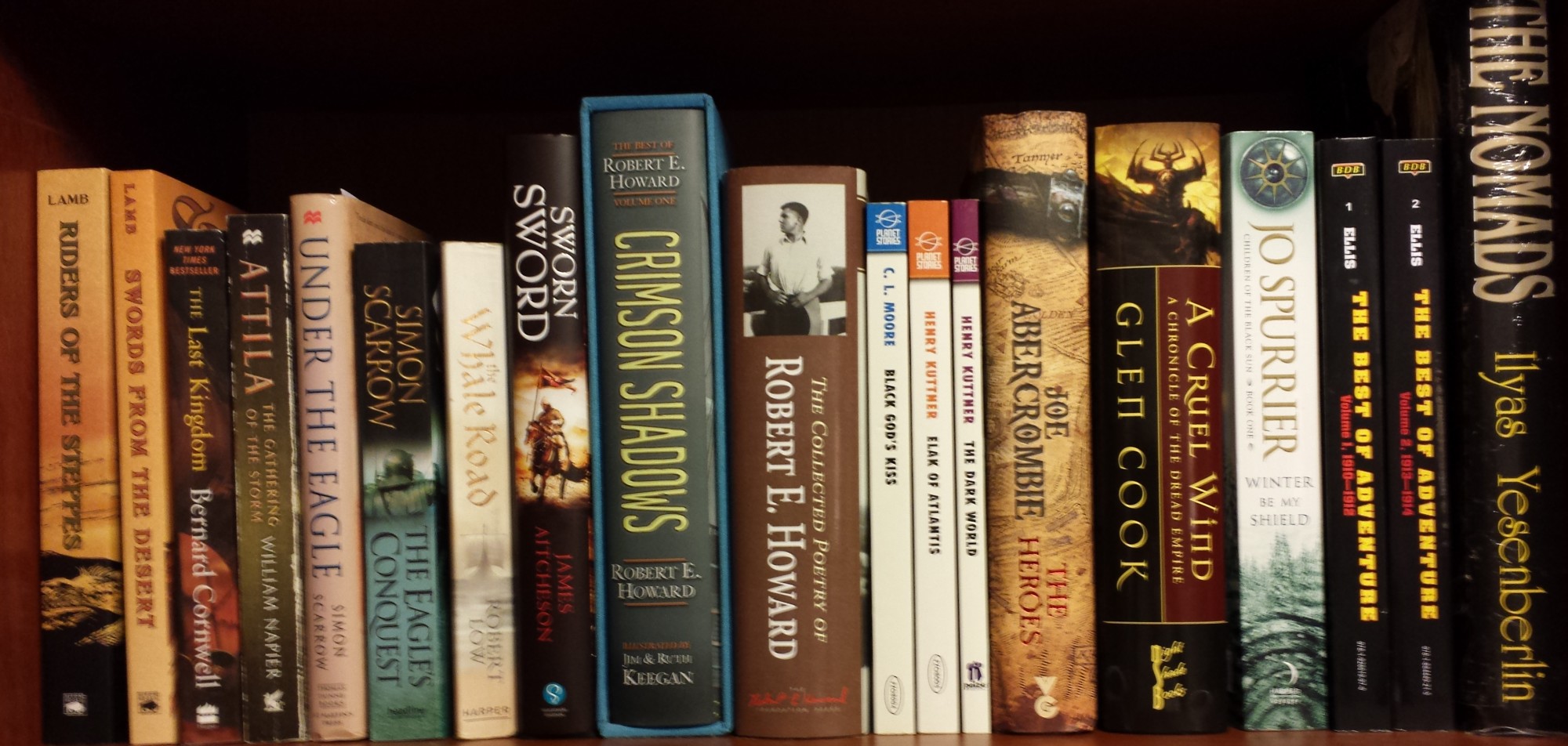
Why You Soon Won’t be Able to Find a Good Book in a Store

I was reading one of Kris Rusch’s columns over at The Business Rusch the other day, the topic being shelf space disappearing in book stores.  At that reminded me of an unpleasant experience I had the other day in Wal-Mart, one that is now repeated every time I walk into the store (which isn’t nearly as often as it was a few weeks ago).  If you haven’t read Kris’s column, please go read it now.  I’ll wait.

There, that didn’t take too long, did it?  Ms. Rusch brings up some very disturbing points, and while some of them are negative, others are mixed.  For what it’s worth, here’s my take on things, including why I’m not going to be shopping at Wal-Mart as much in the future.
 For starters, I understand the point Kris makes about Barnes and Noble trying to drive customers online.  It helps their bottom line for two reasons.  First, in the short term, it provides an incentive for Nook purchases.  Eventually that market will saturate, either because everyone will have one and the technology will mature to the point that repeatedly releasing an updated version will no longer be cost effective, or more likely that a new technology will come along and make the Nook obsolete.  The second reason, and the one that bothers me, is that it will allow B&N to either close more stores to get out of expensive leases or devote more shelf space to non-book items such as toys, games, stationary, and greeting cards.  Along with more floor space to sell the Nook.

Borders, even before it declared bankruptcy, was undergoing this at a disturbing rate.  When I started graduate school at UT Dallas back in the early 90s, the Borders at the intersection of  Royal and Preston was one of the two go-to bookstores in the Dallas area, the other being the Taylor’s near Prestonwood Mall, although living at what was then the northern edge of the suburban sprawl, i.e, in the other direction, I tended to frequent the Bookstop in Plano near Collin Creek Mall rather than drive an extra hour.  All three had excellent selections of science fiction and fantasy, mystery, and scientific and technical books, and all were willing to order titles not in stock (although Taylor’s charged to do so). 

Then Taylor’s closed, Barnes and Noble bought the Bookstop chain and closed the one in Plano to open a B&N on the opposite side of the mall, and suddenly Borders was the only good place to get almost anything in print. 

That didn’t last long.  I’ve only been in that Borders a few times in the last five years, and usually it was to find a magazine I couldn’t get at the big B&N on Northwest Highway.  I don’t know if that particular store is still open.  I’ve bought very few books there in the last half decade or so.  Each time I went in, it seemed the fantastic literature had been moved to a different area and had less shelf space.  Along with all the other books.  And there more titles turned face out, which is one of the points Ms. Rusch made in her essay.  Books facing out take up more space, meaning the shelves hold fewer books.  The last time I was there, it wasn’t worth the gas to drive over.

So how does Wal-Mart figure into this?  It’s simple.  They’re committing the same type of stupidity as the major chains, but they don’t have the excuse of an ereader to fall back on.  I live a little over two blocks from K-Mart, four or five blocks from Target, and about a mile and a half from the nearest Wal-Mart (there are four in town).  I’ve been going to this Wal-Mart for one reason.  They have had a section of their book department devoted to science fiction, meaning that the section was labeled as such.  Now the selection was at least 50% fantasy, but I’m not complaining.  I read considerable amounts of both. I’ve seen Wal-Marts that devote some shelf space to a few sf/f titles before, but this is the only one with entire section devoted to the stuff.  A number of them have sections for westerns, which I’m not knocking, except I don’t think westerns sell as well as sf & f.  Maybe Wallyworld is different, because the westerns section in my local Wal-Mart is still intact.  And none of the employees, excuse me, associates, I talked to could tell me who made the decision to remove the fantasy and science fiction. 

What did they put in its place?  They moved the romance section over and put “Books” where the romance previously was.  They’re still putting the display together (they’re anything but quick here), but it appears to be mostly children’s books and cook books.   All face out.  I guess they think fewer titles with more visibility will sell more books.

So now I have one less venue I can walk into, pick up any one of several books, and browse through them.  As far as I’m concerned, electronic browsing isn’t worth the time it takes.  I like to flip through the book.  I’ve bought plenty of books at that Wal-Mart, some of which I’ve reviewed at Adventures Fantastic. And I like a good selection, which, given its size, this one had.  But it’s no longer worth the time and gas to drive over and put up with the crowd for the books they have now.

My local B&N has a decent selection, meaning I can find something that interests me.  But I can’t find everything, including much of the stuff I want.  Kris Rusch wrote about not being able to find her latest science fiction novel, City of Ruins, in a B&N but being told it was in the warehouse and she could order it.  The local one here didn’t stock it either.  Nor did they stock Howard Andrew Jones’ The Desert of Souls or Scott Oden’s The Lion of Cairo.  They had a novel by Paul Finch which I wanted to review, only they sold it before I could buy it and didn’t order a replacement copy.  It was a zombie novel; the replacement would have sold.  I’m going to have to order all of these books.  And that’s a hassle.  I ordered the Oden, but haven’t gotten around to reading it yet.  The other three will probably get ordered sometime before the end of the summer.  I want to review and discuss all four of them, but I’ll probably review other things I have at hand first.  It’s easier and faster that way.

I could go on.  There’s a locally based chain with a number of stores in Texas called Hastings I could write an entire post about, but this is negative enough as it is.  The more I write, the grumpier and more depressed I’m getting.  If you’re like me and like to spending time in book stores just browsing to see what treasures you can find, I don’t hold out a lot of hope of being able to do that much longer.

This essay has been cross-posted at Futures Past and Present.

Independence Day Greetings

I’m traveling this weekend and will have limited computer access, so most of the work I’m doing on the blog will be to get caught up on some reading.  I’ll be posting a couple of reviews this next week, one an anthology and the other a novel.  Since I had a few minutes where I could log on, I wanted to wish everyone a safe and happy Independence Day.  And if you are a citizen of a country that doesn’t celebrate American independence, please accept my wishes for a good weekend.

The Best Six Novels I’ve Read in the First Six Months of 2011, Sort of

Well, 2011 is about half gone, and while I’m not going to look at the New Year’s Resolutions I posted (because I’ve exceeded some considerably and failed at other even more), I thought this would be a good time to look back over the novels I’ve read during the first half of the year that I’ve written about and see which ones were the best.

One thing quickly became clear:  I need to read more novels.  Not all the novels I’ve read have appeared here for the simple reason that some of them were not fantasy or historical adventure.  I’ve decided to keep the science fiction separate (which is why I started Futures Past and Present), and after one review, I’ve not blogged about any mysteries or detective stories.

So here’s my list of the top six (very loosely defined, as you’ll see) of the best novels I’ve read so far this year.

6.  The Alchemist by Paolo Bacigalupi and The Executioness by Tobias S. Buckell.  Okay, if you want to get picky, these are two books, not one, and they’re novellas rather than novels.  I”m going to stretch the definitions a little because they were written in a unique collaborative manner, take place in the same world, were marketed together, and were published at the same time.  They discuss a world filled with something called bramble, which I described in my review as kudzu on steroids.  Bramble is the side-effect of using magic and is slowly taking over the world.  And it’s a world I want to see more of.

5.  Hawkwood’s Voyage by Paul Kearney.  This one is the first of a series of five.  It’s in print in an omnibus volume entitled Hawkwood and the Kings along with the second installment, The Heretic Kings.  I’ve read both of them, although I haven’t gotten to the remaining three yet (I will).  I think I prefer Hawkwood’s Voyage to The Heretic Kings simply because of the way it’s structured.  There are several viewpoint characters, and in the first book, the viewpoint alternates between chapters.  In the second, the book is divided into sections with each section telling the story from a particular character’s viewpoint.  This is epic fantasy on a dark and bloody scale, with action, intrigue, heroism, villainy, and mystery.  They’re both much better than average, and if you haven’t read them, you should.  My reviews of both are here and here

4.  This book will be discussed later.  You’ll see why.  Trust me.

3.  The Cloud Roads by Martha Wells.  This is the first in a series of at least three.  Martha Wells has been posting snippets of the next volume on her blog, but I’ve not had a chance to read them yet. This series could turn out to be science fiction at some point, but for now I’m considering it fantasy for two reasons.  One, Martha has only written fantasy so far.  Two, it reads like a fantasy.  But it has that sense of wonder you get with the best science fiction that seems to be missing these days.  It’s the story of a young man (but not a human man) you discovers who his people are and what his purpose in life is.  It has some of the best aerial combat sequences I’ve read in a long time.  Here’s what I thought of it in detail.

2.  Among Thieves by Douglas Hulick.  This one is a great novel about an honorable thief who finds himself trying to save his kingdom.  The sword fights go on for pages, yet Hulick, an accomplished fencer, makes them seem like only a couple of paragraphs, they flow so naturally.  Beginning writers should study him to learn how to write a fight scene.  Loads of fun.  The complete review is here.

4.  Thirteen Years Later, 1. Twelve by Jasper Kent.  Vampire hunting during the Napoleonic Wars. Evil, repulsive vampires, not the sweet, sexy kind meant to appeal to the necrophilic fantasies of teenage girls.  The vampires in these books are pure evil and not to be trusted at all.  This is vampire hunting for the intelligent reader.  I’ve put these two books together because they are part of a greater story arc.  While you can read Twelve as a standalone, Thirteen Years Later is very much dependent on the previous book.  I put them together on the list because I think of them as part of the same work.  How to rank them, along with The Cloud Roads and Among Thieves was tough.  I loved each of these four books, but for different reasons.  In the end, I decided to use the vampire books to bookend (so to speak) the other two.  This pair of books is intelligent, fresh, and surprising.  A high water mark in vampire fiction.  Reviews are here and here.

And that’s it.  The best six novels I’ve read in the first six months of the year.  If you’re looking for a good read, you can’t go wrong with any of these.  I’ve put a widget up at the top of the page in case anyone decides to take a closer look at one of these books.  It will probably stay up for the next month or so.

I’m looking forward to what the next six months will hold.

David Gemmel Legend Award Winners Announced

The winners of the David Gemmell Legend Award were announced

The winner of the Morningstar Award for Best Newcomer was Warrior Priest by Darius Hinks.

The other nominees were Spellwright by Charlton Blake, The Hundred Thousand Kingdoms (The Inheritance Trilogy)by N. K. Jemison, Shadow Prowlerby Alexy Pehov, and Tymon’s Flight: Chronicles of the Tree Bk 1by Mary Victoria.

The Ravenheart Award for best cover art went to Olof Erla Einarsdottir for Power and Majesty by Tansy Raynor Roberts.  Since many of these books weren’t published (at least originally) by US publishers, I’m going to refer you to the Award website, where you can see the cover art.  The art often differs from country to country, and what I find may not be the correct illustration.  (Since I’m writing this during a break at work, I’m pressed for time and doubt I can find the correct covers before I have to go back on the clock. And I’m not sure about the legality of posting them without permission simply to show off the ark.)

The Legend Award for Best Novel went to Brandon Sanderson for The Way of Kings.  The other nominees were The Desert Spear by Peter V. Brett, The War of the Dwarves by Markus Heitz,The Alchemist in the Shadows by Pierre Pevel, and  Brandon Sanderson and Robert Jordan for Towers of Midnight (Wheel of Time, Book Thirteen).

There’s a nice writeup on the Award site with a slide show of the presentations.  If you have a second, you should definitely check it out.

Gods of Justice

Gods of Justice

Kevin Hosey and K. Stoddard Hayes, ed.
Mark Offutt and Joel Gomez, ill.
Cliffhanger Books, 205 p., ebook $4.99, print (forthcoming)

This is turning out to be the summer of the superhero.  Not only are we seeing more superhero movies than we ever have in a single summer, but print-wise superheroes seem to be on the rise as well.

Case in point, Gods of Justice, edited by Kevin Hosey and K. Stoddard Hayes.  This the sophomore publication of Clffhanger Books, a new small press.  Their first publication was an anthology of paranormal romance.  It was a nominee for Best Book of 2010 for The Romance Review.  That means they set a high standard their first time out.

The question is, do they live up to it in this book?

The answer is “Yes, they do.”  The book’s webpage summarizes the stories, so I won’t try to do that here.   Instead, I’ll give you my overall impressions.

First, these stories are not set against a common background or universe.  Of the ten stories, one is set in a dystopian future and one on a distant planet (that one is a Western, of all things, and one of the best in the book).  The remaining eight take place on Earth, with one occurring in No Man’s Land in World War I.

The tone and settings vary widely.  So do the characters.  Some are about scared people trying to do the right thing when the right thing isn’t always clear or could be quite costly.  Some deal with the obligations of heroes and power, while others examine the corrupting effects that power has on the hero and how heroes can sometimes become villains.  More than one author deals with time travel, a popular theme in superhero tales.  Although there’s no explicit sex, a couple of stories contain mature themes and language, so if you’re thinking of giving the book as a gift to a young reader, you might keep in mind age-appropriateness.  I’d say the book is a PG-13.  But if your reader is mature enough, you should give the book.

I met editor Kevin Hosey back in February at ConDFW.  When the review copy showed up, I had let the book slip my mind, so it’s arrival was a pleasant surprise.  The next pleasant surprise was in reading it.  With the exception of DC Comics writer Ricardo Sanchez and Star Trek author Dayton Ward, the lineup seems to consist of fairly new authors.  At least I wasn’t familiar with the authors names, so I was a little unsure about what to expect.  I needn’t have worried.  

While one or two entries didn’t do much for me (primarily for reasons of personal taste), I found the quality quite high over all.  If most of the writers are at the beginning of their writing careers, they should only get better with time.  I’m going to watch for some of these people.  The variety makes this another diverse anthology, meaning most readers should find plenty to like here.  I certainly did.  I seem to be blessed with a number of this type of anthology lately, with one more I should have finished in a few days.

A couple of stories committed what I think of as comic book logic, which threw me out of the story, but the level of craftsmanship is better than what you would find in most anthologies with a high percentage of new writers. I think this is the first time I’ve read a western set in space in which I want to read more.  While I like westerns, I’ve found they usually don’t work well on other planets.  This one did, and it couldn’t have been set in the Old West and worked.  The story about the time travel murders was a refreshing twist as well.  And “The Justice Blues” had one of the best character developments of the book.

Most of the stories have an illustration, which was a nice touch (particularly the one on p. 71).  But the focus here is on the stories.  As it should be.

All in all, I found this to be a fun book.  The contents were well-written, thought provoking, imaginative, and entertaining.  I was sorry there were no more stories when I reached the end of the book.  If you like comics and superheroes, by all means give this one a try.  This is the first in a series with at least two more planned, although I have no idea when they’ll be published.  Hopefully soon.  I’m looking forward to them.

This review was also posted at Futures Past and Present.

First J. K. Rowling; Who’s Next?

It’s been a busy week, and I’ve not had time to post as much as I’d like.  (I did manage to submit a story to a top pro market, so the week hasn’t been a total wash.)

One thing that did happen, which is still echoing, was the announcement by J. K. Rowling that she will be publishing the Harry Potter books herself through a new website.  She’s able to do this because she retains the rights to the electronic editions.  (If you want to know more about this, start with this series of posts by Passive Guy at The Passive Voice.)

There’s been a lot of talk (mostly from publishers and agents) about how Rowling is an outlier, that most writers won’t be able to do this.  I’m not so sure.  This could very well change publishing permanently.  For the first time an author will control access and price, not a publisher, not a distributor, not a buyer for a major chain, not Amazon. 

While the ramifications of this development are still being debated, I thought I would throw out a question:

What other authors, fantasy in particular but other genres are open to consideration, could be the next to pull something like this off?  Which ones would you like to see next? 

From what I understand, it takes some financial resources to put together a deal like this.  Forget the interactive website for a minute and just think about books.  Who do you think is a big enough name to self publish their works and sell directly from their website only without going through an intermediary?  I’m not talking about a newbie who doesn’t have the audience, but someone who is a brand name.  I’m also not talking about an author like J. A. Konrath, who sells through Amazon, Smashwords, B&N, etc.  I’m talking about the author being the only source for the book.

Stephen King and Tom Clancy come to mind.  George R. R. Martin is riding high right now with a successful adaption of A Game of Thrones on HBO and the upcoming release of A Dance with Dragons.  He could probably pull it off.

I realize that many of the top names may not own the electronic rights to their works or have other contractual restrictions.  Let’s assume for the sake of this discussion that those things don’t apply.  Also, Rowling’s announcement says she wants her readers to be able to read he books on any platform.  So let’s assume that the ereader isn’t an issue.

Who is next?

RIP, Martin H. Greenberg

Dean Wesley Smith is reporting that Martin H. Greenberg passed away this morning after a long illness.  If you’ve ever picked up an anthology is the last twenty or thirty years, there’s a good chance his name was on the cover, usually following the name of a well known author or editor.  (Isaac Asimov comes to mind as the most prominent, but he was far from the only one.)  If the anthology was published by DAW books, then his name was almost certainly on the cover.  Greenberg was the publisher of Tekno Books, one of the leading book packagers in the world.  (A packager puts the project together, then sells it to publisher.)  While his work was often behind the scenes, he was a major player in fantasy and science fiction publishing, as well as a number of other genres.  I never met Mr. Greenberg, but I’ve always heard only good things about him.  His passing is a major loss to the science fiction and fantasy fields.  Think of him the next time you read one of the anthologies he put together.  Dean Wesley Smith worked with Greenberg and has written a moving eulogy.

1066: An Invasion, a Tapestry, and a Mystery

1066:  The Hidden History in the Bayeux Tapestry
Andrew Bridgeford
Walker & Co., 384 p.,  $15.95 softcover, various ebook editions available

From time to time, I like to post something having to do with history, and just history, no fiction.  Or rather, no more fiction than serious history books promulgate.  I came across this book while browsing in the local box store, read a chapter or two, came back a week later and read another chapter, and then bought the thing for my ereader.

I found it quite fascinating.  I knew, of course, who William the Conqueror was.  The coaches teaching my history classes in school were able to impart that much information to me.  And I’d heard of the Bayeux Tapestry, the only surviving tapestry from the time period, and considered one of the primary sources of information (albeit limited) that we have about the events leading up to the invasion.  But I’d never really known many of the details about either.  Until now.

I have to say, I found this to be a engaging book.  The conventional wisdom is that the tapestry shows the invasion of England from the Norman point of view.  Bridgeford, through meticulous but entirely readable, historical detective work, builds an alternative interpretation.  Throughout the book he builds his case that the Tapestry tells the story of the events leading up to the invasion (leaving out Harold’s defeat of the invading Harald Hardrada of Norway a few days prior to the Battle of Hastings) from the English point of view.  Furthermore, he argues that William the Conqueror (also called William le Batard, although not often to his face) isn’t the central figure of the Tapestry.  Rather Count Eustace II of Boulogne is.

Detail of the Bayeux Tapestry showing Harold’s death

While much of the argument is speculative, something the author readily admits more than once, he does his best to build his case on existing records and documents.  He’s surprisingly thorough and makes his case, at least as far as this nonexpert is concerned, quite consistent, both with itself and with known facts.

There are a number of mysteries associated with the Tapestry.  To name a few:  How did the Tapestry come to Bayeux?  How did it manage to survive when no other tapestry from that era has?  Who are the four named figures who are not royalty in the tapestry and why are they significant?

Bridgeford addresses all of these at length, providing historical and sociological background.  The history of the Tapestry, so far as it’s known, is quite interesting.  He does what any good historian should do, or teacher in general for that matter.  He makes you want to go and learn more.  His prose is easily readable.  While there are endnotes, there aren’t so many that they distract from the flow of the text.

I learned a lot from reading this book.  There has been some discussion, to use that word somewhat loosely, at various websites over the last few months about the role of women in positions of power throughout history.  In providing some of the backstory to the events of 1066, we meet several who were at least, if not more, ruthless than the men.

The only place where I found the argument to be somewhat far-fetched was in the chapter on Turold the dwarf.  I’m not saying Bridgeford isn’t right, just that this chapter is the most speculative in nature of all of them.

If you like a good history book that’s easily accessible and well written, then this is a book for you.  If you have any interest in this time period, check it out.  There’s enough information that a good fantasy writer can probably come away with one or two ideas for a good story. 

This book is available at Adventures Fantastic Books

Announcing Futures Past and Present

I’d like to announce a new blog I’ve started, Futures Past and Present, which will focus on science fiction. 

Relax, I’m not abandoning Adventures Fantastic.  Far from it.  I want to keep AF going and make it stronger.  It’s looking like this month is going to be the best one yet, and thank you, everyone who has stopped by to browse, see what I said about your story, followed (formally and informally), or posted a comment.  This is still going to be my primary blog.

So why am I starting another one?  That’s a  good question that has several answers.
First, I’ve always loved science fiction.  Even before I really started reading fantasy, I was into science fiction.  Now I’ve posted reviews of science fiction here, but I don’t want to do too much of that.  I want to keep my the focus of AF on three or four main areas:  fantasy (especially heroic and sword and sorcery fantasy), historical adventure, occasional editorials on publishing and writing, and once in a while some historical fact pieces (look for one in the next couple of days).  Of course there will be deviations from time to time, but for the most past, that’s the approach I’ve tried to take for the last few months.  It seems to have worked.  I’m getting more readers, and I don’t want to alienate them.  I lost a few of the early followers back when I was just getting started.  I can’t help but wonder if it was because I wasn’t as focused as I am now.

Also, I try to review mostly new fantasy, with certain notable exceptions such as Robert E. Howard.  There will be some other giants from the fantasy field I’ll write about in future posts, but for the most part the fantasy focus will be on what’s happening in fantasy in general, and sword and sorcery in particular, now, at the present time.

For the science fiction, I want to take a broader approach.  By that I mean not just look at new stuff (although I will), but at some of the classics as well things I have on my shelf that I simply haven’t had a chance to read yet that I might like to write about or recommend.  I explain this a little more in the “Opening Salvo“.  The thing is, if I take the time to read a lengthy science fiction novel, I will either be hard pressed to find a justification for writing about it here, or I will try to read other things at the same time.  The latter is a strategy that is rarely successful for me.  An additional blog will allow me to write about science fiction without stretching the limits of this blog too much.

The other thing I want to do is to have the freedom to experiment and play around with things like formatting and design.  I tried to set up a Facebook page for AF a few weeks ago.  Somewhere in the process, Facebook turned the page from a page for the blog into an individual page for me.  I’m not sure what happened, because I intentionally didn’t set it up as a personal page.  Now I’ve refused for years to get on Facebook, MySpace, or any of the other social networks.  Lost friends from high school are lost for a reason and should remain that way, and if I wanted them to have the means to find me, they wouldn’t be lost in the first place.  I couldn’t figure out how to turn the page back into a page for the blog, so I deleted it.  I’ll try again with Futures Past and Present.  I’ll also try Twitter and some other stuff.

I’ll only post there about once a week or ten days, not nearly as often as I post here.  Like I said, this will still be my primary blog.  There will be some  items I’ll cross post, like the extensive look at Henry Kuttner’s short fiction I’m working on in my spare time.  The cosmetic things at Futures Past and Present will change fairly frequently, though.  Once I get something figured out, or decide I like a certain approach or look to something, or find something that works really well, I’ll import it over here.  

The first post is up, a review of Jonathan Strahan’s anthology Engineering Infinity.  Check it out.  And check back here for more sword and sorcery and historical adventure.

Now if I can find a venue to write about detective fiction, I’d have all my bases covered…