
This is another chiller. It’s not set at Christmas, but it is the kind of story that might be related around a fire. It’s author wrote at a time when genre conventions weren’t as well established (rigid) as they are today. Supernatural elements mixed with mundane settings. the thing that mattered wasn’t so much the genre, but the quality fo the story.
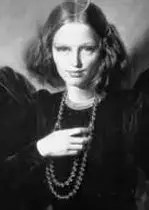
Henrietta D;. Everett
Heniretta D. Everett (1851-1923), sometimes bylined as H. D. Everett, wrote twenty-two novels. According to what little I coudl discover about her, about half of them had fantasy or proto-science fictional elements.
“Wth Death Mask” is her best known ghost story and was the title of her collection of stories published in 1920. This story was praised by H. P. Lovecraft. I didn’t read it. I listened to it on audio in The Literature of Lovecraft Vol. 1 produced by the H. P. Lovecraft Historical Society. It is the usual high quality production the HPLHS does. M. R. James also had a high opinion of this story.
A man has been widowed. His wife was very domineeering. For example she restricted his cigar smokiing to a single room. (I was reminded of Rudyard Kipling’s poem “The Betrothed” at this point.) Before she died, she made him promise to take a handkerchief from a drawer in her dresser and place it over her face before she was buried. He does.
The man had been afraid she would make him promise not to marry again.
That is essentially what happens. A year or so later, he meets a young woman who has moved into the area with her family. Anytime he his alone with her, whatever piece of cloth in the room forms itself into a visage of the dead wife’s face.
A controlling and domineering wife. I’m starting to see a pattern here. That was what we had in the previous installment of these posts.
“The Death Mask” is typical of ghost stories we’ve looked at. Two men are talking. The initial narrator is basically a mechanism to allow the other character to speak of something. This trope isn’t unique to ghost stories. P. G. Wodehosue used it in some of his non-Jeeves stories.
Sometimes the initial narrator isn’t really needed. He sets the stage for the true narrator. In other stories, the narrator and the friend who is actually telling the story will speak to each other. Maybe the narrator (the person who opens the story in first-person) asks a question or interjects a comment.
 When done well, and Everett certainly did it well, this approach adds to the story rather than detracting from it.
I had read this story before, but I didn’t remember where. None of its appearances in the ISFDB match any place I could have read it. My memory on some the details was a little mixed up. In this story, it opens with the men being restricted to a single room to smoke cigars. There is a scene where the widower and his fiance are sitting on a couch and the dead wife’s face appears in a cloth lying behind the couch. In my memory I had combined both scenes.
Be that as it may, the story was powerful enough that it stuck with me for more years than I can accurately say.
There is a collection of Everett’s work that is currently available entitled The Crimson Blind. It cotains “The Death Mask”
Thanks for the info on these chillers. The Wordsworth Tales Of Mystery and the Supernatural is a fine series.
Yes, it is an excellent series.
I took a look at my Supernatural Horror Index for the story, which is a little dated (Greenwood Press, 1995), but here are the entries where it appeared:
Shivers (1932), unknown editor
Creeps Omnibus (1935), Philip Alan publisher
Perturbed Spirits (1954, reprinted 1958), Arthur Barker Publishers/Dragon Books.
Tales of Horror (1962) ed. by Charles Higham, Horwitz publishing
Eerie, Weird and Wicked (1977) ed, Helen Hoke, Dent Publishing.
It was the last publication where I first read it.
That’s pretty much what the ISFDB listed. Unless I’m confusing it with another story, I must have read it in the same anthology, although I would have sowrn I never heard of that anthology before now.