Tag Archives: C. L. Moore

Kuttner’s Death, Moore’s Silence

Henry Kuttner and C. L. Moore

Deuce Richardson pointed out to me in an email that today is the 60th anniversary of Henry Kuttner’s death. Since I don’t think I’ll be able to finish what I had intended to review today, this is a good topic to talk about.  (Thanks, Deuce.)

I’ve done a few posts on the anniversary of a person’s death  before, but I prefer to acknowledge birthdays. However, a 60th anniversary is a milestone. So if you’ll indulge me, I’d like to share a few somewhat random thoughts.

Kuttner had been teaching a course on writing at USC when he died, and Moore took over. I’m not sure how long she continued teaching, if it was only to finish out the semester or if she taught beyond that semester.

She remarried in 1963. Her husband Thomas Reggie didn’t want her writing anymore. At least that’s the legend, and I’m inclined to believe it. C. L. Moore’s voice fell silent. She never wrote fiction again.

Her husband supposedly (according to Wikipedia) asked the Science Fiction Writers of America not to honor her with a Grand Master Award because by that time Catherine was suffering from Alzheimer’s by then. Her husband thought the ceremony would be too stressful and confusing.

Let that sink in for a moment. This had to have been sometime in the early to mid-1980s. Moore died in 1987.* Andre Norton was the Grand Master for 1984. There wouldn’t be another woman to receive the honor until Ursula K. LeGuin in 2003, nearly 20 years later. I don’t know why Moore couldn’t have been presented with the award and it simply be announced that she was unable to attend for unspecified health reasons.  Essentially, her husband denied her recognition that was well deserved.** Continue reading

C. L. Moore Channels Brackett and Howard

“There Shall Be Darkness”
Miracle in Three Dimensions
Isle Press
Trade Paper, $16.95
Original publication, Astounding, February 1942

I meant to have this review posted a few days ago, but Real Life got in the way. (I am legally prohibited from discussing the situation; its a personnel matter.) I just finished reading the story a little while ago.

It’s definitely a blend of Brackett setting and Howardian themes. James Douglas, AKA Jamie, is the commander of the Earth forces on the planet Venus. There’s some indication this may taken place in the future of the Northwest Smith series. In the first scene, Jamie comes in and asks for segir whiskey, the preferred drink of Northwest Smith. If it is the same future, it’s much later along the timeline.

You can’t blame him for wanting a drink. He’s in a bad situation. He’s just received his orders to evacuate Venus. The Empire of Earth is falling. Barbarians, the less developed races in the solar system in this instance, have conquered Mars and are in the process of invading Earth. There are overtones of ancient Rome in this setup. Jamie’s Venusian lover, Quanna, begs him to take her to Earth. He refuses, so she takes matters into her own hands.

Jamie is dealing with an outlaw chieftain, Vastari, who is the only person who can unite the squabbling Venusian tribes into a single unit. Vastari sees himself as a freedom fighter, a soldier struggling to throw off the yoke of tyranny. He’s also Quanna’s brother. Jamie thinks she’s a loyal lover. Vastari thinks she’s a loyal spy. Quanna is only loyal to herself. Continue reading

Rereading C. L. Moore

Catherine Lucille (C. L.) Moore was born today (January 24) in 1911. These days she’s remembered for one of three things. Creator of Northwest Smith. Creator of Jirel of Joiry. Wife and writing partner of Henry Kuttner and coauthor of some of the greatest science fiction and fantasy classics of the 1940s.

All of which are achievements which should be acknowledged. Moore was one of the best stylists of her era and a true trailblazer.  But she also wrote quite a bit of fiction that was her solo work that wasn’t Northwest Smith or Jirel but in many cases was just as good.

Much of this short fiction is collected in Judgment Night or The Best of C. L. Moore. I’m going to be dipping back into those volumes as it’s been years and in some cases decades since I read some of those stories. Outside of a small circle of pulp fans, she’s not that well known, and I aim to change that as much as I can.

But first I’m going to read some C. L. Moore that I’ve not read at all. Ten years ago a collection entitled Miracle in Three Dimensions was published.  I’ll talk further about this book in future posts. The thing about the book that makes it stand out is it contains five stories that have never appeared in one of Moore’s collections (although three of them have been anthologized), one of which has never been published before its appearance in this book if the ISFDB is correct. Continue reading

Cross Genre-ing

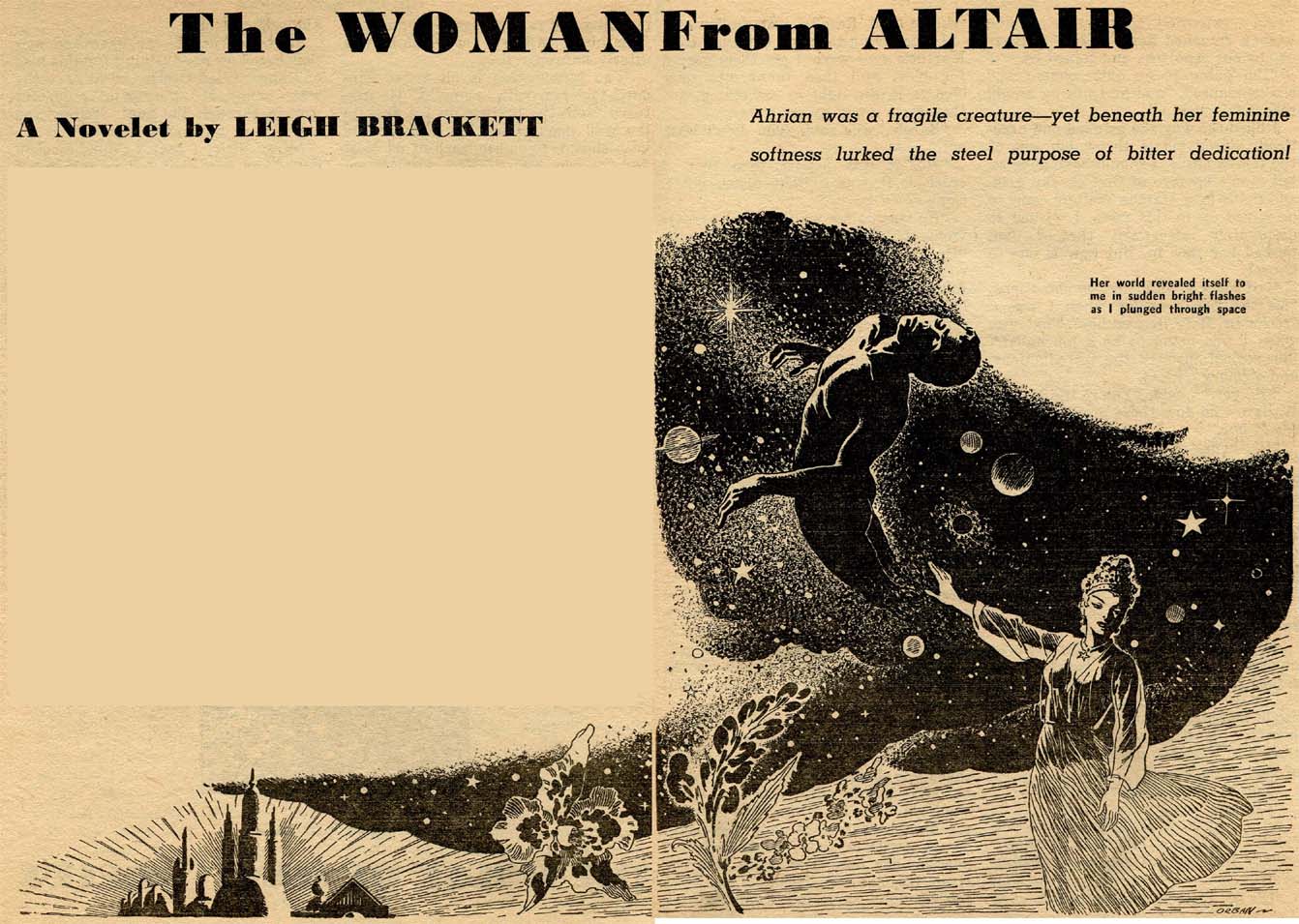
I got into a conversation on Twitter this morning with PC Bushi that grew to include several other individuals. Mr. Bushi initiated things by saying Leigh Brackett’s short story “The Woamn From Altair” demonstrated her range as a writer because it was a well-written story that wasn’t an adventure story.  I agreed. (If you’re interested, my review from a couple of years ago is here.)

Early in the course of the conversation, he linked to a post he had written about Jack Vance and Andre Norton, discussing their versatility as writers.  He says some good stuff, and you should check it out.

The conversation moved onto to all the genres Brackett wrote in.  In addition to space opera and science fiction, she also wrote detective stories (which is what got her the job writing for Howard Hawks on The Big Sleep) and westerns. This discussion got me to thinking… Continue reading

Blogging Jirel of Joiry: “Hellsgarde”

Published in the April 1939 issue of Weird Tales, “Hellsgarde” is in many ways the last of the Jirel stories, at least her solo adventures.  She will meet up with Northwest Smith in “Quest of the Starstone”.  That’s another post for another day. “Starstone” was actually published first, in 1937, but all collections I’ve seen place it last in the book.

I found this story to have a bit more depth than “The Dark Land”, which we looked at yesterday. YMMV. There will be spoilers in this post. You have been warned.

It opens with Jirel riding to the castle of Hellsgarde,which sits in a vast swamp of quicksand and only appears at sunset. Two hundred years ago, Andred, master of Hellsgarde had found a great treasure which he kept in a small box. No one knew the exact nature of the treasure, but many coveted it. Andred died defending his treasure, but his killers never found it. Since then many have died trying to find it, and Hellsgarde has gained an evil reputation.

Now Guy of Garlot has taken some of Jirel’s men prisoner. He’s told Jirel that he will kill them unless she brings him Andred’s box from Hellsgarde. Guy’s fortress sits atop an unassailable cliff. Jirel has no choice but to go for the treasure. Guy is too cowardly to attempt finding it himself. Although it’s never stated, I suspect Guy hopes to take control of Jirel’s lands if she fails. Continue reading

Blogging Jirel of Joiry: “The Dark Land”

“The Dark Land” was the fourth of the Jirel of Joiry stories. It was originally published in the January 1936 issue of Weird Tales.

Of all the Jirel stories I’ve looked at so far, I found this to be the weakest. The story opens with Jirel lying unconscious and near death from a pike wound to the side. As the priest shows up to give her last rites, she disappears.

She finds herself on a platform facing a giant statue of a man. Around his head is a crown of flames. It isn’t long before the subject of the statue shows up. He appears in a swirl of light whose description sounds a lot like the transporter effects from Star Trek TOS.

The man informs her his name is Pav. He’s brought her to his kingdom of Romne. He intends for Jirel to be his queen. It’s her fiery fighting nature that’s drawn his attention. Continue reading

Happy Brithday, Farnsworth Wright

Weird Tales editorial office, l. to r., unknown, Farnsworth Wright, Henry Kuttner, Robert Bloch

By the time of his death in 1940, Farnsworth Wright had become one of the most influential editors the field of the fantastic would ever see. Wright was born in 1888 on July, 29.  I would argue his influence on science fiction, fantasy, and horror has been greater than any other editor, including John W. Campbell, Dorothy McIlwraith, Fred Pohl, Ray Palmer, or Hugo Gernsback.

Yes, I realize that last sentence could be controversial, especially the inclusion of Campbell and Gernsback.  So be it.  Farnsworth Wright edited Weird Tales during what is considered to be the magazine’s golden age.  The authors he published have had a greater impact on the literature of the fantastic than those of any other editor at any time in history. Continue reading

Breaking the Bough on Kuttner’s Birthday

“When the Bough Breaks”
as by Lewis Padgett
originally published in Astounding Science Fiction November 1944

Henry Kuttner was born on April 7, 1915.  Anyone who has read much of this blog knows that Kuttner is probably my favorite author, at least on days ending in “y”.  After his marriage to C. L. Moore, everything he and Moore wrote was a collaboration to one degree or another.

Both authors were masters of fantasy, science fiction, and and everything in between, including horror.  Much of their best work was published in Astounding in the mid-1940s.  Almost all of these stories have been collected in at least one of Kuttner’s collections, either in his lifetime or in the years since.  There are a few that haven’t, which I’ll address at another time.  Continue reading

Blogging Brackett: “The Dancing Girl of Ganymede”

“The Dancing Girl of Ganymede”
Originally published in Thrilling Wonder Stories, Feb. 1950

I read “The Dancing Girl of Ganymede” for the first and, until I reread it yesterday, only time when I read The Halfling and Other Stories back in high school. I’m not sure why I haven’t reread it more. It’s an excellent story, and one that put me in mind of two other famous works, one of science fantasy and one of science fiction.

This story is a mature work by Brackett, one of her later works, and you can see it in the way she both executes the story, the twist the tale takes midway through, and the serious themes she injects.  This one is more than must pulp adventure escapism (not that there’s anything wrong with that).

Edmond Hamilton, her husband, writes in the introduction to The Best of Leigh Brackett, that she would write science fiction when not actively writing screenplays in Hollywood.  A quick check with the ISFDB shows a hiatus of Brackett stories from the mid-1940s until about 1950, when there was another wave of her work hitting the magazines, the story under consideration among them.  I’ll be looking at this story in detail, so consider this to be the standard SPOILER ALERT. Continue reading

An Ode to the Ballantine Best of Series and Why We Need it More Than Ever

The original Star Wars came out when I was in elementary school, and it was a mind-warping experience.  I had come to science fiction and fantasy through comics, but it was the sense of wonder and excitement this movie generated that turned me from reading mystery books to reading science fiction books checked out from the school library.  As I read above grade level, I was soon searching out science fiction in the adult section of the public library and in book stores.  Like a second hand book store at the flea market.

This place sold second hand paperbacks for a quarter, IIRC.  The covers were stripped, which meant the books had been reported to the publishers as having been been pulped and the covers returned for credit.  In other words, they were technically stolen.  I didn’t know that then.  There were a number of titles I recognized, such as some H. P, Lovecraft.  I picked up The Best of Jack Williamson there, and later The Best of L. Sprague de Camp.

The Williamson volume started with stories from the 30s and went up to the 70s.  There was an introduction by Frederik Pohl and an afterward by Williamson.  This was the pattern of the series.  An introduction by an author or editor associated with the writer of the book, and if the author was still living (most were but not all) he or she contributed an afterward.  My mind was blown.  David Hartwell once said the golden age of science fiction is thirteen.  I was, and it was. Continue reading