
Today is July 2, which is the birthday of Hannes Bok (1914-1964) and C. M. Kornbluth (1923-1958). They both died far too young.
 Hannes Bok was both an artist and a writer. His primay contribution to the field was his art. He wrote only four novels. Two were in collaboration with A. Merritt.
Bok’s style involved curves. His figures weren’t meant to be realistic in the way, say. Edd Cartier’s were (although a case could be made that Cartier’s were always realistic). Bok’s figures often had exaggerated limbs and faces, usually elongated. They had a very distinct look that makes Bok’s art easilyl recognizable. Bok’s style of art was greatly influenced by Maxfield Parrish.
 Bok didn’t just do covers of books and pulps, he also did interior illustrations. It’s his cover art that gets the most attention, though. Interior art didn’t have color. Not all of Bok’s cover art used a lot of color, either. An example is the cover for L. Sprague de Camp’s The Wheels of If.
You can see the influence of Parrish in the first two covers I’ve posted.
 An even more monotone illustration is the cover for de Camp’s Lest Darkness Fall. This one is more photorealistic than the other two samples I’ve provided. There are no exaggerations of form. It’s rather minimalist in comparison to some of h Bok’s other work, but it makes me want to read the book.
Or reread it, rather. I read it way back in high school in the Del Rey edition with the Darrel K. Sweet cover.
But I digress.
Bok got his start in the professional art world in an unusual way. He was friends with a young fan, name of Ray Bradbury. Ray offered to take some of Bok’s work with him to the 1939 World Science Fiction Convention.
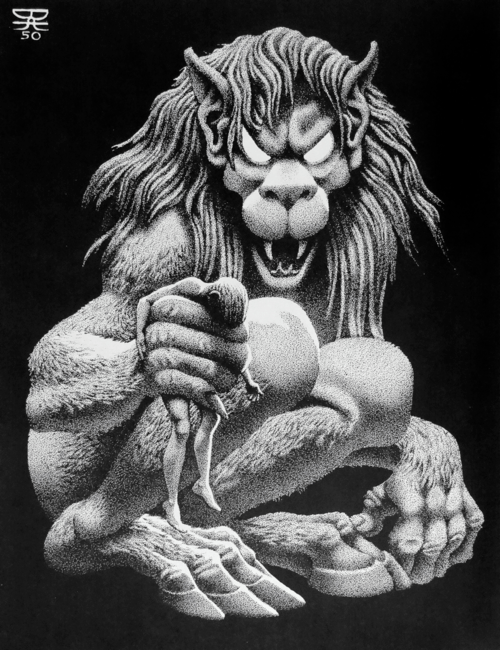
Pickman’s Model
As he grew older, Bok began to have more conflicts with editors over his work. He also became more interested in the occult. The last years of his life were difficult for him, and he lived in a state of poverty. He died of an apparent heart attack. Forrest J. Ackerman says he starved to death.
Cyril Kornbluth was one of the famed Futurians, the group of writers in the late thirties and early forties that also included Donald A. Wolheim and Fred Pohl.
Most of Kornbluth’s novels were collaborations, either with Pohl or with Judith Merrill. His primary length was the short story or novellette. Much of his work with Merrill was published under the pen name of Cyril JUdd. His most notable work with Pohl was The Space Merchants. There have been a couple of collections of the short stories he wrote with Pohl.
NESFA Press collected all of Kornbluth’s short fiction together in one volume. That was in 1997, with the Science Fiction Book Club publishing their edition shortly thereafter.
 Several of Kornbluth’s stories have become classics in the science fiction field. “The LIttle Black Bag” is a chilling horror story about time travel and a medical bag that can do amazing things.
Until it can’t.
The ending of that one is horrifying not because of what it says, but because of what it doesn’t say. I think this one was a Twilight Zone episode.
“The Marching Morons” is another horrifying story, but for a completely different reason. It concerns government manipulation of the population. It’s as relevant today was when it was published in the fifities.
 Kornbluth participated in the Battle of the Bulge during WWII. That left some lingering health issues, which resulted in his doctor putting him on a special diet. Kornbluth and the diet didn’t get along. Shortly after that, he was offered the position as editor of F&SF. He shoveled snow, rushed to the train station to catch a train into New York, and had a fatal heart attack on the platform before he could take the job.
I can only weep at what stories he might have bought and what authors h e might have developed had he lived.
Kornbluth’s work usually has a level of cynicism to it that some people find uncomfortable. I rather like it. I first discovered him in the SFBC edition of The Best of C. M. Kornbluth.
Kornbluth’s solo work is worth seeking out, as is his collaborative work, especially the stories and novels he wrote with Fred Pohl.
Tragically, Bok’s work had just begun to sell again when he died. The issue of The Magazine of Fantasy & Science Fiction that announced his death had a wrap-around cover by him, illustrating Zelazny’s “A Rose for Ecclesiastes”.